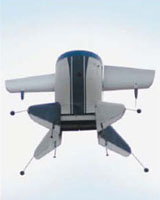
Aurora Flight Sciences announced that the company's GoldenEye 80 unmanned air vehicle made a successful first flight. The flight marked another first as GoldenEye 80 became the first ducted fan UAV to fly under the power of a heavy fuel engine. The GoldenEye 80 UAV is being developed under contract to the Defense Advanced Research Projects Agency (DARPA) through its Organic Air Vehicle (OAV-II) program.
"GoldenEye 80 is designed to give company commanders the ability to spot, identify, designate, and destroy targets," said Aurora CEO John Langford. "With its powerful sensors and quiet operation, the aircraft can dash to a target area, hover motionless in the sky, and observe and designate a target — all without being heard by people on the ground."
"Today's first flight is a major milestone toward providing US military forces with a powerful VTOL UAV capability that will revolutionize future combat against asymmetric threats," said DARPA OAV-II Program Manager Dan Newman.
GoldenEye 80 is designed to carry an advanced sensor payload developed by the US Army's Night Vision Lab and FLIR Systems that includes a high resolution video camera, a high resolution infrared camera for night viewing, a laser rangefinder, a laser tracker, and a laser designator. Standing 65 inches tall and weighing about 150 pounds, the GoldenEye 80 takes off and lands vertically but can transition to horizontal flight using wings. Because GoldenEye 80 is fully autonomous, a pilot is not required to fly the aircraft.
GoldenEye 80 is the third generation ducted fan aircraft developed by Aurora. The first, GoldenEye 100, was a proof of concept aircraft first flown in 2003 under the "Clandestine UAV" project. This success led a smaller aircraft, the GoldenEye 50, which in 2005 successfully demonstrated the ability to transition to and from horizontal flight using wings that "float" rather than being rigidly attached to the plane's body. GoldenEye 80 combines the stealth features and the performance features of the earlier programs with a heavy fuel engine and an advanced sensor payload to create a system with true combat effectiveness.
Aurora's partners in the GoldenEye development program include General Dynamics Robotics Systems, Northrop Grumman Corporation, and Athena Technologies.