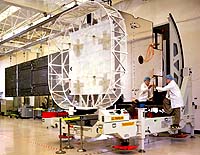
UFO 11 has the most sophisticated digital signal processor in the constellation.
UFO 11 has the most sophisticated digital signal processor in the constellation. |
UFO 11 has the most sophisticated digital signal processor in the constellation. Its ability to reprogram existing user channels allowed Boeing to exploit small, unused portions of the allocated radio frequency spectrum to add 10 channels, for a total of 54.
"Given the extremely high demand for tactical communications in Southwest Asia, our Navy customer asked us to investigate ways to maximize the current capabilities of the UFO 11 spacecraft," said Craig Cooning, vice president and general manager of Boeing Space and Intelligence Systems. "After a series of careful analyses and rigorous testing, we found a way to achieve this goal at no additional cost to the customer.
"The military's need for communications bandwidth continues to rise," Cooning added. "Our unique combination of highly capable satellite hardware and experienced, highly skilled engineers allowed us to provide additional bandwidth that will directly support our men and women in uniform."
The satellite reconfiguration was accomplished in conjunction with U.S. Strategic Command, the Navy's Program Executive Office - Space Systems, and the Naval Satellite Operations Command.
Boeing received the UFO contract in July 1988. By November 1999, all options had been exercised and the company began production of UFO 11. The spacecraft features both ultra high-frequency and extremely high-frequency payloads, which provide protected communications. Boeing UFO satellites have provided the Navy with a total of more than 100 years of service to date.
Share This Article With Planet Earth
 del.icio.us del.icio.us |
 Digg Digg |
 Reddit Reddit |
 YahooMyWeb YahooMyWeb |
 Google Google |
 Facebook Facebook |
 Boeing Develops Common Software To Reduce Risk For TSAT
 El Segundo CA (SPX) Nov 18, 2008
| The content herein, unless otherwise known to be public domain, are Copyright 1995-2007 - SpaceDaily.AFP and UPI Wire Stories are copyright Agence France-Presse and United Press International. ESA Portal Reports are copyright European Space Agency. All NASA sourced material is public domain. Additional copyrights may apply in whole or part to other bona fide parties. Advertising does not imply endorsement,agreement or approval of any opinions, statements or information provided by SpaceDaily on any Web page published or hosted by SpaceDaily. Privacy Statement |