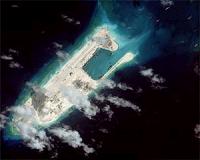
Beijing came under pressure at an Asian summit Wednesday over its "illegal" island-building in the South China Sea, after the Philippines produced photos it said showed fresh construction activity at a flashpoint shoal.
Any artificial island at Scarborough Shoal could be a game-changer in China's quest to control the South China Sea and raises the risk of armed confrontation with the United States, security analysts say.
Beijing insists it has not started building at the shoal — a move that could lead to a military outpost just 230 kilometres (140 miles) from the main Philippine island, where US forces are stationed.
But the Philippines released images which it said showed Chinese ships in the area that were capable of dredging sand and other activities required to build an artificial island.
The photos were released during an annual summit of the 10-member Association of Southeast Asian Nations in Laos, and the bloc voiced alarm.
"We remain seriously concerned over recent and ongoing developments and took note of the concerns expressed by some leaders on the land reclamations," said a joint statement at the end of their two-day summit.
China claims nearly all of the South China Sea, through which $5 trillion in trade passes annually, even waters approaching the coasts of the Philippines and other Southeast Asian nations.
The competing territorial claims have long been a major source of tension in the region, with China using deadly force twice to seize control of islands from Vietnam.
– Illegal island building –
Tensions have escalated sharply in recent years as China built islands and airstrips on reefs and islets in the Spratlys archipelago — another strategically important location — that are capable of supporting military operations.
The United States has reacted to that build-up by sailing warships close to the new islands, and sending warplanes over them, deeply angering China.
A UN-backed tribunal ruled in July that China's claims to most of the sea had no legal basis and that its construction of artificial islands in the disputed waters was illegal.
But Beijing vowed to ignore the ruling.
China took control of Scarborough Shoal in 2012 after a standoff with the Philippine Navy, and has since deployed large fishing fleets while blocking Filipino fishermen.
Expanding that presence with a military outpost is vital to achieving China's ambitions of controlling the sea, according to security analysts.
US officials fear any Chinese military airfield at the shoal would enable Beijing to enforce a threatened air defence identification zone in the sea.
An outpost at the shoal would also put Chinese fighter jets and missiles within easy striking distance of US forces stationed in the Philippines.
US President Barack Obama reportedly directly warned his Chinese counterpart Xi Jinping during a meeting in March not to push ahead with any island-building there.
– Conflict risk –
The United States, which is a treaty ally of the Philippines, has repeatedly said it does not want to fight a war over the shoal.
But military skirmishes cannot be ruled out if China does start to build an island, according to security analysts.
"We could witness a physical confrontation between Chinese Coast Guard and Filipino vessels backed up by the US Navy," Carl Thayer, an emeritus professor at Australia's University of New South Wales, told AFP.
An Obama aide on Wednesday played down the significance of the Philippine photos, telling reporters the United States had not detected any unusual activity at Scarborough Shoal.
Philippine President Rodrigo Duterte had said he did not want to anger China by highlighting the row at the ASEAN events.
Chinese Premier Li Keqiang, Obama and leaders from other regional powers are also in Laos this week for separate meetings with ASEAN.
But the release of the photos came just a few hours before ASEAN leaders met Li, in what Duterte's spokesman said was a deliberate move.
The ASEAN statement warned that further land reclamation could escalate tensions, and called for respect for United Nations' maritime laws.
Yet the statement did not explicitly call on China to abide by the July ruling, reflecting divisions in ASEAN.
Cambodian Prime Minister Hun Sen has repeatedly said he does not want to pressure China, his most important ally, over the issue.
Obama had planned to discuss the sea issue during a meeting with Duterte on the sidelines of ASEAN.
But he cancelled after the volatile Philippine president called him a "son of a whore" for expressing concern about Duterte's war on crime which has claimed 3,000 lives.
Manila's foreign secretary Perfecto Yasay said the two leaders had a brief, impromptu meeting as delegates gathered for a gala dinner on Wednesday evening without elaborating on what was said.
South China Sea: facts on a decades-long dispute
Vientiane (AFP) Sept 7, 2016 –
The disputed South China Sea was in focus Wednesday at a regional summit in Laos, the first such gathering since an international court said Beijing's artificial island building programme there was "illegal".
China claims most of the sea, even waters approaching neighbouring countries, based on a vaguely defined "nine-dash-line" found on Chinese maps from the 1940s.
The Philippines and other Southeast Asian nations dispute this claim.
Commentators say the 3 million square kilometres (1.2 million square miles) of water are a potential flashpoint for regional conflict.
Here are four key questions about the sea and the issues around it.
– What's there and who's disputing it?
It's mostly empty — hundreds of small islets, rocks and reefs that are not naturally able to support human settlement.
Significant chains include the Paracels in the north, and the Spratlys in the south.
But everyone surrounding the sea — Vietnam, Malaysia, the Philippines, tiny Brunei, Taiwan and, most significantly, China — lay claim to at least some part of it.
– If there's nothing there, why is there any dispute?
Scientists believe the seabed could contain unexploited oil, gas and minerals, which would be a boon to any country that can establish their claims, especially in resource-hungry Asia.
It's also home to abundant fisheries that feed growing populations.
But the sea's key value is strategic.
Over $5 trillion in ship-borne trade passes through the waters annually, including raw materials, finished products and enormous quantities of oil.
Beijing views the South China Sea as its own backyard, a place where it is entitled to free rein and where its growing navy should be able to operate unhampered.
China also sees control of the waters as crucial to its effort to weaken American influence in the region.
– How have these disputes been playing out?
For years, claimants have been building up the tiny reefs and islets to bolster their claims. China's land-reclamation programme has been particularly aggressive.
Satellite pictures now show inhabited Chinese islands where there was once only submerged coral. Many have multiple facilities, including some with runways long enough for huge planes.
Beijing insists its intent is peaceful but the US and others suspect China is trying to assert its claims and say that it could pose threats to the free passage of ships.
Washington says the waters are international and regularly sends warships there to press freedom of navigation.
China counters that these missions are provocations and warns the US not to interfere. It regularly stages its own exercises in the area as a show of force.
– What was the international ruling about?
A UN-backed tribunal in The Hague ruled in July that China has no historic rights to resources in sea areas falling within the so-called "nine-dash-line".
It was a sweeping victory for the Philippines, which filed the case in 2013.
The tribunal also found that artificial islands that China has been building over recent years do not have the 200 nautical mile "exclusive economic zone" (EEZ) enjoyed by inhabited land, effectively shrinking areas of sea that China claims.
It said China had behaved unlawfully and damaged the environment.
But Beijing has ignored the ruling, announcing penalties for "illegal" fishing in the sea and continuing its reclamation activities.