
. Military Space News .


SUPERPOWERS
Chinese nationalists covet Japan's Okinawa
by Staff Writers
Beijing (AFP) Oct 10, 2012


In a glass case at Beijing's Imperial College, an 18th century book with a yellowed title page in bold, black characters is evidence -- some Chinese say -- that a swathe of modern-day Japan belongs to China.

The two Asian powers are already at loggerheads over a set of tiny uninhabited islets in the East China Sea, even stoking fears of armed conflict.

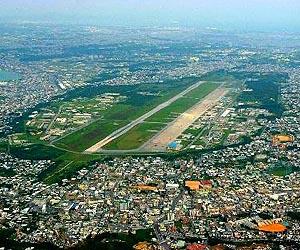
But the most aggressive Chinese nationalists -- tacitly encouraged by authorities -- say far more is open to claim, including the island of Okinawa, home to 1.3 million people and major US military bases.

The biggest of the Ryukyu Islands, which stretch for about 1,000 kilometres (620 miles) from Japan's mainland almost to Taiwan, Okinawa was the centre of the Ryukyuan kingdom, which pledged fealty to both Chinese emperors and Japanese feudal lords.

For hundreds of years it paid tribute to China's Ming and Qing dynasties, until it was absorbed by Japan in 1879.

The people of the Ryukyus are considered more closely related to Japan in ethnic and linguistic terms, than to China.

Some Chinese, however, see historical and cultural ties as a basis for sovereignty and dismiss Japan's possession of the islands as a legacy of its aggressive expansionism that ended in World War II defeat.

"This kind of thing proves Ryukyu is China's," said electrical engineer Zhu Shaobo, looking at a Qing dynasty volume from the 1760s about Ryukyuan students on display at the Imperial College, now a tourist site.

"Ryukyuan students studied hard and the cultural level of some was not inferior to Chinese students," explains an exhibit panel at the institution, which trained Imperial officials and some foreign students.

The belief that China has a legitimate claim to the Ryukyu Islands has existed among flag-wavers in China -- and Taiwan -- for years.

But it has been given new attention by the row over the uninhabited islets, known as the Diaoyu islands in China, which claims them, and as the Senkaku chain in Japan, which controls them.

In recent anti-Japan protests in China, some demonstrators carried signs reading: "Retake Ryukyu" and "Take back Okinawa".

China's government does not make such claims, but state media have carried articles and commentaries questioning Japan's authority.

In an article carried by state media in July, People's Liberation Army Major General Luo Yuan wrote: "The Ryukyu Kingdom had always been an independent kingdom directly under the Chinese imperial government before it was seized by Japan in 1879."

The kingdom, which lasted from 1429 until 1879, had a complex history wedged between powerful neighbours.

In return for tribute to Chinese emperors, trade and cultural ties flourished. But from the early 17th century, it came under pressure from Japan, suffering a punitive invasion and demands for loyalty and tribute.

Nominal independence, however, was maintained, and the "dual subordination" continued until the late 19th century when a modernising Japan could no longer tolerate Ryukyu's vague status.

Western and Japanese scholars say Okinawa's links to China are no basis for sovereignty claims today. Many states were part of a China-centred structure of international relations in Asia.

"It was a system of cultural subordination and also a way of the Chinese empire attempting to control trade," said Gregory Smits, an expert on Ryukyu history at Pennsylvania State University.

Experts see little chance of Beijing pushing a demand for Okinawa.

Gavan McCormack, emeritus professor at Australian National University, called any claim "quite unrealistic", adding it was probably "an extreme position to try and attract Japan back to the negotiating table".

Jia Qingguo, an international relations expert at Peking University, added: "I don't think the Chinese government wants to further complicate the already complicated issue."

Still, questions being raised over Japan's sovereignty worry Akihiro Kinjo, a 25-year-old Okinawa native and restaurant manager in Beijing.

Okinawa was the site of a deadly 1945 battle between Japan and the United States.

"Our grandmothers experienced war and based on their stories they had a horrible time," he said.

Under a security treaty with Japan the US maintains major military facilities on the island, and Washington is also making a strategic "pivot" to Asia, raising fears in Beijing of containment.

In August, the World Journal, a military affairs tabloid, carried a cover showing a projectile soaring toward Okinawa under the headline: "People's Liberation Army guided missile targets Okinawa bases."

Related Links
Learn about the Superpowers of the 21st Century at SpaceWar.com
Learn about nuclear weapons doctrine and defense at SpaceWar.com


.
.
Get Our Free Newsletters Via Email
...
Buy Advertising Editorial Enquiries


China finance chiefs to skip Japan IMF meetings
Tokyo (AFP) Oct 10, 2012 - Two of China's most senior finance officials will skip International Monetary Fund meetings in Japan, the Fund and a report said Wednesday, as Tokyo and Beijing remain locked in a diplomatic row.

The news is the latest indication that a spat over uninhabited, but possibly resource-rich, islands has spilled over from the political into the economic realm.

People's Bank of China Governor Zhou Xiaochuan, who had been due to deliver a lecture on Sunday, the centrepiece of the final day of the annual conference, will now send his deputy, the IMF said.

"We were informed two days ago that Governor Zhou's schedule might require him to cancel his lecture in Tokyo," a Fund spokesman said.

"It has now been confirmed that his deputy Yi Gang will represent him at the IMF-World Bank Annual Meetings and will deliver his Per Jacobsson Lecture."

Finance Minister Xie Xuren has also pulled out of the meetings, Kyodo News said, citing an unnamed Chinese official.

China's state-run Xinhua news agency reported that the Chinese delegation to the IMF and World Bank meetings "will be led by Yi Gang, vice governor of the People's Bank of China, and Zhu Guangyao, vice minister of finance".

Its report Tuesday did not mention Zhou or Xie, but an official from the central bank confirmed that Zhou would not be in Tokyo.

"Yi Gang, the deputy governor went to Tokyo, but Zhou Xiaochuan, the governor didn't," he told AFP. When asked about possible reasons, he said: "Zhou has a tight schedule and he doesn't have time."

The pull-outs come as Tokyo and Beijing remain at loggerheads over the sovereignty of a Japan-administered island chain in the East China Sea that both countries claim.

The dispute, which has rumbled on for decades, flared in August and September with landings by nationalists from both sides and the subsequent nationalisation of the islands by Tokyo.

They also come after several private Chinese banks were reported to be limiting or cancelling their participation in events linked to the IMF and World Bank meetings, which began on Tuesday and will run until Sunday.

Japan's top government spokesman, Osamu Fujimura, told a regular news conference Tokyo was disappointed.

"The Tokyo meeting is an important meeting. We would very much regret it if the representatives of the authorities do not take part," he said.

"Since economic exchanges between Japan and China are important, our country will take a broader view and continue to try communicating with China."

The countries have a two-way trade relationship well in excess of $300 billion a year.

Sometimes-violent protests rocked Chinese cities in September in the wake of Tokyo's purchase of three of the islands, known as the Senkakus in Japan and the Diaoyus in China.

Japanese businesses and diplomatic missions were targeted by mobs, with some factories and shops shuttering their operations.

Firms with operations in China reported a tightening of customs regulations and difficulties in getting visas for foreign staff, in what commentators said was China's way of making its displeasure known.

Japan's top three automakers said Tuesday their sales in China plunged in September, with Toyota reporting they had shifted half as many vehicles as in the same month last year.

Toyota -- the world's largest car firm by sales in the first half of the year -- and Honda both said Tuesday they would continue "adjusting" production in China as reports said automakers plan to roughly halve output at their facilities there.

It was reported last week that big Japanese insurers have stopped covering firms against riots in China, in a move seen likely to hit investment in the country.


.

. Comment on this article via your Facebook, Yahoo, AOL, Hotmail login.

Share this article via these popular social media networks
del.icio.usdel.icio.us DiggDigg RedditReddit GoogleGoogle


SUPERPOWERS
Obama slams Romney on Iraq
Columbus, Ohio (AFP) Oct 9, 2012
US President Barack Obama hit out at his Republican foe Mitt Romney on Iraq Tuesday, warning that America did not need a another president who started wars with no plan to end them. Obama pounced on Romney's complaint in a major foreign policy speech on Monday that the president had failed to secure Iraqi agreement for a residual US troop presence after the withdrawal of troops last year. ... read more


SUPERPOWERS
Northrop Grumman Completes SBIRS HEO-3 Payload Integration and Ambient Functional Test

Report: Funding for Iron Dome could be cut

Israel deploys Patriot missiles near northern port

'No flexibility' with Putin on missile defense: Romney

SUPERPOWERS
Raytheon awarded $349 million US Army contract for TOW missiles

UN's Ban alarmed by North Korea missile claim

Raytheon awarded US Army contract for TOW missiles

New US-SKorea missile deal to help Seoul defense: US

SUPERPOWERS
Two Global Hawk Unmanned Aircraft Fly in Close Formation, Move AHR Program Closer to Autonomous Aerial Refueling

Lockheed Martin-Led Industry Team Receives $13.5 Million Contract to Develop New Autonomous Technology Aboard Unmanned Aircraft

US drone strike kills five 'militants' in Pakistan

Israel shoots down unidentified drone

SUPERPOWERS
Lockheed Martin-Led Team to Begin Work on $4.6 Billion Defense Information Systems Agency Contract

Raytheon to provide Joint Tactical Terminal radios with latest security features to US Navy

Northrop Grumman Awarded Contract to Extend BACN Communications Connectivity to the Tactical Edge

Hughes Awarded Custom SATCOM Solutions Contract by GSA

SUPERPOWERS
4,000 tonnes of old munitions explode in Russia

Lockheed Martin Completes Centralization Of Targets and Countermeasures Operations in Huntsville

US hails war vehicle that saved lives, bypassed bureaucracy

Raytheon MALD-J Decoy Goes 4 for 4 in Operational Flight Tests

SUPERPOWERS
Boeing, KAL-ASD Broadening Defense Collaboration for Miltary Aircraft

Raytheon studies intelligence analysts' tradecraft to learn more about decision-making process

EADS, BAE Systems: how they measure up

EADS/BAE merger hangs on government deal

SUPERPOWERS
Obama slams Romney on Iraq

Chinese nationalists covet Japan's Okinawa

China banks to skip World Bank, IMF talks in Japan

The Cuban missile crisis: when the world held its breath

SUPERPOWERS
Drawing a line, with carbon nanotubes

Nano-hillocks: Of mountains and craters

Nanoparticles Glow Through Thick Layer of Tissue

All systems go at the biofactory


Memory Foam Mattress Review

Newsletters :: SpaceDaily Express :: SpaceWar Express :: TerraDaily Express :: Energy Daily
XML Feeds :: Space News :: Earth News :: War News :: Solar Energy News

.

The content herein, unless otherwise known to be public domain, are Copyright 1995-2012 - Space Media Network. AFP, UPI and IANS news wire stories are copyright Agence France-Presse, United Press International and Indo-Asia News Service. ESA Portal Reports are copyright European Space Agency. All NASA sourced material is public domain. Additional copyrights may apply in whole or part to other bona fide parties. Advertising does not imply endorsement,agreement or approval of any opinions, statements or information provided by Space Media Network on any Web page published or hosted by Space Media Network. Privacy Statement