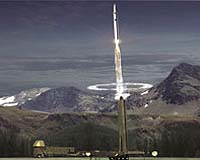
The Kinetic Energy Interceptor is a mobile, fast-reacting missile that can be quickly deployed worldwide for early interception of ballistic missiles.
The Kinetic Energy Interceptor is a mobile, fast-reacting missile that can be quickly deployed worldwide for early interception of ballistic missiles. |
Ballistic missile defense has the potential to strengthen deterrence by discouraging smaller nuclear nations from acquiring or launching weapons of mass destruction. While current U.S. defensive efforts pose little danger to the attack capabilities of Russia and China, they could completely defeat attacks by North Korea or Iran. That is especially true if enemy missiles can be intercepted in the earliest and most vulnerable stage of their trajectory, known as boost phase.
Interception of ballistic missiles in boost phase or the "ascent phase" that immediately follows rocket motor burnout enables defenders to destroy payloads before they separate into numerous, hard-to-track objects. This maximizes the effectiveness of any defensive system, thinning out or eliminating the threat faced by subsequent layers of defense.
The U.S. Missile Defense Agency currently is funding several boost-phase interception programs. The Kinetic Energy Interceptor is a mobile, fast-reacting missile that can be quickly deployed worldwide for early interception of ballistic missiles. The Airborne Laser is an aircraft-mounted beam weapon that can hit lofting missiles at the speed of light and will be demonstrated against a live target in 2009.
The Network Centric Airborne Defense Element and Air Launched Hit-to-Kill programs are less costly adaptations of existing weapons to the boost-phase interception mission.
In the long history of warfare, no weapon has ever surpassed the fearsome lethality of ballistic missiles equipped with nuclear warheads. A single such missile, equipped with multiple warheads, can kill a million people and cause hundreds of billions of dollars in damage. The warheads are so small, and move so fast, that they are devilishly difficult to intercept before they reach their targets.
Because the prospects for effective defense against ballistic missiles seemed bleak during the Cold War, the United States and the Soviet Union decided to rely instead on the threat of nuclear retaliation to prevent war. That approach, called deterrence, worked when there were only two countries with sizable nuclear arsenals. Today, however, there are nine nations capable of launching nuclear warheads mounted on ballistic missiles, and several other countries, such as Iran, that are actively pursuing the capability.
(Loren B. Thompson is chief executive officer of the Lexington Institute, an Arlington, Va.-based think tank that supports democracy and the free market.)
(United Press International's "Outside View" commentaries are written by outside contributors who specialize in a variety of important issues. The views expressed do not necessarily reflect those of United Press International. In the interests of creating an open forum, original submissions are invited.)
Share This Article With Planet Earth
 del.icio.us del.icio.us |
 Digg Digg |
 Reddit Reddit |
 YahooMyWeb YahooMyWeb |
 Google Google |
 Facebook Facebook |
 Outside View: BMD priorities -- Part 5
 Washington (UPI) Jan 21, 2009
| The content herein, unless otherwise known to be public domain, are Copyright 1995-2007 - SpaceDaily.AFP and UPI Wire Stories are copyright Agence France-Presse and United Press International. ESA Portal Reports are copyright European Space Agency. All NASA sourced material is public domain. Additional copyrights may apply in whole or part to other bona fide parties. Advertising does not imply endorsement,agreement or approval of any opinions, statements or information provided by SpaceDaily on any Web page published or hosted by SpaceDaily. Privacy Statement |