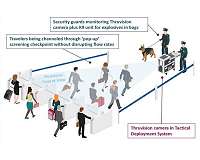
The odds are high that you have already interacted with one of ESA's most-far-reaching inventions without realising it. Terahertz security cameras – currently employed in 18 countries including many major airports and the LA Metro – scan passengers for concealed weapons or contraband in their clothing from up to 10 metres away, operating on an entirely passive, non-invasive basis.
There is no need to step into a dedicated machine, as with X-ray scanners – you just walk on by. No radiation is emitted by the imager; instead it works by detecting the extremely high-frequency 'terahertz' waves emitted by anything that is warm, including the human body, and highlighting anything blocking these emissions. The scanning resolution is low enough that no anatomical details are revealed.
"Our imagers are looking at the thermal contrast between the temperature of the body and any items concealed around the body," explains Colin Evans, CEO of the Thruvision company, licensing the terahertz imaging technology from co-patent holders ESA and the Rutherford Appleton Laboratory in the UK.
"Because they are passive sensors, emitting no harmful energy, then their operation is covered by standard CCTV legislation. It's like looking at someone with night vision goggles, except at higher frequency."
The technology dates back to the start of this century, and an ambitious ESA-RAL research effort. This was the first of the ESA-led 'StarTiger' projects, gathering together top experts at a single site to work on a single, top priority project.
"Terahertz and sub-millimetre waves are used in space quite often," explains Peter de Maagt, head of ESA's Antennas and Sub-mm Waves Section, and co-author of the patent on the ESA side. "For instance to track early galactic evolution, or to perform temperature and humidity sounding for weather forecasting and atmospheric research.
"But the devices back then were really bulky, built up from unintegrated blocks, and multi-frequency real-time imaging was still a problem. What we did was to completely integrate everything into a very small credit-card-like unit.
"The whole basis of StarTiger is that, at the end, we have to produce working hardware, not just a report. So we targeted a camera capable of photographing the human hand in terahertz waves. We harnessed micro-machining technology used for mobile phone technology to make it work, achieving several technical world firsts in the process."
Dr Chris Mann led the work from the RAL side, and is the other patent co-author: "Every single element in the detector had to be hand-crafted using milling machines. We had to redesign all the optics because we weren't radio-astronomers looking at light years distant but wanting to image something just a few metres away.
"The challenge really captured people's imagination, and this was where the StarTiger approach came into its own, because we achieved in a few months what otherwise might have taken years."
Dr Mann went on to establish Thruvision, today serving as the company's Chief Scientific Advisor. He holds the same role in another company, SubTeraNDT, applying the same ESA-RAL patent for oil and gas infrastructure inspection.
"It has been a long process, but today Thruvision is well-established," adds Colin Evans. "Based over the road from RAL, our core sensor is manufactured here. And we've worked hard to build up a full supply chain for our extremely high-precision components, which operate at 250 Ghz, way above standard.
"We're very proud of our pioneering ESA and RAL technological heritage, and that absolutely cuts the mustard on the world stage – giving us a very strong pedigree."
The terahertz technology is part of ESA's intellectual property rights portfolio, consisting of around 450 patents on space innovations, available for licensing by European companies for both space and terrestrial applications.