|
 |
 |
 |
 |
 |
 |
 |
 |
 |

| . |  |
. |
European Eldorado Eludes Unlucky Migrants
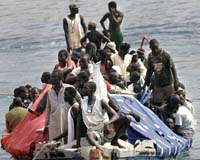
Banjul (AFP) Sept 14, 2006 Cheikh Ndiaye Toure, a Senegalese street vendor, still passionately dreams of the European eldorado. His first attempt at the perilous journey failed just a few kilometres into Spanish waters due dangerously bad weather, but he is prepared to give it another go. Toure recounts moments of fears and joy during a nine-day journey on a barely seaworthy dugout canoe on the Atlantic Ocean towards the Spanish Canary Islands, now the favourite stepping stone to Europe for African illegal immigrants. "We travelled under more or less precarious conditions. We were crammed because we were between 75 and 100 people in the pirogue -- Gambians, Senegalese and Guineans," said the 31-year old father, who hawks mobile phone accessories on the streets of the Gambian capital Banjul. "We were on board a large pirogue, like the ones that fishermen use on long distances," he said after his return. The first day of the trip -- August 15 -- was tough. "For a lot of us it was baptism by fire at sea. Several of the travellers got sea sickness. Some got dizzy while others vomited a lot." But all "returned to normal on the second day and people were getting used to the waves. The mood was good. The people were singing, chatting away. There was a great sense of friendship among us as if we had known each other for years." According to him all arrangements had been taken to facilitate the trip. "For example there was a place set aside to serve as a dormitory. Little mats had been put in place and served as beds. There was also a place to relieve oneself," he said. He said "there was great solidarity among us", as people took turns to sleep given the limited space. The pirogue was also equipped with GPS receiver, a satellite-based navigation system, which allowed the boat driver to know his position. The boat was stocked with drinking water, food, medicines, fuel and even life jackets. "From Casamance (southern Senegal), we went around the coast of Dakar. Then we headed towards Mauritania and the coast of Morocco. It was at 23 kilometres in Spanish territorial waters (near the Canaries), after five days of crossing that our dream vanished. "We were surprised by a very violent wind which rendered our path impossible. We could not see anything anymore and the sea became more and more angry. It was at that time that there was a bit of panic. "Most of the passengers were gripped by so much fear that the driver was forced to make a u-turn", he said, and thus marked the end of the dream. Four days later they docked at Saint Louis, Senegal's second largest seaside city. "We set out on the trip with one goal, to find employment over there so as to improve our very difficult conditions in Africa." The number of Africans risking the dangerous Atlantic journey as shot up in recent months after Spain and Morocco ramped up surveillance of the Strait of Gibraltar, far easier to cross and previously the preferred route. More than 20,000 have made it to the Canaries so far this year, more than doubling the previous annual record of 9,929 set in 2002. Like his other unfortunate comrades from the boat, he had parted with 20,000 dalasis (750 euros, 950 dollars) to make the crossing to the Canaries. Despite the enormous risks involved and the trying conditions of the trip, Toure is prepared to go again. "If the opportunity arises, I will try the adventure afresh. There are others, more lucky than us, who are actually in Spain. Why not me?
Source: Agence France-Presse Related Links Out Of Africa  Wen issues warning on Darfur
 London, Sept 13, 2006
 Chinese Premier Wen Jiabao said Wednesday he backed the proposed deployment of UN peacekeepers in strife-torn Darfur, but warned that Sudanese government consent was vital first. Speaking after talks in London with British Prime Minister Tony Blair, Wen said China was worried by developments in the western Sudanese region. |
|
|

| The content herein, unless otherwise known to be public domain, are Copyright 1995-2006 - SpaceDaily.AFP and UPI Wire Stories are copyright Agence France-Presse and United Press International. ESA PortalReports are copyright European Space Agency. All NASA sourced material is public domain. Additionalcopyrights may apply in whole or part to other bona fide parties. Advertising does not imply endorsement,agreement or approval of any opinions, statements or information provided by SpaceDaily on any Web page published or hosted by SpaceDaily. Privacy Statement |