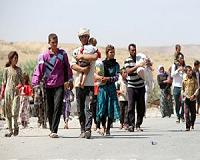
Iraq's Yazidi minority held its summer festival on the weekend, five years after jihadists seized their ancestral heartland of Sinjar, in a brutal assault that still haunts the community.
On August 3, 2014, Islamic State group fighters seized Mount Sinjar, and went on to slaughter thousands of Yazidi men and boys and abduct girls to be used as "sex slaves".
The United Nations has said IS's actions could amount to genocide, and is investigating jihadist atrocities across Iraq.
On Saturday, women wearing white T-shirts paraded around Lalish temple, the Yazidis' holiest shrine, brandishing banners to commemorate the "genocide" and portraits of IS victims.
They were led by Hazem Tahsin Bek, who late last month was enthroned as the community's prince at a ceremony in Lalish, succeeding his father Tahsin Said Ali who died in January after a long illness.
Yazidi dignitaries in long white robes took part in the ceremony during which participants lit candles and burned special oils as part of the annual ritual to purify the temple.
"The summer festival takes place at the same time as the commemoration of the genocide that took place in Sinjar when IS launched its assault against the mountain," Hazem Tahsin Bek told AFP.
The 56-year-old hereditary leader is in charge of running the community and cooperating with Kurdish authorities in the north and the federal government in Baghdad.
"We are remembering all those killed during this genocide five years ago," he said.
– 'Stability is crucial' –
The UN special envoy to Iraq, Jeanine Hessni-Plasschaert, also paid tribute in a statement to "the suffering of the Yazidis on the fifth anniversary of ISIL's (IS) onslaught".
The envoy "lamented the current failure to bring about stability in the area," adding that "stability is crucial for the stricken community to return home and rebuild its life".
She urged Iraq's federal authorities and those in the autonomous Kurdish region to "urgently find solutions that put the needs of the people first".
Of the world's 1.5 million Yazidis, around 550,000 were living in the remote corners of northern Iraq before 2014.
The brutal assault launched by IS in August that year pushed around 360,000 Yazidis to flee to other parts of Iraq, including the Kurdish region, where they live in ramshackle displacement camps.
According to authorities, more than 6,400 Yazidis were abducted by IS and only half of them were able to flee or be rescued, while the fate of the others remains unknown.
Another 100,000 fled abroad.
– 'Sinjar is devastated' –
"I hope that something will be done for Sinjar. It is so devastated, as if it never existed," said Alia Barkat, a young woman who took part in Saturday's commemoration.
Barkat, who wore fashionable sunglasses and a white skirt, was among hundreds of people who thronged Lalish.
The shrine lies at the centre of the community's other main hub in Iraq, in the Nineveh Plains, north of second city Mosul.
Five years after the onslaught, Sinjar, some 300 kilometres (190 miles) to the west, remains out of bounds for Yazidis.
IS destroyed the fields and the farming infrastructure which were the backbone of the minority's livelihoods, while basic services have yet to be re-established and reconstruction has been delayed.
The Yazidi cause has found a powerful symbol in Nadia Murad, a former IS abductee from Sinjar who escaped and went on to win the Nobel Peace Prize for her activism against sexual violence.
The Yazidi faith emerged in Iran more than 4,000 years ago and is rooted in Zoroastrianism, over time integrating elements of Islam and Christianity.
Activist Murad urges Yazidis to return to Iraq
Stuttgart, Germany (AFP) Aug 3, 2019 –
Nobel laureate Nadia Murad on Saturday urged Iraq's Yazidi minority to return to their ancestral heartland of Sinjar, five years after jihadists launched a brutal assault on their community there.
Murad was one of thousands of women and girls from the ancient faith abducted by the Islamic State group as their overran swathes of Iraq in 2014.
Speaking in the southwestern city of Stuttgart at the invitation of Germany's central Yazidi council, she said that more than 90,000 had already returned to Sinjar.
But "we need even more to return there so as to thwart the IS's plan to chase them out from Sinjar," she said.
"The Kurdish and Iraqi authorities have done nothing for us and there is currently no local authority in the region of Sinjar," Murad said.
Describing the de-mining of the territory and the exhumation of mass graves as "a positive step forward," she called for the restoration of public services, including schools and hospitals, in the region.
She also argued that the Kurdish and Iraqi authorities should "compensate the Yazidi survivors of the IS, but so far they have still had nothing."
Baghdad has awarded some Yazidis a one-off payment of $1,700, equivalent to just over three times the average monthly wage in Iraq.
On August 3, 2014, Islamic State group fighters seized Mount Sinjar, and went on to slaughter thousands of Yazidi men and boys and abduct girls to be used as "sex slaves".
The United Nations has said IS's actions could amount to genocide, and is investigating jihadist atrocities across Iraq.
Of the world's 1.5 million Yazidis, around 550,000 were living in the remote corners of northern Iraq before 2014.
The brutal assault by IS pushed around 360,000 Yazidis to flee to other parts of Iraq, including the Kurdish region, where they live in ramshackle displacement camps.
According to authorities, more than 6,400 Yazidis were abducted by IS and only half of them were able to flee or be rescued, while the fate of the others remains unknown.
Another 100,000 fled abroad.
The number of Yazidis living in Germany is around 150,000.