
RAY GUNS
High-Tech firepower: Russia develops new space laser cannon
by Staff Writers
Moscow (Sputnik) Jun 13, 2018

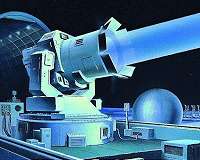
file illustration only

A company affiliated with the Russian space agency Roscosmos is reportedly moving to develop a powerful new laser capable of evaporating targets in orbit for the benefit of all mankind.

Researchers at the Scientific and Industrial Corporation 'Precision Instrument Systems' (NPK SPP), a subsidiary of Roscosmos, are developing a new technology which would allow for the vaporizing of potentially harmful space debris via a focused laser beam, according to a report submitted to the Russian Academy of Sciences.

The proposal drafted by the scientists involves creating "an optic detection system which includes a solid-state laser and a transmit/receive adaptive optical system."

The company confirmed the existence of this document, but declined to elaborate any further.

The scientists intend to use the massive soon-to-be-built telescope at the Altay Optical-Laser Center and convert it into a laser cannon. The device is expected to be powered by a solid-state generator, though the project team has yet to choose which model to use.

The cannon is expected to be able to gradually vaporize space debris objects through laser ablation.

Earlier it was reported that there are at least 13,000 space debris objects orbiting Earth, according to the Russian space control system.

In 2016 Roscosmos scientists determined that if the issue of space debris is not addressed, in one or two centuries it may clog Earth's orbit and make space launches nearly impossible.


Related Links
Directed Energy news at SpaceWar.com
Learn about laser weapon technology at SpaceWar.com

RAY GUNS
US Air Force to begin fighter-mounted laser testing this summer
Washington (AFP) March 19, 2018
The US Air Force will this summer begin testing a laser that will be mounted on an F-15 warplane, an official said Monday. The Pentagon last year awarded a $26 million contract to Lockheed Martin for a laser program called SHiELD (Self-protect High Energy Laser Demonstrator.) The idea is to put a laser system on aircraft with an output of about 50 kilowatts to test their ability to zap drones or cruise missiles. "We have got tests starting this summer and the flight tests next summer," Jeff ... read more

Comment using your Disqus, Facebook, Google or Twitter login.

Share this article via these popular social media networks
del.icio.usdel.icio.us DiggDigg RedditReddit GoogleGoogle

RAY GUNS
Saudi Arabia says new Yemen missile intercepted

Saudi Arabia says new Yemen missile intercepted

Northrop tapped for ballistic radar detection services

Saudi Arabia says new Yemen missile intercepted

RAY GUNS
Navy taps Raytheon, Kongsberg for Naval Strike Missile

New hypersonic missiles guarantee parity with US: Putin

Saudi warns of military action if Qatar gets Russian missiles: report

Boeing contracted for test kits for air-launched cruise missiles

RAY GUNS
Kratos awarded unmanned $90M aerial target drone systems contract

Use of armed drones increasing under Trump: study

Aerial robot that can morph in flight

UAV aircrafts provide new insights into the formation of the smallest particles in Arctic

RAY GUNS
On-the-move communications system set to field this fall

Lockheed Martin's 5th AEHF comsat completes launch environment test

IAP Worldwide Services tapped for satellite systems

Hughes to prototype Multi-Modem Adaptor for Wideband SATCOM use

RAY GUNS
Thai junta seeks $10 billion in new security budget

Army taps AM General for 300 Humvees

Oshkosh tapped for tactical vehicle support

Leidos tapped for services as unconventional weapons gain prominance

RAY GUNS
Bulgaria OKs spending on new fighter jets, armoured carriers

Mack receives more than $296M for dump trucks

Dassault's death spurs speculation over fate of French empire

BAE welcomes Australian economic plan for defense industry

RAY GUNS
Trump's G7 bust-up shows risks for North Korea summit

Summits fuel questions about Trump's embrace of autocrats

France challenges Beijing in South China Sea

Kim's wingman: Air China flight shows Beijing's influence

RAY GUNS
AI-based method could speed development of specialized nanoparticles

Researchers use magnets to move tiny DNA-based nano-devices

Atomically thin nanowires convert heat to electricity more efficiently

Change the face of nanoparticles and you'll rule chemistry