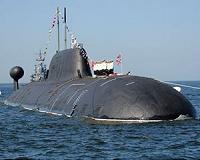
India will commission the construction of six nuclear-powered attack submarines (SSNs), India's navy chief Adm. Robin Dhowan said.
The boost to India's navy will renew the country's submarine fleet currently composed of 13 aging diesel-powered submarines and one Nerpa SSN, called Chakra locally, on lease from Russia.
"The six SSNs will be constructed under the Make in India program," Dhowan said, as quoted by The Times of India on Thursday.
Technical parameters are being drawn up, and a shipyard for the construction is yet to be selected, according to the newspaper. Another three Scorpene-class submarines will be ordered from the French DCNS company.
India's own nuclear-powered ballistic missile INS Arihant submarine is due to be commissioned next year at the Navy Shipbuilding Centre in Visakhapatnam.
earlier report
Under the Sea: Russian,Chinese Submarines Challenge for US
The industry for building and acquiring modern submarines is growing exponentially. The United States, Russia, China and even India are designing and building multiple new classes of subs, equipped with a growing variety of weapons and sensors.
Christopher P. Cavas in his article for the Defense News wrote that although the US builds extremely capable submarines, at about $2 billion each, there are only so many subs the US Navy can acquire as 'the supply will never meet the demand.'
Retired Vice Adm. Michael Connor, a former commander of the US Navy's submarine forces, in a recent hearing on Capitol Hill said, "The undersea arena is the most opaque of all warfighting domains. It is easier to track a small object in space than it is to track a large submarine, with tremendous fire power under the water. That is why countries with the technical wherewithal to operate in this domain are pursuing advanced capability," The Defense News website reported.
"The two countries that present the biggest challenge in the undersea are Russia and China, with Russia being the more capable of the two," Connor said.
Connor in his briefing stressed that instead of building more submarines, more focus should be on sustained development of weapons and sensors to increase the power of US undersea forces. Among Connor's top recommendations was the aim to extend the striking range of submarine-launched weapons.
He further mentioned that improvements should be made in the endurance of the vehicles, expanding the payload set and reaching a point where any submarine can recover the mission data, if not the vehicle.
"We need to do this while keeping the cost of the vehicle down. The cost should be low enough such that, while we would always like to get the vehicles back, it is not a crisis if we don't. The value is in the data, not the vehicle," Connor said, Defense News reported.
According to the Rep. Randy Forbes, R-Va., chairman of the subcommittee, "There's a recognition that if we're going to keep up with undersea dominance, it's not just about creating more platforms, but we have to create relatively sophisticated systems of systems with the ability to multiply capability but not just adding a platform," he said in a post-hearing interview, the Defense News reported.