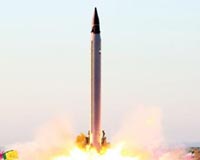
Iran said on Saturday that its recent test launch of a long-range missile does not violate UN Security Council resolutions as claimed by the United States and France.
"Our missile tests have nothing to do with Resolution 2231, which only mentions missiles designed to carry nuclear warheads," Iranian Foreign Minister Mohammad Javad Zarif told a news conference.
Speaking in Tehran alongside his German counterpart Frank-Walter Steinmeier, he added: "None of the Islamic Republic of Iran's missiles have been designed for nuclear capabilities."
Iran announced Sunday it had successfully tested a new domestically produced long-range missile without specifying its exact range.
Defence Minister Hossein Dehghan said the new missile "can be guided and controlled until hitting the target."
The US ambassador to the UN Samantha Power on Friday said the missile launched by Iran is a "medium-range ballistic missile inherently capable of delivering a nuclear weapon".
"This was a clear violation of UN Security Council Resolution 1929," she said, echoing similar criticism from the French foreign ministry, adding that the US would seek action at the Security Council.
Resolution 1929 prohibits Tehran from conducting ballistic missiles tests.
Resolution 2231, which was adopted a few days after Iran struck the July 14 landmark nuclear deal with world powers, bars Iran from developing missiles "designed to carry nuclear warheads".
The nuclear deal reached with Britain, China, France, Germany, Russia and the United States aims to limit Iran's nuclear program in return for lifting international sanctions.
Iran insists it has no plans to develop atomic weapons.
Zarif told the news conference that "nuclear weapons have no place in the military doctrine of Iran" and said that the missile programme of the Islamic republic does not violate UN resolutions.
Nuclear deal 'opening' for Mideast diplomacy: Steinmeier
Tehran (AFP) Oct 17, 2015 –
The nuclear deal between Iran and the world powers is "an opening for further diplomatic endeavours" to resolve the conflicts in the Middle East, the German foreign minister said in Tehran Saturday.
"This region needs more diplomacy, not less" said Frank-Walter Steinmeier, pointing to the conflicts in Syria, Yemen and Iraq, according to the text of a speech he delivered.
"We need and we are ready to discuss these questions with Iran", Steinmeyer said, encouraging Tehran to "play a constructive role in the international community toward its neighbours in the region."
"Peaceful solutions never depend on one player and that's why my voyage does not stop here," said the German minister, who will travel to Iran's great regional rival, Saudi Arabia, on Sunday.
Acknowledging that there are "many question marks regarding Iran's intentions in the region and plenty of suspicion," he said Tehran, even if it finds them "unfair and unfounded… should not ignore but address them constructively."
Speaking at a joint press conference, Iranian Foreign Minister Mohammad Javad Zarif said: "I believe that realism has increased in the West about the Syrian crisis and there are solutions on which we can all come to an agreement."
But he said foreign involvement should "be aimed at resolving the crisis and not to impose their own views on the Syrian people."
Iran is Bashar al-Assad's strongest regional ally, sending financial help and military advisers, while Western countries, the Arab monarchies of the Gulf and Turkey are helping rebel groups in Syria.
Zarif also criticised Saudi Arabia for its regional policies.
"Iran does not seek to eliminate Saudi Arabia but also will not let Saudi Arabia eliminate Iran from the region," said Zarif.
The kingdom's "efforts to eliminate Iran have led to bloodshed and fuelled clashes in the area and must end."