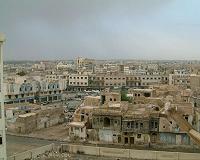
Abu Mariam's spacious villa sits in an upscale Mosul district, but when Iraq's second city became a war zone, the family sought refuge in their basement.
The house sits at the end of the "fourth bridge", which lies broken in half across the Tigris River dividing Islamic State group-held west Mosul from the Iraqi government-controlled east.
Iraqi forces seized the bridge at the end of last month after retaking east Mosul from IS in January. Today, they are advancing in the city's west.
Abu Mariam's house stands on the front line.
Iraqi soldiers lounge on the steps as explosions rock surrounding streets.
"I'm afraid an IS shell will fall on us," says Abu Mariam, a 46-year-old public servant with a trim salt-and-pepper moustache.
He is interrupted by two explosions that shake the house which has already lost all its windows.
Abu Mariam, his wife, their three children abandoned their spacious kitchen, elegant living room with its flat-screen TV and several large bedrooms to seek refuge underground. An octogenarian neighbour has joined them.
It's a wise precaution.
Two shells have landed on the roof of the villa and a third in the garden since Iraqi forces began their assault, Abu Mariam says.
In nearby streets, houses are deserted, with broken windows and missing doors. Occasionally a child's face appears behind a window. A burned-out car sits in a driveway. In another, three dead IS fighters lie face down on the ground.
Soldiers sit on the steps in the garden, sipping tea that Abu Mariam has prepared. One sits on a swing. The lawn is littered with empty plastic water bottles and polystyrene boxes — discarded meal containers.
"They searched the house when they arrived. They were polite," says Abu Mariam.
– Three months underground –
Down in the basement, four beds of different sizes are lined up in a row, facing a small TV screen.
At the other end of the room, dozens of water bottles sit on a kitchen table alongside some packets of rice and bulgur wheat. A gas stove sits on the floor.
"We only go upstairs to use the toilet. It's been like this for three months, since shells started falling on the area," says Abu Mariam.
Wrapped up in bed, a shawl over her shoulders, their 82-year-old neighbour says she never wanted to leave the home she had occupied for 40 years.
"My nephews begged me (to leave) over and over again, but I only feel comfortable at home, and I didn't want to be a burden," Suhair, a retired teacher who doesn't want to use her real name, tells AFP.
She eventually gave in when the bombing got too close, joining her neighbours in their basement.
Like many residents of Mosul, Abu Mariam says he is glad to be rid of IS, which conquered the city in June 2014.
"The situation was terrible. We're still afraid now," he says, refusing to appear on camera for fear of reprisals.
"They would hold you to account for everything: your beard, your clothes, how you walk," he says.
"Once they asked why my daughter had trousers, even though she was wearing a long jacket and a scarf on her hair. She's only 10 years old!"
He says he wants the whole of Mosul to be "liberated" and safe again.
But for now, the neighbourhood is a war zone. Outside, just a few metres (yards) away, security forces shoot at a car rigged with explosives. It blows up in a huge fireball.
A few minutes later, crouched on Abu Mariam's lawn, two soldiers shoot down an IS drone flying overhead. The jihadists have been using the devices to dump explosives on Iraqi forces' heads.
When relative calm returns, Abu Mariam says he has decided to retreat.
"The children are afraid, we will spend a night or two with our neighbours a street back," he says.
Iraqi forces battle IS in heavy west Mosul fighting
Iraqi forces battled the Islamic State group in hours of heavy clashes in west Mosul on Sunday, as the number of people who fled fighting in the area topped 45,000.
Iraqi forces have recaptured several areas in west Mosul since launching the push to retake it on February 19, but their pace has slowed amid bad weather which muddies streets and makes air support more difficult.
West Mosul … read more