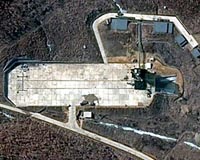
North Korea has successfully tested a new, high-powered rocket engine, state media said Tuesday, a move Seoul said was designed to showcase its progress towards being able to target the US east coast.
The ground test comes less than two weeks after Pyongyang detonated what it said was a miniaturised atomic bomb.
Taken together, the two tests raise the prospect that the isolated state could be inching towards its ultimate goal of developing a nuclear-tipped missile that could hit Washington DC.
State-run news agency KCNA trumpeted the engine test, which it said would give the country "sufficient carrier capability for launching various kinds of satellites".
Rocket engines are easily re-purposed for use in missiles, and outside observers say that Pyongyang's space programme is a fig leaf for weapons tests.
The North's leader Kim Jong-Un hailed the test and called for more rocket launches to turn the country into a "possessor of geostationary satellites in a couple of years to come", KCNA said.
A geostationary satellite must be propelled to an altitude of 36,000 kilometres (22,500 miles), a Unification Ministry official was quoted as saying by South Korea's official Yonhap news agency.
"The distance to the eastern part of the United States is some 12,000 kilometres. The North is thus showing off its ability" to hit the US east coast, the official added.
Rocket scientist Chae Yeon-Seok at the South's Korea Aerospace Research Institute said such an engine would represent "a technical leap forward" in developing launch vehicles.
It suggests the North is "coming close to having an inter-continental ballistic missile (ICBM) that could hit the US mainland".
Pyongyang regularly parades homegrown missiles and boasts of its plan to develop long-range missiles capable of targeting America.
It has already carried out a series of long-range missile tests presented as satellite launches, most recently in February, and has fired missiles from a submarine.
A proven submarine-launched ballistic missile system would allow deployment far beyond the Korean peninsula and a "second-strike" capability in the event of an attack on the North's military bases.
– 'Great satisfaction' –
After supervising the test at the country's Sohae satellite-launching site, leader Kim Jong-Un called on officials, scientists and technicians "to round off the preparations for launching the satellite as soon as possible", KCNA reported.
Kim "expressed great satisfaction" with the results of the test, according to KCNA, and said the North had made cutting-edge scientific advances despite difficult economic conditions.
North Korea has been hit by five sets of United Nations sanctions since it first tested a nuclear device in 2006, but has insisted it will continue.
Professor Yang Moo-Jin of the University of North Korean Studies said the North had set a five-year space development programme that ends this year.
"This new test heralds an upcoming landmark ICBM test. The next test, disguised as a satellite launch, is likely to come when the UN Security Council adopts new sanctions over its last nuclear test or around the time when the US presidential election takes place in November", Yang said.
The US has a range of missile-defence technologies at its disposal, including the Aegis Combat System, Patriot missiles and sophisticated radars.
Washington is also working with Seoul to install a missile defence system known as THAAD in South Korea, though Beijing says the hardware poses a significant threat to regional security.
Yonhap news agency said two B-52 heavy bombers were to be sent from Guam to the South as a fresh show of force against the North this week.