
SPACEWAR
Offensive War in Space
by Staff Writers for Launchspace
Bethesda, MD (SPX) Jun 12, 2019

.

A new arms race is unfolding among spacefaring nations. Space experts have been telling us about contested space for the last several years. Today, there are about 1,300 active satellites in a crowded nest of Earth orbits. They provide worldwide communications, GPS navigation, weather forecasting and planetary surveillance.

Military organizations rely on many of these satellites in support of modern warfare. The three main contenders are the U.S., China and Russia. The ongoing power struggle may ignite a conflict that could cripple the entire space-based infrastructure while reducing the capabilities of warfighter organizations.

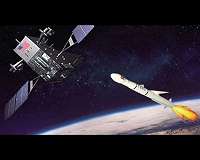
There are several ways to disable, destroy or reduce effectiveness of satellites. One obvious way is to attack them with anti-satellite devices. Another is to simply approach a satellite and spray paint over its optics.

Other ways include manually snapping off communications antennas and destabilizing orbits. Lasers can temporarily or permanently disable satellite components. Ground station interference using radio or microwave emissions can jam or hijack transmissions to or from ground controllers.

The concept of war in space is not new. The prospect of Soviet nuclear weapons launched from orbit in the 1950s motivated the U.S. to begin the testing of anti-satellite weaponry. Fortunately, orbiting weapons of mass destruction were banned through the UN Outer Space Treaty of 1967. Consequently, space-based surveillance became a major component of the Cold War that served as an early-warning system for the deployment or launch of ground-based nuclear weapons.

Throughout most of the Cold War, the U.S.S.R. developed and tested "space mines" which could self-detonate in order to destroy U.S. spy satellites.

The militarization of space issue peaked again when President Reagan initiated the Strategic Defense Initiative to develop orbital countermeasures against Soviet ballistic missiles. In 1985, the USAF staged a demonstration when an F-15 fighter jet launched a missile that took out a failing U.S. satellite in low orbit.

Today, the situation is much more complicated. Low- and high-Earth orbits have become hotbeds of scientific and commercial activity, filled with hundreds of satellites from about 60 different nations. Despite their largely peaceful purposes each satellite is at risk because a few military space powers insist on continued development and test of new space weapons.


Related Links
Launchspace
Military Space News at SpaceWar.com

SPACEWAR
House committee delays decision on funding Space Force
Washington (UPI) Jun 10, 2019
A draft of the National Defense Authorization Act released by the House on Monday has no mention of the Space Force envisioned by President Donald Trump. The House Armed Services Committee will debate the matter on Wednesday, members of the committee said. Rep. Adam Smith, D-Wash., committee chairman, said any inclusion of funding would build an outer space military branch "smaller and more focused" than Trump's plan, which calls for a Space Command as a division of the U.S. Air Force be ... read more

Comment using your Disqus, Facebook, Google or Twitter login.

Share this article via these popular social media networks
del.icio.usdel.icio.us DiggDigg RedditReddit GoogleGoogle

SPACEWAR
Pentagon calls Turkey plan to buy Russian missiles 'devastating'

Syrian air defence fires at 'enemy missiles' in Damascus: state media

Erdogan offers Trump working group on Russian missiles

Washington says 'possible' Ankara will reject Russian missiles

SPACEWAR
Turkey's Erdogan says no backtracking on S400 deal with Russia

Britain's Royal Air Force tests miniature missile decoys on Typhoon jets

Raytheon nabs $38.2M contract for Army TOW missiles

US approves missile sales to S.Korea, Japan

SPACEWAR
Amazon says drone deliveries coming 'within months'

Insitu nabs $47.9M to deliver ScanEagle drones to four U.S. allies in Asia

Northrop Grumman nabs $65M for drones for Navy, Australia

General Atomics awarded $36.4M for drone, intelligence work in Afghanistan

SPACEWAR
AFRL demonstrates world's first daytime free-space quantum communication enabled by adaptive optics

Harris to build new satellite connection system prototype for USAF

Navy to transfer future satcom programs to Air Force

Future narrowband satellite capability to transfer to Air Force

SPACEWAR
Trump blames drug use for transgender army ban

U.S. Army changes recruitment approach with new advertising agency

Oshkosh, Broshuis land $13.3M Army contract for new semitrailers

Making DoD's Vast Logistics Enterprise More Resilient

SPACEWAR
Big US defense merger touts tech, but Trump has questions

Senators seek to block Trump's arms sales to Saudis

Citing Iran, Trump bypasses Congress to sell arms to Saudis, UAE

New criticism over French arms shipments to Saudi Arabia

SPACEWAR
China's Xi in Russia to boost cooperation amid US tensions

Hong Kong leader refuses to scrap extradition bill despite rally

'Union Jack' returns to bows of U.S. Navy ships

China nominates 'the vulture' to lead UN drug agency

SPACEWAR
Monitoring the lifecycle of tiny catalyst nanoparticles

Fast and selective optical heating for functional nanomagnetic metamaterials

2D gold quantum dots are atomically tunable with nanotubes

Harnessing microorganisms for smart microsystems