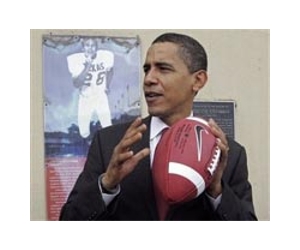
As U.S. President Barack Obama and his administration begin a second term, they face powerfully transformed political landscapes at home and abroad.
Regarding the international scene, so far, these extraordinary and indeed tectonic shifts have either been ignored or simply unrecognized. To be blunt, the United States is engaging a 21st-century world with 20th-century tools.
Three paradigm shifts underscore this point:
First, the fear and foundation for much of the past six or seven decades for the West was the massive destruction of a thermonuclear war that would have annihilated many tens or hundreds of millions.
Despite valid concerns over nuclear proliferation, the largest danger today to advanced and advancing societies is massive disruption. One most visible effect of Sept. 11, 2011, (and July 7, 2005, in Europe) was to disrupt our economies (perhaps eviscerating several trillion dollars) and our psyches regarding a sense of security. And from the threat of cyberwar to destructive acts of nature, it is disruption and not societal wide massive destruction that should concern us most.
Second, the diffusion of all forms of power has imposed obvious limitations on the authority and influence of the United States as the economies of China, India and other states grow.
This is self-evident. But the other side of this diffusion coin is far more dramatic: given an interconnected and wired world, individuals and non-state actors possess unprecedented leverage in influencing and affecting events.
The self-immolation of a Tunisian fruit vendor that kicked off the Arab Spring is Exhibit A. There are many others. What is also fascinating is that unlike earlier eras when a spark could ignite a crisis or world war — and the assassination of Archduke Franz Ferdinand and his wife 99 years ago this June is Exhibit B — today, sparks or fuses bring with them their own explosive or incendiary mixtures beyond obvious potential time bombs say in Syria, Iran or North Korea.
Third and ironically, the militarily strong are increasingly vulnerable to the militarily weak. That the United States possesses the most capable military in the world wasn't sufficient to declare victory over insurgents in Iraq and Taliban in Afghanistan who employed very cheap improvised explosive devices, basic weapons such as AK-47's and rocket-propelled grenades and terror to counterbalance total military inferiority. Yet the United States seems determined to continue spending huge amounts of money on systems that have only limited utility in conditions most likely to see their use.
To put a further twist on this irony, consider cost exchange ratios — that is what we spend to counter an adversary. IEDs offer a vivid example. The United States has spent between $60 billion-$70 billion to counter IEDs in Afghanistan and Iraq. Price tags cannot be put on lives saved. However, the total amount of money used by our adversaries in fielding IEDs at best can be measured in the millions. A billion is a thousand million. So by any count, the enemy has a cost exchange ratio of many, many thousands to one in their favor. At some point that exchange ratio becomes unaffordable.
Meanwhile at home, government is badly broken and shows no sign of remediation. Politics have sunk to even lower depths as campaigning is a chronic 24/7 and the intent remains to defame and demonize the opposition.
A dinner with a dozen senators and lunch with a handful of House members isn't a long-term solution. In essence, the U.S. government is incapable of rational decision as the sequester so sadly demonstrated.
Lenin famously asked, "What can be done?" The tragic answer is probably nothing. Given the absence of an intellectually rigorous concept for governing and complete understanding of why today's world is so different, muddling through by default becomes the answer. Unfortunately, given the paradigm shifts noted above, muddling through is very high risk.
Because individuals and non-state actors have become potentially so empowered by this diffusion of power and the electron that instantly interconnects virtually all parts of the globe, the major danger to most states is massive disruption. Of course, in war-torn states such as Syria and elsewhere death and destruction continue. This disruption will be intensified particularly for the United States by its balance sheet and debt and deficits.
Interest rates cannot stay indefinitely at current levels. At some stage, rates will go up. Then, interest payments alone will make tough economic times even tougher. Yet, Congress and the White House ignore this peril for shorter-term focus on scoring political points and the 2014 congressional elections.
Churchill extolled that the United States finally will make the right decision after exhausting all others. Whether Churchill was being prescient or generous, given today's realities, that isn't a good basis on which to bet the farm or any other items of value to the country.
(Harlan Ullman is chairman of the Killowen Group, which advises leaders of government and business, and senior adviser at Washington's Atlantic Council.)
(United Press International's "Outside View" commentaries are written by outside contributors who specialize in a variety of important issues. The views expressed do not necessarily reflect those of United Press International. In the interests of creating an open forum, original submissions are invited.)