|
 |
 |
 |
 |
 |
 |
 |
 |
 |

| . |  |
. |
Saturday Launch Marks Quarter Century For Shuttle
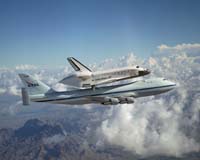
Washington DC (SPX) Jun 30, 2006 When space shuttle Discovery lifts off from Kennedy Space Center in Florida for its next flight, it will mark more than 25 years of service taking both astronauts and heavy payloads into space. The shuttle fleet, which will be retired in 2010, took off for the first time from the Kennedy Space Center on April 12, 1981. That first shuttle was Columbia, piloted by astronauts John Young and Robert Crippen. Columbia then disintegrated over Texas skies on Feb. 1, 2003. In 113 subsequent missions, shuttles Columbia, Challenger, Discovery, Atlantis and Endeavour have transported 607 men and women into orbit. The fleet has also worked like a space truck, carrying 1,500 tons of equipment - about the displacement of a World War II vintage submarine - in low Earth orbit. Some of its most notable cargo has included the Hubble Space Telescope and the major components of the International Space Station. The shuttle comprises more than 2-million parts, some of which have failed in spectacular and tragic ways. Shuttle Challenger exploded during liftoff on Jan. 28, 1986, when a rubber o-ring joint filler allowed hot gases from one of the orbiter's solid booster rockets to reach the main fuel tank. Columbia's demise occurred because a 1.5-pound piece of insulating polyurethane foam detached from the external tank. Traveling at more than 500 miles per hour, the fragment punched a large hole in the leading edge of the shuttle's left wing. The hole allowed super-heated gases to enter the wing's interior during atmospheric re-entry, causing a catastrophic failure of Columbia's structure. In all, 14 astronauts died in the Challenger and Columbia disasters. Though seven is the normal crew complement, each shuttle has room for three astronauts in its cockpit and five others in the passenger compartment. It also features an 18-meter (59-foot) long, 4.6-meter (15-foot) wide cargo bay to carry equipment. For each launch, the orbiter is placed in a vertical position for liftoff with an external fuel tank attached to its underbelly and flanked by two rocket boosters. The spacecraft uses three engines for takeoff. The main engine is fueled by a mixture of super-cooled liquid oxygen and hydrogen stored in the huge external tank. The two solid-fuel boosters provide additional thrust. The boosters, which furnish 83 percent of the power at launch, separate from the shuttle at an altitude of 45,700 meters (28 miles) about two minutes into liftoff. From there, they parachute back to Earth, where they are recovered and reused. About eight minutes after liftoff, the external fuel tank separates from the shuttle just before it reaches orbital speed and disintegrates in Earth's atmosphere. Once the solid boosters and main fuel tank separate, the shuttle relies only on its maneuvering jets, and on its retro-rockets to de-orbit. Then, during re-entry, the spacecraft must glide without power to landing, usually at a 20,000-foot runway at Kennedy Space Center, or sometimes at Edwards Air Force Base in California. If a landing at Edwards is required, NASA uses a specially modified Boeing 747 to transport the orbiter, piggy-back style, back to Kennedy. Related Links Shuttle at NASA  Weather Doubts Remain Over Discovery Launch
 Cape Canaveral, Florida (AFP) Jun 29, 2006
NASA said Thursday that bad weather remained a threat to the scheduled launch this Saturday of the Discovery shuttle. While the US space agency said it was technically ready for a blastoff, NASA meteorologist Kathy Winters told a press briefing there was a 60 percent chance that storms and rainfall around the Cape Canaveral launchpad would force a delay. |
|
|

| The content herein, unless otherwise known to be public domain, are Copyright 1995-2006 - SpaceDaily.AFP and UPI Wire Stories are copyright Agence France-Presse and United Press International. ESA PortalReports are copyright European Space Agency. All NASA sourced material is public domain. Additionalcopyrights may apply in whole or part to other bona fide parties. Advertising does not imply endorsement,agreement or approval of any opinions, statements or information provided by SpaceDaily on any Web page published or hosted by SpaceDaily. Privacy Statement |