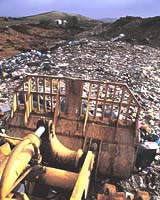
Tons of Canadian trash is shipped to the United States every day but it is not screened for security threats, according to a newly released government report.
A bipartisan Senate report issued Thursday calls for the suspension of trash shipments until U.S. Customs and Border Patrol can insure the containers do not pose a security threat, among other reforms in port security.
A January Homeland Security Department inspector general report found that Customs "does not have an effective method to screen and inspect the 350 truckloads of municipal solid waste that enter the U.S. daily through the Detroit and Port Huron ports of entry."
X-rays cannot penetrate the dense trash containers to reveal whether weapons or terrorists or other dangerous cargo is secreted inside, according to the Senate report "An Assessment of U.S. Efforts to Secure the Global Supply Chain."
Toronto, Canada, shipped approximately 100,000 containers of trash across U.S. borders into Michigan in 2004 alone, according to the DHS report. It has been exporting waste to Michigan since 1998. Mexico also ships solid waste to the United States.
The DHS inspector general report was issued in January but marked "for official use only." The Senate Homeland Security and Governmental Affairs subcommittee on investigations released it publicly Thursday after its second hearing on the precarious state of port security
Sen. Carl Levin, D-Mich., the ranking member of the subcommittee, is also calling for Congress to adopt provisions approved by the Senate to impose a fee on Canadian trash shipments to cover the cost of a more rigorous inspection regime.
Canadian trash is just one of the many problems the Senate committee investigation found with port security, according to the report.
The Congressional Budget Office put a price tag on the potential economic cost of not securing a port from terrorist attack or contamination. If the Ports of Los Angeles and Long Beach — the two largest — were attacked and shut down, it would cost the United States $150 million a day in lost gross domestic product, or $70 billion a year.
"The economic impact of closing the ports could be comparable to both the attacks of 9-11 and Hurricane Katrina," said Sen. Norm Coleman, R-Minn., chairman of the Senate subcommittee that conducted the three-year investigation underpinning the report. "We cannot afford the devastation these findings imply. We must secure our supply chain before we pay the high price of an attack."
Despite major legislation and an overhaul of port security undertaken in 2002, the U.S. supply chain of consumer goods "remains vulnerable to the proverbial Trojan Horse" to smuggle weapons of mass destruction or even terrorists into the country.
The United States stepped up its global port security efforts after the Sept. 11 attacks, putting in place a number of programs. Among them was the "container security initiative," in which the Customs agency identifies high-risk containers when they are still overseas and inspects them. Just 5 percent of all containers are physically inspected overseas, which represents just 17.5 percent of cargo designated high-risk by U.S. Customs.
U.S. Customs agents generally are not the ones inspecting the containers overseas. That is left to foreign shipping companies and government officials, who in some cases decline to inspect designated containers or do not have the manpower to carry out the inspections, the report said. Moreover, no minimum standards for inspections exist.
The United States also has a program of benefits to induce shipping companies to implement best security practices in their terminals and on their vessels. However, only 27 percent of those companies receiving benefits under the Customs/Trade Partnership Against Terrorism have actually been inspected to see if their security practices comply with program standards. Benefits are conferred upon agreement, rather than after the security practices are verified.
Two incidents in 2005 illustrate that participation in CSI and C/TPAT does not guarantee good security. Twice in 2005 containers full of illegal Chinese immigrants were shipped through a CSI and C/TPAT-protected port and shipping company in Hong Kong to the port of Los Angeles without being detected until they arrived and were unloaded.
The failure to detect the stowaways may be due to the unreliable data that Customs uses to determine which containers qualify as high risk. According to the Senate report, the targeting methodology has never been tested or validated.
Fewer than 40 percent of cargo containers entering the United States are screened for nuclear or radiological materials, largely because less than a third of the planned radiation monitors have been fielded by the Homeland Security Department.
The Senate report points to a few encouraging areas: the Homeland Security Department has created the Domestic Nuclear Detection Office to provide a single point for the distribution and management of radiation detectors which will ease some of the problems with fielding the devices.
There is also a pilot program ongoing at the Port of Hong Kong — the busiest port in the world — that uses a combination of imaging machines, radiation scanners and a system to identify containers to screen 100 percent of containers. The program's performance so far suggests it may be possible to significantly boost the number of containers screened as they come into the United States without slowing the supply chain.