|
 |
 |
 |
 |
 |
 |
 |
 |
 |

| . |  |
. |
Shuttle Discovery To Launch Into A Worrying Unknown
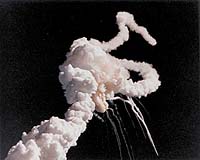
Cape Canaveral, Florida (AFP) Jun 29, 2006 Lingering doubts about falling debris will add to NASA's nerves over the launch of the Discovery, only the second mission since the Columbia disaster three years ago. Despite spending more than one billion dollars to fix the problem, a piece of foam insulation peeled off Discovery's external fuel tank during liftoff last July in the first mission since the Columbia tragedy, which was blamed on a chunk of foam that hit the shuttle during takeoff. The debris missed the shuttle, but NASA grounded its last functioning shuttle again to make more modifications. Discovery should launch Saturday if the weather is good. The space agency removed 17 kilograms (37 pounds) of foam insulation from the external fuel tank in the same spot where 400 grams (14 ounces) fell off two minutes after Discovery's takeoff last year. About 700 grams (1.5 pounds) peeled off Columbia's fuel tank and hit its left wing in February 2003. The foam pierced Columbia's protective skin and during its re-entry to the Earth's atmosphere let in superheated gases that tore apart the shuttle, killing all seven crew. The episode has haunted NASA ever since. "We think we have improved a lot this problem since the last launch of Discovery," said NASA's shuttle program manager Wayne Hale. "What we have done is to eliminate the danger of the loss of big pieces of foam," Hale said. He acknowledged that small pieces of foam could fall off, but that "the risk is now acceptable." The changes to the external fuel tank are the most significant since the first shuttle flight on April 12, 1981, Hale said. But the space agency's chief engineer and top safety officer dissented in a flight readiness review and asked for a six-month delay for the launch to make more safety changes. The two officials called for the redesign of foam insulation, known as ice/frost ramp, that prevents ice-buildup on the fuel tank, which is loaded with extremely cold liquid oxygen and hydrogen. "We both feel that there remain issues with the orbiter -- there is the potential that foam may come off at time of launch," Chief Safety and Mission Assurance Officer Bryan O'Connor and Chief Engineer Chris Scolese said in a joint statement last week. But the two said they believed the seven astronauts can safely return to Earth. The difficult decision taken by NASA administrator Michael Griffin to go ahead with the launch reflects the risky nature of human space exploration, experts say. "Griffin is faced with the reality that there is no space flight without risk," said Paul Czyysz, a retired aerospace engineering professor from St Louis University in Missouri. But NASA's chief "made the right decision" since the astronauts have the option of abandoning ship and taking refuge in the International Space Station (ISS) while waiting for a rescue mission if Discovery suffers any extensive damage. The rescue option convinced O'Connor and Scolese to not appeal Griffin's decision. The shuttle has flown 114 times since 1981 with two accidents that killed 14 astronauts: the Challenger explosion in January 1986 and the Columbia disaster in 2003. The shuttle has also faced several close calls since 1986. In October 2002, four explosive bolts that release the space shuttle upon launch failed to operate, but four backup bolts took over, enabling the shuttle, whose engines had already ignited, to blast off. In March 2002, it was Columbia that experienced problems minutes after launch, when a critical Freon cooling system lost pressure during the shuttle's ascent into orbit. NASA initially considered an emergency return to earth but eventually decided a backup line would adequately cool the spacecraft's electronics. When Discovery took off in late 1999, turbine blades within a metal alloy pump cut a groove into a seal, threatening the integrity of the engine.
Source: Agence France-Presse Related Links -  Weather Doubts Remain Over Discovery Launch
 Cape Canaveral, Florida (AFP) Jun 29, 2006
NASA said Thursday that bad weather remained a threat to the scheduled launch this Saturday of the Discovery shuttle. While the US space agency said it was technically ready for a blastoff, NASA meteorologist Kathy Winters told a press briefing there was a 60 percent chance that storms and rainfall around the Cape Canaveral launchpad would force a delay. |
|
|

| The content herein, unless otherwise known to be public domain, are Copyright 1995-2006 - SpaceDaily.AFP and UPI Wire Stories are copyright Agence France-Presse and United Press International. ESA PortalReports are copyright European Space Agency. All NASA sourced material is public domain. Additionalcopyrights may apply in whole or part to other bona fide parties. Advertising does not imply endorsement,agreement or approval of any opinions, statements or information provided by SpaceDaily on any Web page published or hosted by SpaceDaily. Privacy Statement |