|
 |
 |
 |
 |
 |
 |
 |
 |
 |

| . |  |
. |
Two Roads From Damascus
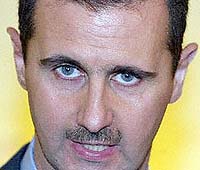
UPI International Editor Washington (UPI) Aug 16, 2006 Syrian President Bashar Assad is at a political crossroad. For the moment he is basking in the glory of Hezbollah's victory in a month-long war the Shiite militia fought with Israel. Although Syria did not directly partake in active combat operations, Damascus has been time and again accused by the United States, and by Israel, of supporting Hezbollah. Damascus has allowed Iran to funnel weapons destined for the Shiite militia to transit through its territory, such as the 4,000 rockers Hezbollah fired at Israel. And of course the Syrians have been sending Hezbollah some of their own hardware. Yet, all throughout the 33 days of heavy bombardment, Syria, much as the rest of the Arab world, had remained silent. Now that Hezbollah appears to have emerged victorious from the month-long war with Israel -- at least in the minds of the Arab world -- Syria (and Iran) is jumping on Hezbollah's coattails. Assad wasted no time going public in praising Hezbollah, claiming "We are the victors." If there was any ambiguity in the past regarding Syria's relationship with Hezbollah, in a speech to the Syrian newspaper association Tuesday President Bashar clearly set the record straight: Syria shares the same goals as Hezbollah. The Syrian president will undoubtedly be harshly criticized by Washington for his open support of the Shiite militia. And not entirely without justification. But Assad's conduct is understandable. For years he has been shunned, ignored and marginalized by the Bush administration despite the fact that many Middle East analysts will tell you that a comprehensive "sustainable peace" in the Middle East, the kind President George W. Bush wants, would be unattainable without Syrian participation. Whether the administration likes it or not, Syria holds an important piece of the Middle East puzzle. Cease-fires, such as the one decreed by United Nations Security Council Resolution 1701 will solve the problem, but only in the short-term. Unless intensive diplomatic efforts are to follow, chances are that within months the United Nations will be voting on yet another resolution calling for a another cease-fire. The long-term cure to the conflict lies in bringing all parties concerned to the negotiating table. The Middle East crisis will remain unsolved unless a peace summit involving all stakeholders in the conflict is held. U.S. foreign policy cannot be conducted by the secretary of state talking only to friendly parties. As the sole remaining superpower with direct interests in the Middle East, and as the one country that can influence Israel, it befalls on the United States to organize such a peace summit. Anything short of that will result in a recurrence of hostilities sometime down the road. And much as the secretary of state said she didn't want to keep returning to the Middle East, Condoleezza Rice will find herself shuttling back and forth trying to negotiate more cease-fires. Given Syria's unequivocal support for Hezbollah, resumption of hostilities may well spread to Syria next time if Israel decides to up the ante. If that were to occur Iran would most likely be dragged into the conflict, given its mutual defense pact with Syria. As things go Bashar is left standing at a major crossroad. One road from Damascus will take him deeper into an alliance with Tehran, to continued support of terrorism and to adopting a more militant policy, if that is possible. The other road from Damascus can lead to closer cooperation with Washington and closer ties with the West. That can only happen if the Bush administration opens up to Syria. U.S. policy towards Syria so far has been mostly stick and no carrot. The carrots for Syria can come in many forms. It can be financial, it can an offer to join in peace talks. Right now Syria is tempted by Hezbollah's victory to bank on the Shiite militia winnings. But that would be shortsighted on the part of the Syrian president. If Assad were to consult recent history books he will quickly come to realize that the honeymoon between Syria and its allies in Lebanon was always short lived. When the Christian militias appeared as though they were about to be defeated by the Palestine Liberation Organization during the 1975-76 civil war they invited Syria to send troops to bail them out. Syria did just that. They joined the Christian militias in battling the Palestinians. But then they refused to leave, quickly putting an end to that relationship. The Syrians next allied themselves with the Palestinians, but it wasn't long before the Palestinians clashed with the Syrians. Why should the relationship with Hezbollah be any different in the long run? Of course the same question applies to Hezbollah. In the wake of their "victory" Hezbollah should now act in Lebanon's interest. Hassan Nasrallah ought to place his country's interest above that of Syria's or Iran's.
Source: United Press International Related Links Your World At War  Germany May Send Mideast Troops
 Berlin (UPI) Aug 16, 2006
Germany's government leaders Monday signaled they may be ready to dispatch German soldiers to aid the United Nations peacekeeping force along Lebanon's border with Israel. But critics counter the army, already overstretched by campaigns abroad, should not be in a position where it may have to engage Israeli forces. |
|
|

| The content herein, unless otherwise known to be public domain, are Copyright 1995-2006 - SpaceDaily.AFP and UPI Wire Stories are copyright Agence France-Presse and United Press International. ESA PortalReports are copyright European Space Agency. All NASA sourced material is public domain. Additionalcopyrights may apply in whole or part to other bona fide parties. Advertising does not imply endorsement,agreement or approval of any opinions, statements or information provided by SpaceDaily on any Web page published or hosted by SpaceDaily. Privacy Statement |