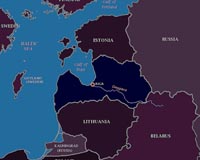
The United States and the three Baltic states neighboring Russia are trying to strike defense cooperation agreements before President Barack Obama leaves office, officials have told AFP.
The three nations — Estonia, Latvia and Lithuania — are former Soviet states now on NATO's front line with a more assertive Russia and have watched President-elect Donald Trump's pro-Moscow rhetoric with mounting unease.
Each is trying to reach a "Defense Cooperation Agreement" with Washington that will include provisions on the status of US forces deployed there.
The deals will "complement the existing bilateral and NATO agreements we have in place with each Baltic state to support our rotational military presence in each country," a senior administration official told AFP.
Lithuanian Foreign Minister Linas Linkevicius told AFP that although there was no concern about Trump's stance — despite his questioning of NATOs relevance — "procedures may take longer when administrations change."
"It is in our interests that it happens soon," he said. "We hope that it will happen at the beginning of next year."
A similar recently signed agreement between the United States and Finland — which also borders Russia, but is not a NATO member — deepened cooperation on cyber security, sharing security information and expanding joint training and military exercises.
The Russian military launched an incursion into Finnish airspace on the eve of the pact's signing in Helsinki.
Researchers for the London-based European Leadership Network have documented six similar violations of Estonian airspace by Russian aircraft this year alone.
Officials on both sides of the Atlantic admit the complex deals may not be concluded before Trump takes office on January 20.
But having them in place quickly would provide extra reassurance to the three US allies, who have long expressed concerns about Russia's covert intelligence and overt military actions.
"The desire to have these agreements illustrates our commitment to a robust, bilateral military relationship with these three NATO allies, and we hope to finalize them soon," Pentagon spokeswoman Commander Sarah Higgins said.
Defense Secretary Ashton Carter in March unveiled the Pentagon's proposed budget for next year, which includes $3.4 billion — quadruple last year's amount — for operations in Europe.
The cash will fund the so-called European Reassurance Initiative, which aims to deter Russia from carrying out additional land grabs following its 2014 annexation of the Crimean Peninsula from Ukraine.
At a summit in Warsaw earlier this year, NATO agreed to deploy multi-national battalions to Estonia, Latvia and Lithuania.
"The Baltic States are all eager to find ways to continue to work with the US, even as the multi-national battalions begin to take shape. These additional (pacts) are a step in that direction," said Magnus Nordenman, an expert in trans-Atlantic security at the Atlantic Council, a Washington think-tank.
"I think they could conclude this before the end of the administration. It's a quick march, but similar agreements have recently been concluded with both Sweden and Finland on relatively short timelines."
burs-arb/grf