
FLOATING STEEL
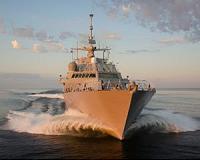
U.S. Navy announces Littoral Combat Ship program overhaul
by Geoff Ziezulewicz
San Diego (UPI) Sep 12, 2016


Argon ST gets U.S. Navy torpedo decoy contract modification
Washington (UPI) Sep 12, 2016 - Argon ST, a Boeing company, has received a $10.2 million U.S. Navy contract modification for procurement of torpedo defense systems.

The modification calls for the procurement of nine AN/SLQ-25A/C countermeasure decoy systems and spares that provide improved naval defense for current threat torpedoes in support of the Undersea Defensive Warfare program.

The decoy, also known as "Nixie," is a modular, digitally controlled, electro-acoustic soft-kill countermeasure system. It uses an underwater towed body acoustic projector, deployed astern by a fiber optic tow cable. The system defends ships against wake homing, acoustic homing and wire-guided torpedoes.

Work will be performed in Pennsylvania, with an estimated completion date of July 2018.

Naval Sea Systems Command is the contracting activity.

The U.S. Navy last week announced an overhaul of its troubled Littoral Combat Ship program that will include turning the first four ships into test vessels.

Thursday's announcement came days after the sea service announced an engineering stand-down for LCS crews following an Aug. 29 engineering casualty on the USS Coronado.

That followed a main propulsion diesel engine casualty on the first LCS, Freedom, on July 11.

Under the plan announced Thursday, the Freedom, Independence, Fort Worth and Coronado will become single-crewed testing ships that could be deployed as fleet assets on a limited basis, the Navy said.

Their primary missions will be to satisfy near- and long-term testing requirements for the entire LCS class without affecting ongoing deployment rotations.

Under the plan, the sea service will also abandon its three-crew LCS construct and move toward the so-called "Blue/Gold" two-crew model used in crewing ballistic missile boats, patrol craft and minesweepers.

Twenty-four of the 28 vessels' crews will also merge, train and rotate with mission module detachment crews, organizing as four-ship divisions of a single warfare area, either surface, mine or anti-submarine.

Those 24 ships will form into six divisions, three on each coast, and each having a single warfare focus.

Despite the new organization, the LCS class will retain its modularity between mission modules.

The changes came about after a comprehensive review of LCS crewing, training, maintenance and operations that began in March.

"The findings and recommendations of the LCS review will allow the LCS program to become more survivable, lethal and adaptable as the LCS become regular workhorses of the fleet," the Navy said.

To facilitate these changes, the Navy will eventually homeport Independence-variant ships in San Diego and Freedom-class ships in Florida.

Plagued by cost overruns, design and survivability issues, the planned LCS fleet has been winnowed from an original projected force of 52 ships.

To fill that gap, the Pentagon has announced a multi-mission frigate.

A June Government Accountability Office report recommended that Congress not fund any LCS in Fiscal 2017 while making sure the sea service had an acqusition strategy for the frigate program.

.


Related Links
Naval Warfare in the 21st Century


Comment on this article via your Facebook, Yahoo, AOL, Hotmail login.

Share this article via these popular social media networks
del.icio.usdel.icio.us DiggDigg RedditReddit GoogleGoogle

Previous Report
FLOATING STEEL
Russian Navy getting new cruise missile corvettes
Kubinka, Russia (UPI) Sep 9, 2016
The Russian Navy is to receive additional missile corvettes from the Zelenodolsk Shipbuiding Plant under an agreement signed by the Russian Defense Ministry. The ships are of the Bayan-M class, a river/sea vessel designed by the Zelenodolsk Design Bureau. According to Tass, the Russian new agency, the vessels each displace about 1,047 tons, are 203.4 feet long and have a speed of ... read more


FLOATING STEEL
Saudi shoots down missile from Yemen: coalition

US has North Korea missile threat covered: Pentagon

Poland requests multi-billion-euro Patriot missile system

Lockheed Martin gets $204 million Aegis contract modification

FLOATING STEEL
Raytheon awarded $9.8 million AMRAAM contract modification

Raytheon awarded $13.8 million SM-2, SM-6 contract modification

Raytheon receives U.S. Air Force AMRAAM contract

MEADS International, Poland's PGZ partner for missile deal

FLOATING STEEL
DARPA announces Aerial Dragnet drone monitoring program

Tactical Robotics expands Cormorant drone testing

Where eagles dare! Dutch police unveil new arm against drones

Northrop Grumman gets $108 million contract for Fire Scout drones

FLOATING STEEL
Newest DARPA Challenge: 'Shift Paradigm' With Robot Radio

SES Government solutions to provide the US with a high performance network

The sky's no limit for young space professionals

Datron gets $495 million Afghan radio contract

FLOATING STEEL
Protective additive for Army combat uniforms being developed

Russian military hardware put to the test in 'battles' in the Moscow region

BAE to upgrade and repair Brazilian M109A5 Howitzers

First GMLRS warhead rolls off production line

FLOATING STEEL
Hughes, Airbus DS to expand partnership

Booz Allen Hamilton wins USMC support contract

Raytheon sued by former employee over Afghanistan fraud allegations

S. Korea hosts arms show after N. Korea missile tests

FLOATING STEEL
US 'surprised' at Chinese influence-buying in Australia

Philippines says US ties strong despite Duterte tirades

Hollande says France 'cannot be alone' on EU defence

Sweden re-militarises Baltic island of Gotland; NATO, Russia hold 'risk reduction' talks

FLOATING STEEL
Researchers synthesize atomically precise diamond-shaped nanoclusters of silver

Rice University-led team morphs nanotubes into tougher carbon for spacecraft, satellites

Location matters in the self-assembly of nanoclusters

'Helix-to-Tube,' a simple strategy to synthesize covalent organic nanotubes