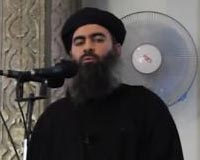
An Islamic State group video purporting to show supremo Abu Bakr al-Baghdadi for the first time in five years may herald a new chapter for the jihadists, according to experts.
The release of the video Monday addresses key issues for IS, analysts told AFP, as the jihadists look ahead following the collapse of their so-called caliphate.
Why now?
Baghdadi has been laying low for years — earning him the nickname "The Ghost" — and his whereabouts have never been confirmed.
His last voice recording to his supporters was released in August, eight months after Iraq announced it had defeated IS and as the US-backed Syrian Democratic Forces closed in on the jihadists in neighbouring Syria.
Monday's video, released one month after the IS proto-state was declared defeated, "comes at a crucially important time," said Charles Lister, senior fellow at the Middle East Institute in the United States.
IS is emerging from a "territorial defeat in its Syria-Iraq heartlands, and (is) attempting to re-assert itself as a global movement capable of conducting major attacks around the world," he said.
Pieter Nanninga, from the University of Groningen in the Netherlands, said the difficulties facing IS explains the timing.
Baghdadi wants "to boost morale of his supporters by showing that IS is still a powerful group."
A new era?
In the video released by IS's Al-Furqan media arm, the man said to be Baghdadi acknowledged "the battle for Baghouz is over".
The fight for IS's final redoubt in the Syrian village of Baghouz ended in March.
In a segment in which the man is not on camera, his voice describes the April 21 attacks in Sri Lanka, which killed 253 people and wounded nearly 500, as "vengeance for their brothers in Baghouz."
He insisted IS's operations against the West were part of a "long battle," and that IS would continue to "take revenge" for members who had been killed.
Amarnath Amarasingam, from the Institute for Strategic Dialogue, said Baghdadi's speech served to "contextualise… or make sense of the defeat," of the IS proto-state.
"That was largely the point of the speech — to show that they are going through a transition period, (and that) the defeat is real, that there is focus on places outside of Syria and Iraq in the next few months," he said.
Charlie Winter, a researcher at King's College London, said that Baghdadi wants to demonstrate that the influence of the group's extremist ideology remains dangerously intact even after the collapse of its so-called caliphate.
"Baghdadi wants to show that if the territory has been lost, it doesn't matter," he said.
"The ideology has been globalised in a manner that was never possible before."
At the peak of its military success, IS claimed a string of attacks around the world, from the November 2015 coordinated attacks in Paris to the deadly rampage of a gunman at an Istanbul nightclub minutes into 2017.
The latest video demonstrates that the risk of attacks anywhere in the world remains just as high, even after the territorial defeat of the group.
"Videos like this one won't only serve to remind IS and its support base that the 'Islamic State' project remains alive, but that it's now more important than ever to demonstrate that with violent action," said Lister.
Baghdadi still in control?
Reclusive even when IS was at the peak of its power, the 47-year-old Iraqi, who suffers from diabetes, was rumoured to have been wounded or killed several times.
Monday's video, according to Winter, is "about proving that Baghdadi is alive."
Experts also said the video seeks to demonstrate he is still in control.
"This is illustrated by the final minutes of the video, which feature al-Baghdadi and some men (with blurred faces) sitting next to him" Nanninga said.
"These men hand him some (hard-copy) reports about some of IS's 'provinces' (wilayat), which suggests that these men are updating their leader about the current state of affairs in these regions," he added.
Aymenn Jawad Tamimi, an academic and expert on jihadists, said the video is designed to address internal criticisms after Baghdadi remained distant and absent when his "caliphate" was crumbling.
"The video, at least, attempts to show that he does have control over the organisation and that he is aware of everything that goes on."
Iraqi premier warns IS weakened, not defeated
Berlin (AFP) April 30, 2019 –
Iraqi Premier Adel Abdel Mahdi said Tuesday the Islamic State group had been militarily weakened but not defeated, as the recent deadly Sri Lanka bombings had shown.
An IS propaganda video released Monday with a purported appearance by the jihadist group's elusive supremo Abu Bakr al-Baghdadi showed him in what appeared to be a "very simple and isolated" location, Mahdi said on a visit to Berlin.
"One and a half years ago Daesh (IS) controlled large areas in Iraq and Syria, and now Baghdadi appears in an isolated, unknown location," he said about the world's most wanted man.
"He did not seem to be among his followers like the first time in Mosul", he said, referring to a 2014 video in which Baghdadi announced the birth of the Islamic State group's much-feared "caliphate" across swathes of Iraq and Syria.
After losing its last remaining territory in the Syrian town of Baghouz in March, "IS has not completely disappeared but suffered painful blows", the Iraqi premier said at a joint press conference with German Chancellor Angela Merkel.
Mahdi cautioned that IS "will try to rebuild trust among its fighters, will try to launch further operations" like the Sri Lanka April 21 attacks which killed more than 250 people.
"Daesh was broken, but if little cells are left, it could reactivate and resurface and commit painful attacks," he added, according to interpreted remarks.
Similarly, Merkel said the video was a sign that "we will remain occupied for some time to come with the question of how IS can finally be defeated."
The speaker in the 18-minute video, a man with a long grey beard that appeared dyed with henna, sat in a room with a Kalashnikov assault rifle leaning against the wall behind him.
He was identified as Baghdadi by both SITE, which tracks IS activity, and Hisham al-Hashemi, an Iraqi expert for the group.
Meanwhile, a French IT expert said Baghdadi took a risk in broadcasting the video, but added that IS probably has specialists able to cover any tracks.
"Daesh has a specialist cyber brigade, they're being tracked by security services. They know how to use multiple filters before distributing something," said Gregoire Pouget of cybersecurity NGO Nothing2Hide.
"They are not idiots, these masking tools are easy to use."