|
 |
 |
 |
 |
 |
 |
 |
 |
 |

| . |  |
. |
A-bomb Debate Still Rages Around Historic Test Nuclear Site, 60 Years On
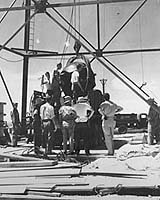
Hot winds breathe fire over this desolate stretch of desert where a world-shattering explosion turned night into day and transformed the sands to radioactive glass 60 years ago. Two generations later, a group of science-savvy teenagers scours the scrub for remnants of the green-glazed earth created by the first ever atomic test, a blast that punched a shallow 800-meter (yard) crater in the soil of New Mexico. Fifty gifted science students pack Trinity Site, the original "ground zero," a plot on a US Army weapons testing range hemmed in by an oval chain-link fence hung with photographs of the historic July 16, 1945 test. They mill around the modest black volcanic-stone obelisk that marks the spot where a 19 kiloton plutonium bomb was detonated atop a steel tower, shattering windows nearly 200 kilometers (120 miles) away, illuminating the sky like a midnight sun and producing the first nuclear mushroom cloud. "This is the birthplace of the A-bomb," said South Korean Lee Ga-Il, 17, one of the elite Summer Science Program students, as he surveyed the lonely but historic corner of the huge and White Sands Missile Range. "And this is a reminder of its unbelievable power," he said, holding up a piece of green-baked earth called Trinitite, formed when the explosion melted the sand here one dawn six decades ago. "I guess a weapon like this is immoral, but in this case it ended the war and saved Koreans and I'm glad about that," said Lee, one of a class of top scientists and high flyers of tomorrow, according to their tutor. The students' fluorescent shirts and reflective sunglasses explode from the silent beauty of the Tularosa Basin, lying between rugged red-stone hills covered in low green bushes. They spar over whether it was right to create and drop the type of bomb tested here on Nagasaki, on August 9, 1945, three days after a uranium atomic bomb flattened Hiroshima. "The nuke was the end of all wars," said 17-year-old high school student Michael DeLiso from San Francisco. "It sucked for the Japanese, but it saved so many lives by ending the war," said the aspiring chemical engineer. But while the weapon - credited with ensuring that the Cold War never got hot - may have changed the course of mankind, it has left surprisingly few traces on this swathe of desert now ruled by rattlesnakes and horned toads. The half-kilometer (quarter-mile) circle scorched black by the blast's fireball has long since grown back, and the site, open just twice a year to tourists, remains almost totally undeveloped. Set on an active military base used to test missiles and anti-terrorism measures, the 20,600-hectare (51,500-acre) area - dubbed Trinity by the bomb's designer Robert Oppenheimer after a poem by John Donne - was declared a national historic landmark in 1975. But two decades earlier, the military bulldozed the crater and scraped up most of the low-level radioactive Trinitite that coated it to conceal traces of the test, some details of which still remain classified, from the Soviets. The command bunker 10 kilometers (six miles) from ground zero, from where Oppenheimer triggered the detonation of the bomb, was razed in the 1960s, according to base spokesman Jim Eckles. "The military is not sentimental about such things - if it needs to go, it goes," he told AFP as air force F-15 jets roared above Trinity Site, which soldiers began building for the nuclear test in late 1944. Besides the obelisk standing beside one of the four feet of the 100-foot (30.5 m) steel tower that was vaporised by the bomb, the only solid reminders of that fateful day are a giant steel casing that scientists ultimately did not use for the test and the farmhouse where the device was assembled. After it was driven 300 kilometers (200 miles) in an unmarked car from the Los Alamos in northern New Mexico, scientists put the weapon together in the main bedroom of a farm seized by the military in 1942. The simple iron-roofed homestead miraculously survived the blast three kilometers (two miles) away with only its windows and doors being blown out. But the shockwaves buckled the roof of the adjacent barn, wrecking it and heralding the awesome power of the nuclear bomb. "Even when you're standing here at the centre of the blast site, it's impossible to imagine the power the bomb harnessed and the devastation it caused later," said 16-year-old Sean Malone as he read the simple plaque on commemorating the first atomic explosion. "But let's hope world leaders never forget that terrible power and don't use it again," added Lee, dropping his Trinitite, which visitors are barred by law from removing from the site. All rights reserved. � 2005 Agence France-Presse. Sections of the information displayed on this page (dispatches, photographs, logos) are protected by intellectual property rights owned by Agence France-Presse. As a consequence, you may not copy, reproduce, modify, transmit, publish, display or in any way commercially exploit any of the content of this section without the prior written consent of Agence France-Presse. Related Links SpaceWar Search SpaceWar Subscribe To SpaceWar Express  Hiroshima Devastation Heralded Three Weeks Earlier In US Desert
 Trinity Site, New Mexico (AFP) Jul 10, 2005
"Now, I am become Death, the destroyer of worlds," said the father of the atom bomb as he witnessed the world's first nuclear explosion three weeks before Hiroshima was flattened. |
|
|
| The content herein, unless otherwise known to be public domain, are Copyright 1995-2016 - Space Media Network. All websites are published in Australia and are solely subject to Australian law and governed by Fair Use principals for news reporting and research purposes. AFP, UPI and IANS news wire stories are copyright Agence France-Presse, United Press International and Indo-Asia News Service. ESA news reports are copyright European Space Agency. All NASA sourced material is public domain. Additional copyrights may apply in whole or part to other bona fide parties. Advertising does not imply endorsement, agreement or approval of any opinions, statements or information provided by Space Media Network on any Web page published or hosted by Space Media Network. Privacy Statement All images and articles appearing on Space Media Network have been edited or digitally altered in some way. Any requests to remove copyright material will be acted upon in a timely and appropriate manner. Any attempt to extort money from Space Media Network will be ignored and reported to Australian Law Enforcement Agencies as a potential case of financial fraud involving the use of a telephonic carriage device or postal service. |