|
 |
 |
 |
 |
 |
 |
 |
 |
 |

| . |  |
. |
Scientists Create Artificial Cricket Hairs
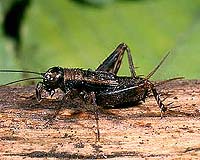
Scientists have re-created one of nature's most sensitive sound detectors � the tiny hairs found on body parts of crickets, which allow them to hear predators and make an escape before the predators get close enough to catch them. Published today (20th June 2005) in the Journal of Micromechanics and Microengineering, an Institute of Physics journal, this research will help scientists understand the complex physics that crickets use to perceive their surroundings and could lead to a new generation of cochlear implants, for people with severe hearing problems, in the far future. Crickets spend most of their lives on the ground, making them vulnerable to wandering and flying predators. Species such as the wood cricket Nemobius sylvestris have developed a pair of hairy appendages at the abdominal end of their body called cerci, which are incredibly good at detecting small fluctuations in air currents � the kind that might be caused by the beating of a wasp's wings or the jump of an attacking spider. Each of the hairs on a cricket's cerci is lodged in a socket, which allows them to move in a preferred direction. Airflow causes a drag force on the hair, rotating its base and firing specific neural cells, which allows the cricket to pinpoint low-frequency sound from any given direction by using the combined neural information from all the sensory hairs on the cerci. Physicists at the University of Twente in the Netherlands have now succeeded in building artificial sensory hair systems, which they hope will enable them to unravel the underlying process and develop sensor arrays with a variety of important applications. The Twente team, led by Gijs Krijnen and Remco Wiegerink, have shown that they can make mechanical hair sensors and are able to fabricate them in large arrays of long hairs for the first time. They have also obtained experimental results, which reveal how good these artificial cricket hairs are at sensing low-frequency sound. The work was carried out by the MESA+ research institute at the University of Twente, as part of the European Union project CICADA (Cricket Inspired perCeption and Autonomous Decision Automata), which aims to develop a life-like perception system by studying biological concepts and trying to mimic these using the latest fabrication technologies. Cricket hairs are incredibly energy efficient sensors, and crickets are thought to perceive flows with energies as small as or even below thermal noise levels (the background "noise" caused by the Brownian motion of particles). By evolution, the cricket has fine-tuned the hairs in order to gain as much energy from the airflow as possible. The cricket hair canopy also shows outstanding directivity, since acoustic flow, in contrast to acoustic pressure, not only has a magnitude but also a direction. Sensitivity and directivity help crickets to perceive and escape from attacking predators, such as the wolf spider. Because of their optimised performance, cricket acoustic sensory hairs are very interesting structures to bio-mimic in man-made acoustic sensors. The Twente team built a mechanical array with up to a few hundred artificial hairs using technologies often referred to as MEMS technology. The sensors are made by depositing and structuring various thin layers of electrically insulating and conducting materials, creating structured electrodes on a suspended membrane. The structured electrodes form two capacitors with the underlying substrate. Long hairs, made of a photo-structurable polymer (SU-8), are put on top of the membranes. Airflow causes drag-forces on the hairs and so the membranes rotate, leading to a change in capacitance value of the capacitors. Marcel Dijkstra, a member of the Twente team, said: "These sensors are the first step towards a variety of exciting applications as well as further scientific exploration. Their small size and low energy consumption make them excellent for application in large sensor networks, whereas there mechanical nature allows for mechanical filtering and parametric amplification. We could use them to visualise airflow on surfaces, such as an aircraft fuselage." In a more advanced stage, the structures may form a stepping-stone towards the fabrication of hairs operating in fluids, such as found in the inner ears of mammals. The team are now producing newer generations of hairs, which they expect to deliver sensitivities at least one order better than what has been presented in the paper. Reference: Dijkstra M, van Baar J J, Wiegerink R J, Lammerink T S J, de Boer J H and Krijnen G J M 2005 Artificial sensory hairs based on the flow sensitive receptor hairs of crickets J. Micromech. Microeng. 15 S132--S138 Related Links Institute of Physics SpaceWar Search SpaceWar Subscribe To SpaceWar Express  IBM And EPFL Join Forces To Uncover The Secrets Of Cognitive Intelligence
 Lausanne, Switzerland (SPX) Jun 08, 2005
IBM and The Ecole Polytechnique Federale de Lausanne (EPFL) are today announcing a major joint research initiative - nicknamed the Blue Brain Project - to take brain research to a new level. |
|
|
| The content herein, unless otherwise known to be public domain, are Copyright 1995-2016 - Space Media Network. All websites are published in Australia and are solely subject to Australian law and governed by Fair Use principals for news reporting and research purposes. AFP, UPI and IANS news wire stories are copyright Agence France-Presse, United Press International and Indo-Asia News Service. ESA news reports are copyright European Space Agency. All NASA sourced material is public domain. Additional copyrights may apply in whole or part to other bona fide parties. Advertising does not imply endorsement, agreement or approval of any opinions, statements or information provided by Space Media Network on any Web page published or hosted by Space Media Network. Privacy Statement All images and articles appearing on Space Media Network have been edited or digitally altered in some way. Any requests to remove copyright material will be acted upon in a timely and appropriate manner. Any attempt to extort money from Space Media Network will be ignored and reported to Australian Law Enforcement Agencies as a potential case of financial fraud involving the use of a telephonic carriage device or postal service. |