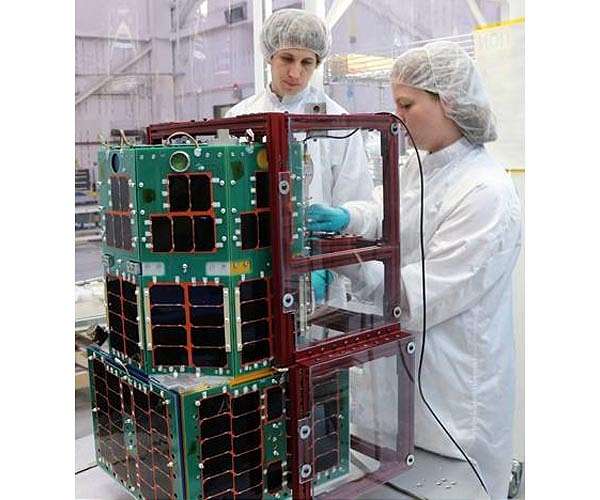
The Air Force Research Laboratory's University Nanosatellite Program (UNP) has selected 10 universities to participate in the upcoming 2-year partnership to design, fabricate and test small satellites.
At the recent Flight Selection Review for the program's tenth cycle, 3 of 10 universities were chosen to remain in the program and continue development of their CubeSats. These universities will be provided flights to space upon completion of their satellites.
The objective of the University Nanosatellite Program (UNP) is to promote and sustain university research and education focused on small satellites and related technologies.
"What a great day it is," said Col. Eric Felt, director of the AFRL Space Vehicles Directorate. "Today, I am excited to announce the selections for our UNP program and begin our 2-year partnerships, and start setting our battle rhythm."
More than 20 universities submitted entries on enabling technologies in the small satellite form factor. These included novel experiments in communications and networking, formation flying, space domain awareness, among others.
"Throughout the 2-year program, student participants will design, fabricate, and test a small satellite," Felt said. "We also hope to foster research in enabling technologies, and the design of experiments that can be performed by small satellites in orbit. We are helping to develop the pipeline for the burgeoning space industry."
In addition to 10 education-focused partnerships, the Georgia Institute of Technology has been selected for a unique experience- a mixed technology and education-focused partnership working directly with an AFRL program.
This project would support the directorate's Space Solar Power Incremental Demonstrations and Research project (SSPIDR). The congressionally-funded project will mature and demonstrate he necessary technologies to develop a space-based solar power transmission capability.
"This potential prototype system will use high-efficiency solar cells to collect the sun's energy and convert it to radio frequency (RF) for transmission to a receiving station on earth," said Rachel Delaney, communications officer for the SSPIDR project. "After collection on the ground, that RF can then be converted back into power and provided to expeditionary forces operating in unimproved areas (e.g., forward operating bases)."
The Georgia Institute of Technology will design, build, test, deliver, and operate a 6U CubeSat to support the SSPIDR program. The CubeSat will serve as a power-beaming receiver for Arachne – SSPIDR's keystone mission, ultimately, demonstrating novel free-space RF power beaming capabilities while in orbit.
The universities selected were:
+ The University of Minnesota
+ Texas A and M University
+ Michigan Technological University
The UNP has also notified 10 universities selected to participate in the upcoming 11th cycle. The universities are listed below, in no specific order:
+ Saint Louis University
+ University of Alaska Fairbanks
+ University of Colorado Boulder
+ University at Buffalo, The State University of New York
+ Western Michigan University
+ University of Maryland
+ Auburn University
+ University of Texas at Austin
+ Rutgers University
+ Purdue University