. Military Space News .
A Celestial Snow Globe Of Stars

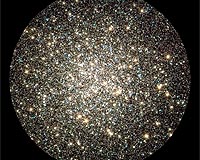
This image is a composite of archival Hubble data taken with the Wide Field Planetary Camera 2 and the Advanced Camera for Surveys. Observations from four separate science proposals taken in November 1999, April 2000, August 2005, and April 2006 were used. The image includes broadband filters that isolate light from the blue, visible, and infrared portions of the spectrum. Credit: NASA, ESA, and the Hubble Heritage Team (STScI/AURA) Acknowledgment: C. Bailyn (Yale University), W. Lewin (Massachusetts Institute of Technology), A. Sarajedini (University of Florida), and W. van Altena (Yale University)
by Staff Writers
Baltimore MD (SPX) Dec 05, 2008
Like a whirl of shiny flakes sparkling in a snow globe, Hubble catches an instantaneous glimpse of many hundreds of thousands of stars moving about in the globular cluster M13, one of the brightest and best-known globular clusters in the northern sky. This glittering metropolis of stars is easily found in the winter sky in the constellation Hercules and can even be glimpsed with the unaided eye under dark skies.

M13 is home to over 100,000 stars and located at a distance of 25,000 light-years. These stars are packed so closely together in a ball, approximately 150 light-years across, that they will spend their entire lives whirling around in the cluster.

Near the core of this cluster, the density of stars is about a hundred times greater than the density in the neighborhood of our sun. These stars are so crowded that they can, at times, slam into each other and even form a new star, called a "blue straggler."

The brightest reddish stars in the cluster are ancient red giants. These aging stars have expanded to many times their original diameters and cooled. The blue-white stars are the hottest in the cluster.

Globular clusters can be found spread largely in a vast halo around our galaxy. M13 is one of nearly 150 known globular clusters surrounding our Milky Way galaxy.

Globular clusters have some of the oldest stars in the universe. They likely formed before the disk of our Milky Way, so they are older than nearly all other stars in our galaxy. Studying globular clusters therefore tells us about the history of our galaxy.
Share This Article With Planet Earth
del.icio.usdel.icio.us DiggDigg RedditReddit
YahooMyWebYahooMyWeb GoogleGoogle FacebookFacebook


Related Links
Hubblesite
Stellar Chemistry, The Universe And All Within It


Memory Foam Mattress Review
Newsletters :: SpaceDaily :: SpaceWar :: TerraDaily :: Energy Daily
XML Feeds :: Space News :: Earth News :: War News :: Solar Energy News


Brown Dwarfs Do Form Like Stars
Cambridge MA (SPX) Dec 04, 2008
Astronomers have uncovered strong evidence that brown dwarfs form like stars. Using the Smithsonian's Submillimeter Array (SMA), they detected molecules of carbon monoxide shooting outward from the object known as ISO-Oph 102. Such molecular outflows typically are seen coming from young stars or protostars.


  • NATO, Russia agree return to top level talks
  • Russia, Venezuela wrap up joint naval exercise
  • NATO agrees thaw with Russia, boosts ties with Georgia, Ukraine
  • America And Russia Tool Up For 21st Century Warfare

  • SKorea braces for provocation by NKorea: defence ministry
  • US panel presents sobering report on WMD threat
  • Boeing To Study ICBM Communications Security Enhancements
  • India, Pakistan nuclear posture unchanged: US military

  • Brazil approves sale of 100 missiles to Pakistan
  • Russia to deploy new missile from 2009: military
  • NLOS-LS Team Completes First Test Of Missile Fired From Container Launch Unit
  • Royal Netherlands Navy Launches Harpoons From New Frigate

  • Russia building missiles to counter US space defences: military
  • SKorea receives first Patriot missiles: air force
  • Czech Political Machinations Could Sink ABM Deal Yet
  • Boeing-backed study lists GMD work benefits for Alaska

  • NASA studies pilot cognition
  • China postpones talks with Airbus: spokesman
  • Two China airlines to get govt aid: state media
  • China's air show saw four bln dollars in deals: report

  • Army To Equip National Guard Unit With FCS Aerial Robots
  • Thales WATCHKEEPER Successfully Passes First System Flight Trial
  • French Ministry Of Interior Awards Light UAS Study Contract To UVS
  • Russian Military Considers Buying Aerial Drones From Israel

  • Iraq centre treats the invisible wounds of US soldiers
  • Gates softens opposition to 16-month Iraq timetable
  • Iraq Status Of Forces Agreement Ratified With A Wrinkle
  • Analysis: Car bombings return to Baghdad

  • Some 100 countries sign ban on cluster bombs
  • US stands by refusal to sign cluster bomb ban
  • LockMart System Directs Laser Beam For MDA's Airborne Laser
  • Hospital On A Chip Could Revolutionize Treatment Of Battlefield Wounds

  • The content herein, unless otherwise known to be public domain, are Copyright 1995-2007 - SpaceDaily.AFP and UPI Wire Stories are copyright Agence France-Presse and United Press International. ESA Portal Reports are copyright European Space Agency. All NASA sourced material is public domain. Additional copyrights may apply in whole or part to other bona fide parties. Advertising does not imply endorsement,agreement or approval of any opinions, statements or information provided by SpaceDaily on any Web page published or hosted by SpaceDaily. Privacy Statement