
. Military Space News .
A Galaxy For Science And Research

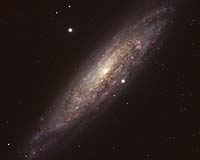
Image obtained with ESO's Very Large Telescope (VLT) of the spiral galaxy observed by the European Commissioner for Science and Research, Janez Potocnik, when at Paranal. NGC 134 is a barred spiral with its spiral arms loosely wrapped around a bright, bar-shaped central region. The red features lounging along its spiral arms are glowing clouds of hot gas in which stars are forming, so-called HII regions. The galaxy also shows prominent dark lanes of dust across the disc, obscuring part of the galaxy's starlight. The image is a colour composite based on data obtained in the B, V, R, and H-a filters with the FORS2 instrument attached to Antu, UT1 of the VLT. Photo courtesy ESO.
by Staff Writers
Paranal, Chile (SPX) Nov 13, 2007
During his visit to ESO's Very Large Telescope at Paranal, the European Commissioner for Science and Research, Janez Potocnik, participated in an observing sequence and took images of a beautiful spiral galaxy. The visit took place on 27 October and the Commissioner observed with one of the FORS instruments on Antu, the first 8.2-m Unit Telescope of the VLT

"Two hours bus ride from the nearest town, Antofagasta, in the middle of nowhere and at 2 600 m altitude, rises a state of the art astronomical observatory at which scientists from across Europe venture to exploit some of the most advanced technologies and sophisticated techniques available within astronomy. One of the facilities is the VLT, the Very Large Telescope, with which, together with the other telescopes, scientists can study objects at the far edge of the Universe," wrote Potocnik on his blog

Known until now as a simple number in a catalogue, NGC 134, the 'Island in the Universe' that was observed by the Commissioner is replete with remarkable attributes, and the VLT has clapped its eyes on them. Just like our own Galaxy, NGC 134 is a barred spiral with its spiral arms loosely wrapped around a bright, bar-shaped central region

One feature that stands out is its warped disc. While a galaxy's disc is often pictured as a flat structure of gas and stars surrounding the galaxy's centre, a warped disc is a structure that, when viewed sideways, resembles a bent record album left out too long in the burning Sun

Warps are actually not atypical. More than half of the spiral galaxies do show warps one way or another, and our own Milky Way also has a small warp

Many theories exist to explain warps. One possibility is that warps are the aftermath of interactions or collisions between galaxies. These can also produce tails of material being pulled out from the galaxy. The VLT image reveals that NGC 134 also appears to have a tail of gas stripped from the top edge of the disc

So did NGC 134 have a striking encounter with another galaxy in the past? Or is some other galaxy out there exerting a gravitational pull on it? This is a riddle astronomers need to solve

The superb VLT image also shows that the galaxy has its fair share of ionised hydrogen regions (HII regions) lounging along its spiral arms. Seen in the image as red features, these are glowing clouds of hot gas in which stars are forming. The galaxy also shows prominent dark lanes of dust across the disc, obscuring part of the galaxy's starlight

Studying galaxies like NGC 134 is an excellent way to learn more about our own Galaxy

NGC 134 was discovered by Sir John Herschel at the Cape of Good Hope and is located in the Sculptor southern constellation. The galaxy is located about 60 million light-years away - when the light that was captured by the VLT originally left the galaxy, a dramatic episode of mass extinction had led to the disappearance of dinosaurs on Earth, paving the way for the appearance of mammals and later specifically of humans, who have built unique high-tech installations in the Atacama desert to satisfy their curiosity about the workings of the Universe. Still, NGC 134 is not very far away, by cosmological standards. It is the dominant member of a small group of galaxies that belongs to the Virgo or Local Supercluster and is one of the 200 brightest galaxies in our skies

Community
Email This Article
Comment On This Article

Related Links
ESO
Stellar Chemistry, The Universe And All Within It


Memory Foam Mattress Review
Newsletters :: SpaceDaily :: SpaceWar :: TerraDaily :: Energy Daily
XML Feeds :: Space News :: Earth News :: War News :: Solar Energy News


Cosmological Data Affected By An Unexpected Source Of Radiation In Interstellar Space
Memphis TN (SPX) Nov 13, 2007
The widely lauded discovery of small-scale structure in the cosmic microwave background may be seriously affected by a previously unidentified source of radio emission in our own Milky Way Galaxy. This is the conclusion arrived at by Dr. Gerrit Verschuur, Adjunct Professor of Physics at the University of Memphis. His work will be published in the December 10 issue of the Astrophysical Journal.


  • India committed to boosting ties with Russia
  • Russian parliament votes freeze on CFE treaty
  • SKorea, US concerned about NKorean missiles
  • Military Matters: The 'Long War' trap

  • Admiral says US attack on Iran not 'in the offing': report
  • Iran president threatens to expose nuclear 'traitors'
  • Pakistan warns against nuclear weapons grab
  • Rice denies US on warpath with Iran

  • Raytheon Delivers 3000th Joint Standoff Weapon To The US Navy
  • Raytheon Standard Missile-3 Achieves Dual Intercepts In Space
  • Pakistan missile attack kills 10, militants parade troops
  • Analysis: Israel ups airline defenses

  • Missile Tit-For-Tat
  • Outside View: BMD base fears
  • Israel gets US aid for anti-missile system
  • USAF Set To Launch Final Northrop Grumman-Built Defense Support Program Satellite

  • Time Magazine Recognizes The X-48B
  • Virgin to offer carbon offsets alongside drinks and perfume
  • NASA sorry over air safety uproar
  • Airbus superjumbo makes first commercial flight

  • Unmanned Air System Project For South Coast Formally Launched
  • SDS Awarded Contract By USAF To Enhance MQ-1 Predator Training System
  • SKorea to discuss spy planes at talks with US: official
  • Silver Fox UAV Flies In The Philippines For The 31st MEU

  • Poland's Iraq mission to end in 'current form': incoming PM
  • Iran offered Iraq assurances on armor piercing weapons: Gates
  • Iran To Present New Settlement Plan For Iraq
  • Tribal leaders seek Gates help in expanding Al-Anbar police

  • Raytheon Selected For Army Common Sensor Payload
  • Lockheed Martin Achieves P-3 Support Milestone For The US Navy
  • Raytheon And US Navy Sign Phalanx Close-In Weapon System Deal
  • US Army Awards Force Protection Contract For Additional Buffalo Vehicles

  • The content herein, unless otherwise known to be public domain, are Copyright 1995-2006 - SpaceDaily.AFP and UPI Wire Stories are copyright Agence France-Presse and United Press International. ESA PortalReports are copyright European Space Agency. All NASA sourced material is public domain. Additionalcopyrights may apply in whole or part to other bona fide parties. Advertising does not imply endorsement,agreement or approval of any opinions, statements or information provided by SpaceDaily on any Web page published or hosted by SpaceDaily. Privacy Statement