-
- |
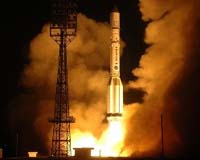
The unsuccessful launch of the most reliable Russian rocket came as a blow to the national space program and jeopardized the vital Global Navigation Satellite (GLONASS) program because GLONASS spacecraft can only lift off of Proton vehicles, and six satellites in this series have to be placed in orbit by late 2007.
The October 26 launch was a success and another one is scheduled for December.
To be frank, Kazakh authorities made everyone nervous because they agreed to lift the ban on Proton launches only on the eve of October 26. However, Moscow began to feel uneasy soon after the crash after Astana estimated toxic-fuel pollution costs and the damage payments at over $60 million. This caused mutterings of discontent at the Russian Space Agency (Roskosmos).
It became obvious that the concerned Russian and Kazakh commissions would have to negotiate damage payments, and that precisely this issue would be the key to subsequent launches.
Russian concerns mounted on October 9, when Kazakh Prime Minister Karim Masimov said he would not visit Baikonur the next day. Previously, Roskosmos said Masimov had planned to visit the Proton launch facility and to make sure that everything was being done to prevent future accidents.
Moscow had every reason to hope that Masimov would lift the ban during his talks with Roskosmos Director Anatoly Perminov at Baikonur.
According to Perminov, the solution of technical problems, rather than damage payments, was the main precondition for launches to resume.
Perminov said a Russian government commission did not link the damage payments with resumed Proton launches. On October 8, Perminov told Masimov in Astana that, under bilateral agreements, a study of the accident's causes and subsequent Russian efforts to prevent technical mishaps were the main precondition for resumed Proton launches.
Despite such logic, Moscow's doubts were not dispelled because both sides failed to agree on damage payments and Masimov did not show up at the Baikonur. Incidentally, an International Space Station crew that lifted off on the same day did not see Masimov either.
But all is well that ends well. We have no reason to doubt the reliability of Proton launch vehicles. Under a Russian-Kazakh protocol, Moscow and Astana should settle all damage payments by December 1, 2007. And, honestly, money is not the most important thing in space.
The opinions expressed in this article are the author's and do not necessarily represent those of RIA Novosti.
Community
 A Super Sonic Sixty Years
 Washington (AFP) Oct 11, 2007
| The content herein, unless otherwise known to be public domain, are Copyright 1995-2006 - SpaceDaily.AFP and UPI Wire Stories are copyright Agence France-Presse and United Press International. ESA PortalReports are copyright European Space Agency. All NASA sourced material is public domain. Additionalcopyrights may apply in whole or part to other bona fide parties. Advertising does not imply endorsement,agreement or approval of any opinions, statements or information provided by SpaceDaily on any Web page published or hosted by SpaceDaily. Privacy Statement |