
. Military Space News .
TIME AND SPACE
A Simpler Approach to Black Hole Description Developed
by Staff Writers
Moscow, Russia (SPX) Jul 30, 2018

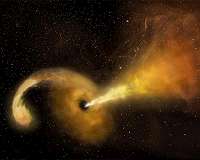
RUDN astrophysicists outlined a way for solving one more problem. We might yet lack a true theory of gravitation. In this case, when describing black holes we have to use equations that take the parameters of each particular theory into consideration. Equations like that also require complicated calculations, but the new approach can make them considerably simpler. (illustration only)

RUDN astrophysicists suggested an approach to simplify calculations of various observable effects in the vicinity of black holes to which the mathematical apparatus of Einstein's classic relativity theory does not apply. The results of the work were published in Physical Review D.

According to the general theory of relativity, the movement of any massive body causes the occurrence of space-time ripples called gravitational waves. They were first registered in 2015. Gravitational waves are echoes of merging of two black holes - areas of space-time where gravity is so strong no body can leave them even if it moves at light speed.

The discovery of gravitational waves made scientists reconsider old theories that explain the structure and characteristics of black holes and develop new ones. Einstein's equations turned out to be wrong in some cases. Several generalized theories emerged in an attempt to understand a number of fundamental issues, including dark matter, dark energy, and quantum gravity.

While waiting for new sightings of gravitational waves, theorists analyze the existing effects from the points of view of different gravitation theories. Scientists face a number of issues, and one of them is the complexity of calculations: they require processing enormous data arrays and capacious numerical integrations, and moreover, the properties of different parts of space-time may be characterized by several functions.

Black holes are described by "elegant" equations only in Einstein's theory, which is the simplest and possesses certain symmetrical features (i.e., if one knows a solution in one point, the solution for the other point, symmetrical to the first one, may be determined automatically). Alternative theories are different: describing black holes requires complex equations, big teams, and supercomputers.

Any equation that describes an object or a phenomenon includes several members. Each member corresponds to a certain systemic parameter and is connected to the basic characteristics that are relatively stable (e.g., mass or charge). These connections may be very complex, and specialists often try to avoid them by making assumptions and approximations.

RUDN scientists showed in their work that the solution process for certain non-Einstein theories may be simplified. Having compared expected and observed results, they found out that the impact of certain members that distort the elegant symmetry is so small it can be neglected.

One can easily verify if these simplified theories describe a space object correctly by entering earlier system characteristics into the equation and calculating its expected present-day values. After the result describing its position, radiation, or other measurable parameter is obtained, it should be compared to the actual data. If the values are similar, a simplified equation is considered to be a correct one.

RUDN astrophysicists outlined a way for solving one more problem. We might yet lack a true theory of gravitation. In this case, when describing black holes we have to use equations that take the parameters of each particular theory into consideration. Equations like that also require complicated calculations, but the new approach can make them considerably simpler.

"The results of our work may be useful not only in the studies of processes in black holes, but also for verifying theoretical predictions and Einstein's theory in general," concludes Roman Konoplya, a co-author of the work and a research associate at the Institute of Gravitation and Cosmology, RUDN.

The laws of existence of black holes differ from what we know from classical or quantum physics. Moreover, it is still unclear if we understand them correctly. Studying black holes will help us see universal development patterns and predict the fate of the universe.

"Axisymmetric Black Holes Allowing for Separation of Variables in the Klein-Gordon and Hamilton-Jacobi Equations," R.A. Konoplya, Z. Stuchlik and A. Zhidenko, 2018 April 25, Physical Review D


Related Links
RUDN University
Understanding Time and Space


Thanks for being here;
We need your help. The Space Media Network continues to grow but revenues have never been harder to maintain.

With the rise of Ad Blockers, and Facebook - our traditional revenue sources via quality network advertising continues to decline. And unlike so many other news sites, we don't have a paywall - with those annoying usernames and passwords.

Our news coverage takes time and effort to publish 365 days a year.

If you find our news sites informative and useful then please consider becoming a regular supporter or for now make a one off contribution.
SpaceMediaNetwork Contributor
$5 Billed Once


credit card or paypal
SpaceMediaNetwork Monthly Supporter
$5 Billed Monthly


paypal only


TIME AND SPACE
NASA's Fermi Traces Source of Cosmic Neutrino to Monster Black Hole
Greenbelt MD (SPX) Jul 13, 2018
For the first time ever, scientists using NASA's Fermi Gamma-ray Space Telescope have found the source of a high-energy neutrino from outside our galaxy. This neutrino traveled 3.7 billion years at almost the speed of light before being detected on Earth. This is farther than any other neutrino whose origin scientists can identify. High-energy neutrinos are hard-to-catch particles that scientists think are created by the most powerful events in the cosmos, such as galaxy mergers and material falli ... read more

Comment using your Disqus, Facebook, Google or Twitter login.


Share this article via these popular social media networks
del.icio.usdel.icio.us DiggDigg RedditReddit GoogleGoogle

TIME AND SPACE
Intercept Sets Distance Record for Lockheed Martin's Hit-to-Kill PAC-3 MSE

L-3 tapped for aircraft for imagery during missile defense tests

Lockheed receives contract for THAAD field support

Israel fires at Syrian missiles on Golan Heights: army

TIME AND SPACE
Russia Hunting Leaker of Hypersonic Missile Details to Western Agencies

Russian Scientist Jailed as Moscow Probes Hypersonic Missile Secrets Leak

Raytheon, Lockheed receive contract for Javelin missile production

Raytheon receives $7.5 million contract for Sea Sparrow missiles

TIME AND SPACE
Insitu awarded contract for RQ-21 unmanned aerial vehicles

An insect-inspired drone deforms upon impact

Insitu receives contract for ScanEagle UAVs for Afghanistan

Army picks Raytheon for counter-UAV drones

TIME AND SPACE
Why Ku-band HTS is superior for AISR

Asia is a huge growth market for government SATCOM

DARPA, Lockheed Martin Demonstrate Technologies to Enable a Connected Warfighter Network

IntelsatOne FlexAir Coming This Summer for Government Aircraft Operations

TIME AND SPACE
US Army Looking Away From Counter-Insurgency Warfare to High-Tech Future Battles

Oshkosh lands $13.9 million Army contract for M-ATV services

Israeli army unveils new 'dual-use' tank

Army researchers suggest uncertainty may be key in battlefield decision making

TIME AND SPACE
US releases $195 million in frozen military aid to Egypt

EU anti-trust officials probe Thales, Gemalto merger

Some countries buying Russian gear deserve sanctions waivers: Mattis

NATO allies agree to partner for joint weapons purchases

TIME AND SPACE
BRICS nations pledge unity against US trade war threat

Chinese man sets off explosive outside US embassy: police

Russia dismisses US Crimea declaration

NATO stands by all allies: official says

TIME AND SPACE
A new 'periodic table' for nanomaterials

Physicists uncover why nanomaterial loses superconductivity

Squeezing light at the nanoscale

A new way to measure energy in microscopic machines


The content herein, unless otherwise known to be public domain, are Copyright 1995-2024 - Space Media Network. All websites are published in Australia and are solely subject to Australian law and governed by Fair Use principals for news reporting and research purposes. AFP, UPI and IANS news wire stories are copyright Agence France-Presse, United Press International and Indo-Asia News Service. ESA news reports are copyright European Space Agency. All NASA sourced material is public domain. Additional copyrights may apply in whole or part to other bona fide parties. All articles labeled "by Staff Writers" include reports supplied to Space Media Network by industry news wires, PR agencies, corporate press officers and the like. Such articles are individually curated and edited by Space Media Network staff on the basis of the report's information value to our industry and professional readership. Advertising does not imply endorsement, agreement or approval of any opinions, statements or information provided by Space Media Network on any Web page published or hosted by Space Media Network. General Data Protection Regulation (GDPR) Statement Our advertisers use various cookies and the like to deliver the best ad banner available at one time. All network advertising suppliers have GDPR policies (Legitimate Interest) that conform with EU regulations for data collection. By using our websites you consent to cookie based advertising. If you do not agree with this then you must stop using the websites from May 25, 2018. Privacy Statement. Additional information can be found here at About Us.