
MISSILE NEWS
Agency Addresses Hypersonic Vehicle Detection, Satellite Survivability
by David Vergun for DOD News
Washington DC (SPX) Jan 14, 2022

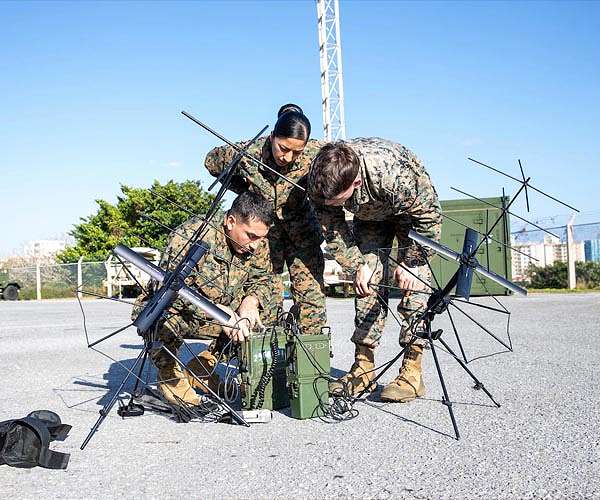
Marines with Communications Company, Combat Logistics Regiment 37, 3rd Marine Logistics Group, program the AB2040 satellite communication antenna during communications training at Camp Kinser on Okinawa, Japan, Dec. 16, 2021.

The Space Development Agency will be fielding satellites that will provide eyes-on capability to detect maneuverable hypersonic glide vehicles during flight, and those satellites will be affordable and prolific, the SDA director said. Speaking at the Mitchell Institute for Aerospace Studies' Schriever Spacepower Forum, Derek Tournear said satellites in low-Earth orbit, or LEO, will make up the tracking layer that will be able to detect hypersonic threats by their heat signatures, eventually on a global scale.

Satellites in LEO can detect those dim heat signatures better than satellites in higher orbits, he added. Also, if there are several satellites doing the tracking, getting a geometric fix on a hypersonic threat is much more precise.

Once the data gets fused in the Joint Overhead Persistent Infrared Ground System, it's then disseminated out typically over UHF or other Link 16 networks, then to weapons platforms.

Those tracking satellites will communicate directly with the transport satellites via laser optical cross links, which can rapidly move large amounts of data.

By September 2024, plans are that 144 transport layer satellites will begin to be launched; that will result in initial warfighting capability, forming a mesh network, he said.

In 2024 or 2025, 28 tracking layer satellites will be launched, resulting in global coverage, he said.

SDA is working in two-year cycles to leverage spiral development of new technologies and launch additional satellites in tranches in that timeframe going forward, he said.

The commercial sector has enabled the growth of this military capability as the prices of satellites and rocket launches have plummeted and as technology has dramatically improved, he said.

Addressing concerns about overcrowding space with satellites, Tournear said space is big, and the higher one goes up in low-Earth orbit, the more room there is.

There's currently a lot of satellite congestion in the 400- to 600-kilometer area above the Earth, he said. SDA is looking to place its satellites in the 1,000- to 1,200-kilometer range.

The goal of putting a large number of small satellites in space, he said, is to create redundancy in the event an adversary tries to take them out with anti-satellite weapons. It would be much harder to disable the network.

The SDA, established in March 2019, will transfer to the Space Force in October 2022, Tournear noted.


Related Links
DOD Space Strategy
Learn about missile defense at SpaceWar.com
All about missiles at SpaceWar.com

MISSILE NEWS
North Korea's Kim urges more 'military muscle' after hypersonic missile test
Seoul (AFP) Jan 12, 2022
Kim Jong Un personally oversaw the successful test of a hypersonic missile, state media said Wednesday, and urged North Korea to press ahead with building more "strategic military muscle" despite international sanctions over its nuclear weapons programme. Pictures in state media showed Kim using binoculars to observe the second missile launch by the nuclear-armed nation in less than a week. Hypersonic missiles are listed among the "top priority" tasks for strategic weapons development in North ... read more

Comment using your Disqus, Facebook, Google or Twitter login.

Share this article via these popular social media networks
del.icio.usdel.icio.us DiggDigg RedditReddit GoogleGoogle

MISSILE NEWS
L3Harris Completes Final US Missile Defense Agency Satellite Design Milestone

Northrop and Raytheon complete Next Generation Interceptor review

Northrop Grumman completes environmental testing for Next Gen OPIR GEO payload

India May Become 1st in Line to Buy Russian Air Defense System S-500

MISSILE NEWS
Israel Knocks out simulated Iranian missile using Arrow-3 Interceptor

US calls on N.Korea to 'cease' its 'unlawful' missile launches

North Korea tests 'tactical guided missiles' in military push

Agency Addresses Hypersonic Vehicle Detection, Satellite Survivability

MISSILE NEWS
Airbus teams with Japan telcos to study connectivity services from high-altitude platforms

Defibrillator drone helps save Swedish heart attack patient

Two drones shot down targeting Iraq base: anti-IS coalition

Australia's First MQ-4C Triton Takes Shape

MISSILE NEWS
Teaming up to deliver a new Airborne ISR SATCOM capability for MilGov Operators

Intelsat buys 2 Software-Defined Satellites from Thales Alenia Space to boost 5G solution

SES Government Solutions Launches On-Demand X-band Service Platform

SPAINSAT NG program successfully passes Critical Design Review

MISSILE NEWS
AFRL'S PNT AgilePod achieves flight test objectives

Two Russian paratroopers die in Belarus drills jump

MISSILE NEWS
US presses for Myanmar arms embargo after massacre

Japan unveils record annual budget and defence spend

UAE protests stringent Biden conditions for jet fighters

Cambodian PM orders US weapons destroyed after arms embargo

MISSILE NEWS
Macron calls for European rearmament, security talks with Russia

Russians pose threat to US training mission in Ukraine

Paris looks to recapture lost beauty after criticism

Russian troops arrive in Belarus for combat drills

MISSILE NEWS
The secret of ultralight but stiff sandwich nanotubes

AFRL Nano Team takes lead in building stronger ties with India