
SPACEWAR
Airbus-built PAZ radar satellite launched
by Staff Writers
Madrid, Spain (SPX) Feb 26, 2018

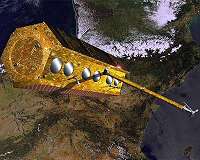
illustration only

The Airbus-built PAZ radar satellite has been successfully launched from Vandenberg Air Force Base, in California, USA. Ten minutes after launch, the satellite separated from the launcher and will soon be positioned at its 514 km orbit.

First contact with the satellite was established from the DLR Ground Control Centre in Germany, where Airbus engineers are supporting the Launch and Early Orbit Phase (LEOP) to check out and configure the satellite, ensuring that all satellite critical systems and communications are functioning as planned.

These activities will take around five days, then the satellite will be handed over to the Ground Control Centre located at INTA (Instituto Nacional de Tecnicas Aeroespaciales) in Torrejon de Ardoz, near Madrid. The satellite will be operated by INTA and Hisdesat (owner of the satellite) technical teams.

During the next three months all In-Orbit Testing (IOT) activities will be carried out from Madrid, and will serve to validate the correct functioning of the spacecraft and its radar performance. The verification of the two secondary payloads, the sophisticated Automatic Identification System (AIS) for global control of the maritime scenario and the Radio Occultation and Heavy Precipitation experiment (ROHP), will be carried out.

As prime contractor, Airbus Spain built the PAZ satellite, leading a team of 15 European companies and three universities. "PAZ is the first Spanish radar satellite and has now joined the TerraSAR-X and TanDEM-X satellites. Operating on the same orbit, the three satellites form a very high-resolution SAR constellation providing reduced revisit time and increased acquisition capacity," said Nicolas Chamussy, Head of Space Systems within Airbus.

"PAZ is another good example of the advanced technologies that Airbus has to offer to improve our everyday lives. Environment monitoring, management of natural resources, urban and agricultural planning and crisis evaluation are just a few examples of the numerous applications this satellite will be used for."

PAZ is equipped with advanced active SAR (Synthetic Aperture Radar) technology designed for high flexibility and the capability to operate in multiple modes with different image sizes and resolutions. It will take images 24/7 and in all weather conditions. PAZ is designed for a mission life time of five and a half years, serving both Spanish government and commercial needs. The initial investment made in the project was 160 million euros.

The new constellation will be jointly exploited by Hisdesat and Airbus. PAZ data will also be used as part of Copernicus, the European Union's Earth monitoring programme.


Related Links
Airbus
Military Space News at SpaceWar.com

SPACEWAR
Star Wars: Why US, Russia, China Make a Big Deal Out of Hitting Satellites
Moscow (Sputnik) Feb 22, 2018
A country capable of destroying the adversary's satellites would easily gain the upper hand in modern warfare, Sputnik contributor Andrei Kots notes; adding that at present only three countries can target orbital spacecraft. However, not one of them has developed a full-fledged operating anti-satellite defense system yet, he remarks. Exactly ten years ago, on February 21, 2008, the US military first shot down a satellite using the RIM-161 Standard Missile 3 (SM-3) system, Sputnik contributor Andre ... read more

Comment using your Disqus, Facebook, Google or Twitter login.

Share this article via these popular social media networks
del.icio.usdel.icio.us DiggDigg RedditReddit GoogleGoogle

SPACEWAR
U.S., Israel test Arrow 3 missile system

Israel, US Successfully Test Hetz 3 Exoatmospheric Anti-Missile System

China to Develop Sea-Based Missile Interceptors

Lockheed awarded $523M for Patriot missiles for Qatar, Saudi Arabia, Romania

SPACEWAR
After Russian veto, US and allies condemn Iran over missiles to Yemen

Raytheon, Lockheed to sell Javelins to multiple foreign customers

State Department approves potential $3.2B missile sale to Sweden

Pentagon looks to counter rivals' hypersonic missiles

SPACEWAR
TEOCO launches UAV Service Enablement Platform for Drones

Lockheed Martin Launches software to simultaneously control multiple UAV types anywhere on Earth

Orbital ATK contracted for testing of drone missile targets

General Atomics enlists Boeing for its MQ-25 Stingray proposal

SPACEWAR
British astronaut hails 'groundbreaking' Airbus satellite

Northrop Grumman gets production, support contracts for E-2D Hawkeye

Studies prove superior performance of HTS for Government customers

SatCom options meet demanding connectivity requirements for helicopters

SPACEWAR
Army awards AM General $11.8M for 60 Humvees

Putin signs new State Arms Program focused on cutting-edge weaponry

Army taps Olin Corp. for $51.1M in small arms ammunition

Raytheon wins $77.3M Air Force contract for SDB II munitions

SPACEWAR
BAE profits fall, counts on government defence spend

Russia's Kalashnikov becomes majority private-owned

Airbus to pay 81 mn euros to end German corruption probe

US budget outline calls for huge Pentagon increase, cuts to State

SPACEWAR
US sees Russia as most significant threat, N Korea as most uncertain - STRATCOM

Russia is 'arsonist and firefighter' in Syria: US general

Trump yet to order spies to retaliate against Russia: NSA chief

China drowns out critics of lifetime Xi presidency

SPACEWAR
UT Dallas team's microscopic solution may save researchers big time

Researchers invent light-emitting nanoantennas

Nanomushroom sensors: One material, many applications

USTC realizes strong indirect coupling in distant nanomechanical resonators