
. Military Space News .
An X-Ray Santa Claus In Orion

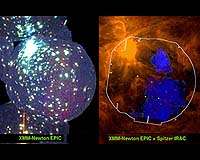
The images show the Orion nebula with its hot gas cloud. The left panel is an image obtained with XMM-Newton data from its European Photon Imaging Camera (EPIC) in X-rays. The right panel shows XMM-Newton data, compared to Spitzer observations of the same region. The Spitzer image is a composite image of data obtained in the infrared. Credits: Panel A: XMM-Newton EPIC (Guedel et al.), Panel B: AAAS/Science (ESA XMM-Newton and NASA Spitzer data)
by Staff Writers
Paris, France (ESA) Dec 03, 2007
Right in time for the festive season, ESA's XMM-Newton X-ray observatory has discovered a huge cloud of high-temperature gas resting in a spectacular nearby star-forming region, shaped somewhat like the silhouette of Santa Claus. An early present for astronomers, the cloud suggests that hot gas from many star-forming regions leaks into the interstellar medium.

The Orion nebula is the nearest dense star-forming region to Earth that contains stars much more massive than the Sun. XMM-Newton's newly-discovered gas cloud is composed of winds blowing from these high-mass stars that are heated to millions of degrees as they slam into the surrounding gas.

"There is one star in particular that dominates the nebula," says Manuel Gudel, Paul Scherrer Institut, Switzerland, who led the team that discovered the gas. The star in question is theta1 Orionis C, a giant star around 40 times mass of the Sun, with a surface temperature of 40,000C. Gudel and his colleagues think that the violent collision between the wind from this star and the surrounding dense gas is largely responsible for the newly-discovered hot gas cloud.

The high-temperature gas fills a region of the nebula that appears to be a huge cavity in optical and infrared images. The new observations, taken with XMM-Newton's European Photon Imaging Camera (EPIC) camera, suggest that astronomers are seeing only a particular portion of the gas. The X-rays from this portion escape absorption by patches of cold gas covering much of the front of the Orion nebula.

The surrounding pattern of absorbing clouds gives the detected gas its Santa Claus shape, with his prominent hat outlined by the northern gas bubble. In its entirety, the hot gas probably fills the whole nebula.

The team discovered it whilst conducting a survey of the young stars in the region. In the background of many of those images was a faint glow of X-rays. "The diffuse signal came up time and time again. Finally, we realized that it was something real," says Gudel.

The presence of the hot gas in a fairly common nebula like Orion is surprising. Although theory has predicted such hot gas clouds, previous observations suggested that a large number of massive stars shedding winds, or supernova explosions are required. These are found in some regions of vigorous high-mass star formation, which are scattered only rarely throughout the galaxy. The new observations show that much smaller collections of high mass stars can produce hot gas as well.

There are many star-forming regions similar to the Orion nebula throughout the galaxy, so there should be a network of channels and bubbles being filled up by the hot gas leaking from these various regions. "This is another possible way to enrich the interstellar medium. You don't have to wait for a sudden supernova to explode. You can do it with just one or two massive stars over millions of years," says Gudel.

The team now plans to obtain new observations to determine how the gas flows out of the Orion nebula. In particular, they want to see whether it connects with a giant bubble created by supernova explosions from previous generations of massive stars.

Community
Email This Article
Comment On This Article

Related Links
XMM-Newton overview
Stellar Chemistry, The Universe And All Within It


Memory Foam Mattress Review
Newsletters :: SpaceDaily :: SpaceWar :: TerraDaily :: Energy Daily
XML Feeds :: Space News :: Earth News :: War News :: Solar Energy News


Embryonic Star Captured With Jets Flaring
Pasadena CA (JPL) Nov 30, 2007
A developing star wrapped in a black cocoon of dust is seen sprouting giant jets in a new image from NASA's Spitzer Space Telescope. The stellar portrait, captured in infrared light, offers the first glimpse at a very early stage in the life of an embryonic sun-like star -- a time when the star's natal envelope is beginning to flatten and collapse, and streams of gas are escaping. The observations will ultimately help astronomers better understand how stars and their planets form.


  • Euro Thaw Not What It Seems
  • OSCE presidency urges Russia to reconsider arms treaty move
  • China says ties with US damaged, amid naval row
  • US, China, feud over Taiwan, Tibet, port dispute

  • Military Deal Far Off For Koreas
  • Northrop Grumman Receives Contract For ICBM Propulsion Replacement Program
  • Iranian Missile Bluster
  • Outside View: Iran war dangers

  • Lockheed Martin-built Trident II D5 Missile Achieves Record 120 Successful Test Launches In A Row
  • Iran builds new longer-range missile
  • India tests SAM missile near Pakistan border: officials
  • Asymmetrical Iskander Missile Systems

  • BMD Base Games Part One
  • STSS's Second Satellite Completes Thermal Vacuum Testing At Northrop Grumman
  • Ex-Czech PM calls US anti-missile plan 'provocation': report
  • US, Russians hold missile defense talks: Pentagon

  • Announcement Of Opportunity For Sounding Rocket And Balloon Flights
  • China to order up to 150 Airbus jets during Sarkozy visit: report
  • Time Magazine Recognizes The X-48B
  • Virgin to offer carbon offsets alongside drinks and perfume

  • UAV Sales Help IAI Bottom Line
  • UK Awards Lockheed Martin 4.8 Million Dollars For Desert Hawk III Unmanned Aircraft Systems
  • Boeing Awarded International Aviation Trophy For X-45A
  • Galileo Avionica: The UAV FALCO System Completes Operational Validation Testing

  • Transition To Iraqi Control Not Easy
  • Feature: U.S. works hearts, minds
  • Analysis: Kirkuk project battle heats up
  • Japan opposition votes to end Iraq mission

  • Secretary Sees First Afterburning Engine Test With Synthetic Fuel
  • Sealift Of Mine-Resistant, Ambush-Protected Vehicles Begins
  • EDO Receives 54.4 Million Dollar Contract For F-22 Weapon-Release System
  • BAE Systems Completes In-Country Commissioning Of Airborne Reconnaissance System

  • The content herein, unless otherwise known to be public domain, are Copyright 1995-2006 - SpaceDaily.AFP and UPI Wire Stories are copyright Agence France-Presse and United Press International. ESA PortalReports are copyright European Space Agency. All NASA sourced material is public domain. Additionalcopyrights may apply in whole or part to other bona fide parties. Advertising does not imply endorsement,agreement or approval of any opinions, statements or information provided by SpaceDaily on any Web page published or hosted by SpaceDaily. Privacy Statement