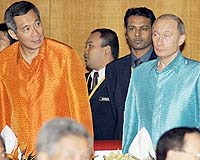
Russian President Vladimir Putin's attendance of the Association of Southeast Asian Nations summit this week in Malaysia has been described as further evidence Moscow prefers closer interaction with Asia over integration with the West because of shared values. This claim fails to understand the Kremlin's global foreign policy agenda.
The Russia-ASEAN summit, the first in 10 years of bilateral cooperation, discussed a joint declaration on comprehensive partnership covering nearly every area of interaction, from counter-terrorism to tourism and sport.
"It (the declaration) gives our country new partners, or to be more precise, new spheres of cooperation with partners that we have acquired in this important region," Russian Foreign Minister Sergei Lavrov said.
In 2004, Russian trade turnover with the 10 ASEAN countries exceeded $4.5 billion. This figure is not significant, less than 1 percent of Russia's foreign annual foreign trade, but compared to 2003 trade turnover it increased by more than $1 billion. This is a trend the Kremlin wants to cultivate.
Russian engagement of Asia is not solely centered on ASEAN. In July, the Shanghai Cooperation Organization, which comprises China, Russia, Kazakhstan, Kyrgyzstan, Tajikistan and Uzbekistan, transformed itself into a regional security forum.
Also this year, Russia held major separate military exercises with China and India. Russia is a member of the Asia-Pacific Economic Cooperation organization and at that bloc's recent summit Moscow's primary focus was how it could meet Asia's demand for energy to fuel the region's economic development.
Does all this mean there is a decided eastern shift to Russia's foreign policy?
As Putin traveled to the summit, news reports said Russia was disillusioned with its role as an outsider in European integration and was keen to get on board a similar process in Asia.
The Russian daily Vremya Novostei wrote, "Europe creates as many problems for Russia as opportunities it offers." The article went on to say, "Asia is different... It shares many values with Russia."
Others have gone even further, suggesting Europe has become disillusioned with Putin's version of "managed democracy" and the state's increasing role in Russia's economy. The same conventional wisdom suggests the Kremlin is apprehensive of NATO's continued expansion and the European Union's growing influence in areas once considered Russia's backyard.
These characterizations miss the mark for many reasons. Suggesting Putin's Russia does not have shared values with the West is an interpretation of events unfolding on the ground. There can be no doubt shared values are part of any country's foreign policy, but all countries have identifiable strategic interests that often have to be balanced with values. Russia's foreign policy is a case in point.
Russia's increased interest in furthering ties with Asia has less to do with values per se, and more to do with the region's enormous economic potential. With half the world's population and a fifth of global trade, it is in Russia's economic and security interests to be a player in East Asia.
Energy Minister Viktor Khristenko said last month that by 2020, 30 percent of the country's oil exports would go to Asia, compared with the current 3 percent. Asia also buys more than 90 percent of Russia's $5 billion annual arms exports. For these reasons alone, Russia is pushing for permanent membership in this bloc.
However, in the larger scheme of things, Russia's intention to increase engagement with East Asia is no different from its other foreign policy goals. The Kremlin is busy finishing negotiations with several countries to enter the World Trade Organization. Russia, much to the annoyance of the West, is expanding its influence in the Greater Middle East through boosted trade.
Europe, Russia's largest trading partner, while very much in need of Russia's energy, has started to enter the country's financial and other non-energy sectors. Russia has even reached out to South America in search of new trade ties.
If there is any "shared value" Russia has with the rest of the world, it is the pursuit of trade -- where ever it can be cultivated.
Peter Lavelle is a Moscow-based writing analysis for RIA Novosti.
Source: United Press International