
. Military Space News .
SPACE MEDICINE
Astronauts experience decrease in blood vessel function during spaceflight
by Staff Writers
Manhattan KS (SPX) May 10, 2017


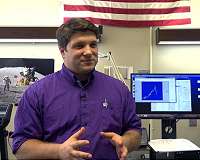
Carl Ade, Kansas State University assistant professor of exercise physiology, and collaborators have found that astronauts' exercise capacity decreases in long-duration spaceflight because the heart and small blood vessels are not as effective at transporting oxygen.

Astronauts aboard the International Space Station have decreased physical fitness because of a decrease in the way oxygen moves through the body, according to a Kansas State University kinesiology study.

Carl Ade, assistant professor of exercise physiology, and collaborators partnered with the Johnson Space Center to find that astronauts' exercise capacity decreases between 30 and 50 percent in long-duration spaceflight because the heart and small blood vessels are not as effective at transporting oxygen to the working muscle.

"It is a dramatic decrease," Ade said.

"When your cardiovascular function decreases, your aerobic exercise capacity goes down. You can't perform physically challenging activities anymore. While earlier studies suggest that this happens because of changes in heart function, our data suggests that there are some things happening at the level of the heart, but also at the level of the microcirculation within capillaries."

In addition to improving astronaut health and providing valuable information for future long-duration spaceflights, the research also can help Earth-bound clinical patients with heart failure, Ade said.

The NASA-funded research appears in the Journal of Applied Physiology in the publication "Decreases in maximal oxygen uptake following long-duration spaceflight: Role of convective and diffusive O2 transport mechanisms." The journal also featured the research in a recent podcast.

Other Kansas State University researchers involved include Thomas Barstow, professor of kinesiology, and Ryan Broxterman, 2015 doctoral graduate in physiology and postdoctoral fellow at the University of Utah. Alan Moore, associate professor of health and kinesiology at Lamar University, also contributed.

While in outer space or on the International Space Station, astronauts have to perform many physically demanding tasks, from the simpler task of opening a capsule door to potentially more intense future planetary tasks such as helping a fallen crew member.

Just as important is making sure astronauts can perform life-saving tasks when they return to gravity - tasks that could include an emergency landing on Earth or performing extravehicular activities on the surface of Mars, Ade said.

For the study, the researchers used Johnson Space Center data on nine male and female astronauts who spent about six months aboard the International Space Station. The data included exercise measurements before and after their time in outer space.

The astronauts performed a stationary bike exercise test several months before they launched to the International Space Station. The researchers established the astronauts' exercise capacity through measurements - such as oxygen uptake, cardiac output, hemoglobin concentration and arterial saturation - that illustrate how effectively the body transports oxygen to the muscle mitochondria. Within a couple of days of returning to earth, the astronauts performed the same stationary bike exercise test to determine changes in aerobic exercise capacity.

By comparing the two sets of data, the researchers saw a 30 to 50 percent decrease in maximal oxygen uptake. Maximal oxygen uptake is the maximum rate of oxygen that is consumed during exercise and shows the cardiorespiratory health of a person.

The researchers attribute this decrease to the way that microgravity changes the interaction between blood vessel capillaries and red blood cells, but say that more research is needed to understand what is happening in the capillaries.

"This decrease is related to not only health, but performance," Ade said. "If we can understand why maximal oxygen uptake is going down, that allows us to come up with targeted interventions, whether that be exercise or pharmacological interventions. This important new information can help these astronauts and prevent any adverse performance changes in their job."

While the research is key to planning for future long-duration spaceflights, such as journeys to Mars or deep space, it also can help understand blood vessel function in older patients or patients with heart failure.

"We have seen similar situations happen with heart failure and with aging," Ade said. "If we can better understand what is happening in the astronaut and how to prevent it, then we might be able to do the exact same thing in a patient who is older or who has heart failure."

SPACE MEDICINE
Medical guidelines for astronauts to be launched in the US
Plymouth UK (SPX) May 01, 2017
With Cassini making final preparations to penetrate Saturn's rings, and renewed interest in colonising the Moon and sending people to Mars, space flight and exploration are experiencing a level of interest not seen since the Apollo missions to the Moon in the late 60's and 70's, and the space shuttle programme of the 80's. Space travel and exploration have resulted in a variety of technolo ... read more

Related Links
Kansas State University
Space Medicine Technology and Systems


Thanks for being here;
We need your help. The Space Media Network continues to grow but revenues have never been harder to maintain.

With the rise of Ad Blockers, and Facebook - our traditional revenue sources via quality network advertising continues to decline. And unlike so many other news sites, we don't have a paywall - with those annoying usernames and passwords.

Our news coverage takes time and effort to publish 365 days a year.

If you find our news sites informative and useful then please consider becoming a regular supporter or for now make a one off contribution.
SpaceMediaNetwork Contributor
$5 Billed Once


credit card or paypal
SpaceMediaNetwork Monthly Supporter
$5 Billed Monthly


paypal only


Comment using your Disqus, Facebook, Google or Twitter login.

Share this article via these popular social media networks
del.icio.usdel.icio.us DiggDigg RedditReddit GoogleGoogle

SPACE MEDICINE
Russia's RS-28 Sarmat ICBM: Hypersonic Disaster for US Missile Defense Shield

China demands halt to US missile shield in S.Korea

THAAD missile defense system now operational in S. Korea

Seoul rejects Trump demand it pays for missile system

SPACE MEDICINE
China says it tested new missile in northeastern sea

Purchase of S-400 From Russia 'Might Signal Turkey's Estrangement From NATO'

Tokyo subway halt for 10 minutes over NKorea scare

Sweden orders additional anti-ship missiles from Saab

SPACE MEDICINE
Lockheed Martin introduces quiet, lightweight variant of Indago drone

US Air Force Space Shuttle X-37B Finally Unmasked

Newest Secret US Spacecraft Returns to Earth After Over 700 Days in Space

US drone back on Earth after nearly two years in space

SPACE MEDICINE
Boeing demonstrates integrated aircraft communications system

Elbit Systems receives Brazilian contract for C4ISR

Genereal Dynamics stages successful test of military 4G network

Israel orders satellite-on-the-go for military vehicles

SPACE MEDICINE
Germany to reactivate Leopard 2 tanks

Engility to continue support for DITRA

Cubic Global Defense to provide training support services for British army

Rheinmetall picks armaments services supplier Australian vehicle contract

SPACE MEDICINE
Dutch court jails Charles Taylor arms-supplier for 19 years

Canada moves to join treaty curbing foreign arms sales

India inks weapons deal worth nearly $2 bn with Israel

U.S. lawmakers push for Pentagon reforms

SPACE MEDICINE
U.S. military launches Operation Northern Edge

France's Macron seen as UN ally

China rebuffs UN criticism of lawyer's detention

Philippines, US launch scaled-down military exercises

SPACE MEDICINE
Scientists set record resolution for drawing at the one-nanometer length scale

X-ray microscope optics resolve 50-nm features while eliminating chromatic aberrations

Self-assembled nanostructures can be selectively controlled

Nanotubes that build themselves


The content herein, unless otherwise known to be public domain, are Copyright 1995-2024 - Space Media Network. All websites are published in Australia and are solely subject to Australian law and governed by Fair Use principals for news reporting and research purposes. AFP, UPI and IANS news wire stories are copyright Agence France-Presse, United Press International and Indo-Asia News Service. ESA news reports are copyright European Space Agency. All NASA sourced material is public domain. Additional copyrights may apply in whole or part to other bona fide parties. All articles labeled "by Staff Writers" include reports supplied to Space Media Network by industry news wires, PR agencies, corporate press officers and the like. Such articles are individually curated and edited by Space Media Network staff on the basis of the report's information value to our industry and professional readership. Advertising does not imply endorsement, agreement or approval of any opinions, statements or information provided by Space Media Network on any Web page published or hosted by Space Media Network. General Data Protection Regulation (GDPR) Statement Our advertisers use various cookies and the like to deliver the best ad banner available at one time. All network advertising suppliers have GDPR policies (Legitimate Interest) that conform with EU regulations for data collection. By using our websites you consent to cookie based advertising. If you do not agree with this then you must stop using the websites from May 25, 2018. Privacy Statement. Additional information can be found here at About Us.