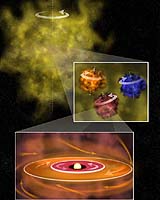
Disk around young star rotating in opposite directions. Image by Bill Saxton, NRAO/AUI/NSF
Disk around young star rotating in opposite directions. Image by Bill Saxton, NRAO/AUI/NSF |
"Our data in conjunction with the data that other people have compiled show the two regions have velocity gradients that are opposite each other," Mike Hollis, a radio astrophysicist with NASA's Goddard Space Flight Center in Greenbelt, Md., told SpaceDaily.com.
Hollis and colleague Anthony Remijan, of the National Radio Astronomy Observatory, used the Very Large Array radio telescopes to track the motion of silicon monoxide molecules within a protostellar disk forming about 500 light-years away in the direction of the constellation Ophiuchus, the Serpent Bearer.
When they compared the newest high-spatial-resolution VLA observations of the motion of SiO molecules - which Hollis said are relatively powerful emitters of radio waves - within the disk with earlier low-spatial-resolution measurements of SiO farther away from its center, the data comparison showed Doppler shifts toward the red and blue ranges on both sides of the disk - meaning there are two masses that had to be rotating in opposite directions, because each side contains SiO moving both toward and away from the telescopes.
As a result, Hollis said, when the disk eventually forms a solar system - perhaps hundreds of millions of years from now - "you could have planets going in one direction in the inner system and in the opposite direction in the outer system."
Current theory stipulates that stars and planets form when a giant cloud of gas and dust collapses due to gravitational attraction. During the collapse, a flattened, rotating disk of material develops around the young star. The disk provides the material from which planets and other bodies form.
It had been thought that the disk and the resulting planets must rotate in the same direction as the original cloud, with the rotational speed increasing as planets draw closer to the center, as when spinning figure skaters spin faster when they draw their arms inward. This is the case of our own solar system, where all planets revolve in one direction around the Sun, and the Sun rotates on its axis in that same direction. For some reason, however, something else is at work in the neighborhood of Ophiuchus.
"This is the first time anyone has seen anything like this, and it means that the process of forming planets from such disks is more complex than we previously expected," Remijan said in a statement.
"We think this system may have gotten material from two clouds instead of one, and the two were rotating in opposite directions," he explained, adding that there is sufficient material to form planets from both parts of the disk. Hollis said the inner part of the disk is about 300 astronomical units (each about 93 million miles) wide, while the outer zone is considerably larger. The disk is located within a large, star-forming region where chaotic motions and eddies in the gas and dust can result in smaller cloudlets rotating in different directions.
Though this is the first time such a phenomenon has been seen in a protostellar disk, Hollis said similar dynamics commonly occur on small and large scales throughout the universe, so it should not be surprising to find such counter-rotation, because the phenomenon has been reported previously in the disks of galaxies.
"There have been some catastrophic events in our own solar system," he said, citing the retrograde rotation of Venus, and the 90-degree-canted rotation of Uranus.
Hollis and Remijan will report their results in the April 1 issue of the Astrophysical Journal.
Related Links
 Spitzer Uncovers Hints Of Mega Solar Systems
 Pasadena CA (SPX) Feb 08, 2006
| The content herein, unless otherwise known to be public domain, are Copyright 1995-2006 - SpaceDaily.AFP and UPI Wire Stories are copyright Agence France-Presse and United Press International. ESA PortalReports are copyright European Space Agency. All NASA sourced material is public domain. Additionalcopyrights may apply in whole or part to other bona fide parties. Advertising does not imply endorsement,agreement or approval of any opinions, statements or information provided by SpaceDaily on any Web page published or hosted by SpaceDaily. Privacy Statement |