
. Military Space News .
TIME AND SPACE
Astronomers discover the most distant radio galaxy ever
by Staff Writers
Amsterdam, Netherlands (SPX) Aug 10, 2018

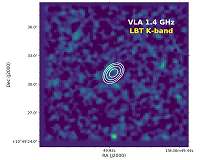
This picture shows the near-infrared image in K band taken using the Large Binocular Telescope in Arizona, with radio emission overlaid in white. The fact that the host galaxy was not detected at infrared wavelengths from where the radio emission originates helped independently confirm the record distance of this galaxy.

After nearly twenty years, the record of the most distant radio galaxy ever discovered has been broken. A team led by PhD student Aayush Saxena (Leiden Observatory, the Netherlands) has found a radio galaxy from a time when the universe was only 7% of its current age, at a distance of 12 billion light-years.

The team used the Giant Meter-wave Radio Telescope (GMRT) in India to initially identify the radio galaxy. The distance to this galaxy was then determined using the Gemini North telescope in Hawaii and the Large Binocular Telescope in Arizona by measuring the redshift of the galaxy. The redshift of z = 5.72 means that the galaxy is perceived as it looked when the universe was only a billion years old.

This also means that the light from this galaxy is almost 12 billion years old. The team consists of astronomers from the Netherlands, Brazil, the United Kingdom and Italy. The study announcing these results has been accepted for publication in the Monthly Notices of the Royal Astronomical Society.

Measuring the redshift of a galaxy tells astronomers its distance. The farther away galaxies are, the faster they move away from us. The light from these galaxies therefore appears to be redder, following an effect that is known as the Doppler shift. Therefore, the higher the speed at which a galaxy moves away from us, the greater its redshift.

Radio galaxies are very rare objects in the universe. They are colossal galaxies with a supermassive black hole in their center that actively accretes gas and dust from its surroundings.

This activity initiates the launch of high-energy jet streams, which are capable of accelerating charged particles around the supermassive black hole to almost the speed of light. These jets are very clearly observed at radio wavelengths.

The fact that such galaxies exist in the distant universe has surprised astronomers. The discovery of such galaxies at extremely large distances is important for our understanding of the formation and evolution of galaxies. Studying these radio galaxies in detail also sheds light on the formation of primordial black holes, which have driven and regulated the growth of galaxies.

First author Aayush Saxena (Leiden Observatory) comments: "It is very surprising how these galaxies have built up their mass in such a short period of time." Co-author Huub Rottgering (Leiden Observatory, the Netherlands) adds: "Bright radio galaxies harbor supermassive black holes. It is amazing to find such objects as early in the history of the universe; the time for these supermassive black holes to form and grow must have been very short."

A radio galaxy with a redshift of z = 5.19 had been the previous record holder since its discovery in 1999. The next generation of radio telescopes, combined with the world's largest optical and infrared telescopes, will be able to detect radio galaxies at even greater redshifts.

Research Report: "Discovery of a Radio Galaxy at z = 5.72," A. Saxena (Leiden), M. Marinello, R. A. Overzier, P. N. Best, H. J. A. Rottgering (Leiden), K. J. Duncan (Leiden), I. Prandoni, L. Pentericci, M. Magliocchetti, D. Paris, F. Cusano, F. Marchi, H. T. Intema (Leiden) and G. K. Miley (Leiden), 2018 Aug. 6, Monthly Notices of the Royal Astronomical Society


Related Links
Netherlands Research School For Astronomy
Understanding Time and Space


Thanks for being here;
We need your help. The Space Media Network continues to grow but revenues have never been harder to maintain.

With the rise of Ad Blockers, and Facebook - our traditional revenue sources via quality network advertising continues to decline. And unlike so many other news sites, we don't have a paywall - with those annoying usernames and passwords.

Our news coverage takes time and effort to publish 365 days a year.

If you find our news sites informative and useful then please consider becoming a regular supporter or for now make a one off contribution.
SpaceMediaNetwork Contributor
$5 Billed Once


credit card or paypal
SpaceMediaNetwork Monthly Supporter
$5 Billed Monthly


paypal only


TIME AND SPACE
Black holes are fuzzy balls of string with an endless appetite for matter
Washington (UPI) Jul 31, 2018
A trio of physicists at Ohio State University believe black holes are like "fuzzballs" with an insatiable appetite for matter. And according to their latest research, these fuzzballs are not surrounded by a "firewall." Classical general relativity presents the black hole as an object with a horizon, beyond which nothing can escape. This dichotomy between something and nothing is referred to as the "information paradox." Using string theory as a guide, scientists at Ohio State presented t ... read more

Comment using your Disqus, Facebook, Google or Twitter login.


Share this article via these popular social media networks
del.icio.usdel.icio.us DiggDigg RedditReddit GoogleGoogle

TIME AND SPACE
Lockheed receives contract for missile warning satellites

Sweden to purchase PAC-3 MSE missile defense system

Lockheed receives contract for Aegis ballistic missile defense

One dead, 11 wounded as Saudi intercepts Yemen rebel missile

TIME AND SPACE
Iran unveils next generation missile: media

IAI contracted for Barak-8 missiles for Israeli corvettes

Lockheed Martin contracted for Air Force's hypersonic missile development

Lockheed receives $218M contract for High Mobility Artillery Rocket System Launcher

TIME AND SPACE
Threat from on high: race on to bolster drone defences

Drones fly to rescue of Amazon wildlife

26 days in the air: Airbus drone smashes world record

Insitu tapped for RQ-21A spare, sustainment parts

TIME AND SPACE
Partners in space, partners in signature: an AEHF tradition

Navy Satellite System Receives Green Light for Expanded Operational Use

Lockheed receives contract for advanced satellite communications

Powerful Communications Satellite for US and Allies Shipped for Launch

TIME AND SPACE
Army taps General Dynamics for Stryker parts

Bukkehave to provide Toyota pick-up trucks to Syrian allies

UES receives contract for flash blindness protection

Rheinmetall tapped by Canada for Argus soldier systems

TIME AND SPACE
US Senate passes huge defense bill, sends it to Trump

Profits down at military equipment firm BAE Systems

US releases $195 million in frozen military aid to Egypt

EU anti-trust officials probe Thales, Gemalto merger

TIME AND SPACE
Malaysian PM heading to China with mega-projects in focus

US defense chief woos Brazil as Chinese influence grows

Sri Lanka gets US military funding as China vies for influence

Britain's RAF intercepts six Russian bombers over Black Sea

TIME AND SPACE
Hybrid nanomaterials bristle with potential

Nanotube 'rebar' makes graphene twice as tough

Individual silver nanoparticles observed in real time

Researchers use nanotechnology to improve the accuracy of measuring devices


The content herein, unless otherwise known to be public domain, are Copyright 1995-2024 - Space Media Network. All websites are published in Australia and are solely subject to Australian law and governed by Fair Use principals for news reporting and research purposes. AFP, UPI and IANS news wire stories are copyright Agence France-Presse, United Press International and Indo-Asia News Service. ESA news reports are copyright European Space Agency. All NASA sourced material is public domain. Additional copyrights may apply in whole or part to other bona fide parties. All articles labeled "by Staff Writers" include reports supplied to Space Media Network by industry news wires, PR agencies, corporate press officers and the like. Such articles are individually curated and edited by Space Media Network staff on the basis of the report's information value to our industry and professional readership. Advertising does not imply endorsement, agreement or approval of any opinions, statements or information provided by Space Media Network on any Web page published or hosted by Space Media Network. General Data Protection Regulation (GDPR) Statement Our advertisers use various cookies and the like to deliver the best ad banner available at one time. All network advertising suppliers have GDPR policies (Legitimate Interest) that conform with EU regulations for data collection. By using our websites you consent to cookie based advertising. If you do not agree with this then you must stop using the websites from May 25, 2018. Privacy Statement. Additional information can be found here at About Us.