
Subscribe free to our newsletters via your
. Military Space News .


BIO FUEL
Better switchgrass, better biofuel
by Staff Writers
Washington DC (SPX) Jun 22, 2015


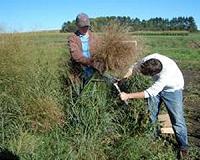
Harvesting switchgrass samples by hand for laboratory analysis. Samples are cut by hand to avoid contamination with soil or other debris. Image courtesy M. Casler.

Using switchgrass to produce biofuel is one way to decrease the United States' dependence on oil, but growing it and making it profitable can be complicated. Switchgrass is an excellent candidate for biofuel production. It is an adaptable plant that can grow on millions of acres of U.S. lands that cannot support crop or food production. It is also a renewable resource.

"Many of these lands are currently in the Conservation Reserve Program," says Michael Casler, a research geneticist with the USDA Agricultural Research Service, located at the U.S. Dairy Forage Research Center. "They are set aside for soil and water conservation only, with no crop production allowed. Growing switchgrass could serve both soil and water conservation goals and provide biomass for energy production."

However, growing and processing switchgrass is barely profitable. It lacks qualities, such as high biomass yield, needed to maximize biofuel production. Thankfully, Casler and others are trying to change that by using alternative breeding methods. Zulfi Jahufer is a senior research scientist in genetics and plant breeding at the AgResearch Grasslands Research Centre in Palmerston North in New Zealand, and was a co-researcher with Casler.

But achieving their goals isn't easy. The ideal switchgrass wouldn't possess one trait, but many. It would have a high amount of biomass per acre and be able to produce a lot of ethanol. It would also have low levels of lignin, a material found inside plants that prevents maximum ethanol production.

Basic plant breeding is simple. Large numbers of plants are grown and evaluated in the field. Researchers select only the best plants with the desired traits and use them to breed the next generation of offspring, explains Jahufer.

When the ideal plant would contain more than one important trait, it's inefficient to select for them one at a time. To combat this issue, and breed switchgrass that has the optimal combination of these traits, the researchers tried evaluating plants using the Smith-Hazel Selection Index.

This index allowed the researchers to estimate and combine information on multiple traits. It also looked at the economic value of each trait, which further maximizes the rating.

"The Smith-Hazel selection index was first developed for animal breeding to select for multiple traits," Jahufer says. "This index is also commonly used in tree breeding, as multi-trait selection is of significant importance in that industry."

He adds that while the results reported are only predicted responses to selection and are specific to a particular type of switchgrass, the study does bring light to the value of using the Smith-Hazel index. By having a way to select for multiple traits at once, the process of breeding the ideal switchgrass could be sped up considerably.

"A selection index in our study that was based on increasing biomass yield and ethanol and decreasing lignin content enabled identification of individual plant families with potential for enhancing ethanol production," he says. "These would otherwise have been left out in commonly practiced single-trait selection for biomass yield."

The two researchers say the next step needed to meet their goals is to use the protocols in an actual breeding program. They will begin to employ the best selection indices over the next few generations to obtain a more ideal switchgrass.

"After we achieve the yield and conversion goals, switchgrass could be a significant component of biomass crop grown east of the Rocky Mountains," says Casler. "We think we can achieve those goals by 2025."

This research was recently published in the journal Crop Science.


Thanks for being here;
We need your help. The Space Media Network continues to grow but revenues have never been harder to maintain.

With the rise of Ad Blockers, and Facebook - our traditional revenue sources via quality network advertising continues to decline. And unlike so many other news sites, we don't have a paywall - with those annoying usernames and passwords.

Our news coverage takes time and effort to publish 365 days a year.

If you find our news sites informative and useful then please consider becoming a regular supporter or for now make a one off contribution.
SpaceMediaNetwork Contributor
$5 Billed Once


credit card or paypal
SpaceMediaNetwork Monthly Supporter
$5 Billed Monthly


paypal only


.


Related Links
American Society of Agronomy
Bio Fuel Technology and Application News


Comment on this article via your Facebook, Yahoo, AOL, Hotmail login.

Share this article via these popular social media networks
del.icio.usdel.icio.us DiggDigg RedditReddit GoogleGoogle


BIO FUEL
A new method of converting algal oil to transportation fuels
Sendai, Japan (SPX) Jun 18, 2015
A new method of converting squalene, which is produced by microalgae, to gasoline or jet fuel, has been developed by the research group of Professor Keiichi Tomishige and Dr. Yoshinao Nakagawa from Tohoku University's Department of Applied Chemistry, and Dr. Hideo Watanabe from the University of Tsukuba. This study is part of a research project titled 'Next-generation energies for Tohoku r ... read more


BIO FUEL
US Authorizes 'Forward-Based' Missile Defense System for Allies

USAF Early Warning Satellites Get No-Cost Update from Lockheed Martin

Boecore to support Army missile defense

Germany opts for MEADS missile defence system

BIO FUEL
Raytheon, Kongsberg extend missile partnership agreement

Javelin demos range, versatility

Egypt orders AASM missiles from Sagem

Aviation security endangered by spread of missiles: study

BIO FUEL
Amazon sees line-of-sight hurdle to US drone parcel delivery

Italy orders Predator UAS simulators

Maneuvering mini drone quickly destroyed in laser test

Australian troops receive small UAS from AeroVironment

BIO FUEL
US nuclear bombers lack satellite terminals for emergencies

New USAF satellites to use updated spacecraft

Harris providing Australia with support for radio system

US Navy accepts third LMC-Built MUOS comsat

BIO FUEL
Northrop Grumman touts its next-generation targeting pod

Thales producing equipment for Canadian vehicles

ONR-sponsored technology to lighten marines' loads

VSE wins places on Army TACOM contracts

BIO FUEL
Senate okays defense bill over White House objections

Spain to decide on lifting A400M flight suspension next week

US Defense Secretary Carter signs defence projects with India

Army contracting official charged in parts investigation

BIO FUEL
China deports British investigator, wife in GSK case

NATO says implementing 'biggest' defence boost since Cold War

Some building in disputed waters to finish soon: China

An eventful year for Great Britiain

BIO FUEL
Nanoparticles can be intrinsically left- and right-handed

Unlocking nanofibers' potential

Scientists observe photographic exposure live at the nanoscale

Measuring the mass of molecules on the nano-scale


The content herein, unless otherwise known to be public domain, are Copyright 1995-2014 - Space Media Network. All websites are published in Australia and are solely subject to Australian law and governed by Fair Use principals for news reporting and research purposes. AFP, UPI and IANS news wire stories are copyright Agence France-Presse, United Press International and Indo-Asia News Service. ESA news reports are copyright European Space Agency. All NASA sourced material is public domain. Additional copyrights may apply in whole or part to other bona fide parties. Advertising does not imply endorsement, agreement or approval of any opinions, statements or information provided by Space Media Network on any Web page published or hosted by Space Media Network. Privacy Statement All images and articles appearing on Space Media Network have been edited or digitally altered in some way. Any requests to remove copyright material will be acted upon in a timely and appropriate manner. Any attempt to extort money from Space Media Network will be ignored and reported to Australian Law Enforcement Agencies as a potential case of financial fraud involving the use of a telephonic carriage device or postal service.