
. Military Space News .


.
NANO TECH
Biocompatible graphene transistor array reads cellular signals
by Staff Writers
Munich, Germany (SPX) Dec 07, 2011

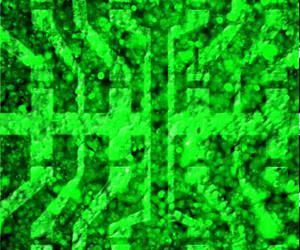
This combination of optical microscopy and fluorescence imaging shows a layer of biological cells covering a graphene-based transistor array. The experimental device, created by scientists from the Technische Universitaet Muenchen and the Juelich Research Center, is the first of its kind to prove capable of recording signals generated by living cells, with good spatial and temporal resolution. With this demonstration, the researchers have opened the way to further investigation of the feasibility of using graphene-based bioelectronics for potential future applications such as neuroprosthetic implants in the brain, the eye, or the ear. Credit: Copyright TU Muenchen.

Researchers have demonstrated, for the first time, a graphene-based transistor array that is compatible with living biological cells and capable of recording the electrical signals they generate. This proof-of-concept platform opens the way for further investigation of a promising new material.

Graphene's distinctive combination of characteristics makes it a leading contender for future biomedical applications requiring a direct interface between microelectronic devices and nerve cells or other living tissue. A team of scientists from the Technische Universitaet Muenchen and the Juelich Research Center published the results in the journal Advanced Materials.

Today, if a person has an intimate and dependent relationship with an electronic device, it's most likely to be a smart phone; however, much closer connections may be in store in the foreseeable future.

For example, "bioelectronic" applications have been proposed that would place sensors and in some cases actuators inside a person's brain, eye, or ear to help compensate for neural damage.

Pioneering research in this direction was done using the mature technology of silicon microelectronics, but in practice that approach may be a dead end: Both flexible substrates and watery biological environments pose serious problems for silicon devices; in addition, they may be too "noisy" for reliable communication with individual nerve cells.

Of the several material systems being explored as alternatives, graphene - essentially a two-dimensional sheet of carbon atoms linked in a dense honeycomb pattern - seems very well suited to bioelectronic applications: It offers outstanding electronic performance, is chemically stable and biologically inert, can readily be processed on flexible substrates, and should lend itself to large-scale, low-cost fabrication.

The latest results from the TUM-Juelich team confirm key performance characteristics and open the way for further advances toward determining the feasibility of graphene-based bioelectronics.

The experimental setup reported in Advanced Materials began with an array of 16 graphene solution-gated field-effect transistors (G-SGFETs) fabricated on copper foil by chemical vapor deposition and standard photolithographic and etching processes.

"The sensing mechanism of these devices is rather simple," says Dr. Jose Antonio Garrido, a member of the Walter Schottky Institute at TUM.

"Variations of the electrical and chemical environment in the vicinity of the FET gate region will be converted into a variation of the transistor current."

Directly on top of this array, the researchers grew a layer of biological cells similar to heart muscle. Not only were the "action potentials" of individual cells detectable above the intrinsic electrical noise of the transistors, but these cellular signals could be recorded with high spatial and temporal resolution.

For example, a series of spikes separated by tens of milliseconds moved across the transistor array in just the way action potentials could be expected to propagate across the cell layer. Also, when the cell layer was exposed to a higher concentration of the stress hormone norepinephrine, a corresponding increase in the frequency of spikes was recorded.

Separate experiments to determine the inherent noise level of the G-SFETs showed it to be comparable to that of ultralow-noise silicon devices, which as Garrido points out are the result of decades of technological development.

"Much of our ongoing research is focused on further improving the noise performance of graphene devices," Garrido says, "and on optimizing the transfer of this technology to flexible substrates such as parylene and kapton, both of which are currently used for in vivo implants. We are also working to improve the spatial resolution of our recording devices."

Meanwhile, they are working with scientists at the Paris-based Vision Institute to investigate the biocompatibility of graphene layers in cultures of retinal neuron cells, as well as within a broader European project called NEUROCARE, which aims at developing brain implants based on flexible nanocarbon devices.

This research is supported by the German Research Foundation (DFG) within Priority Program 1459 "Graphene," the International Helmholtz Research School BioSoft, the Bavarian Graduate School CompInt, the TUM Institute for Advanced Study, and the Nanosystems Initiative Munich (NIM).

Original publication: Graphene Transistor Arrays for Recording Action Potentials from Electrogenic Cells; Lucas H. Hess, Michael Jansen, Vanessa Maybeck, Moritz V. Hauf, Max Seifert, Martin Stutzmann, Ian D. Sharp, Andreas Offenhaeusser, and Jose A. Garrido. Advanced Materials 2011, 23, 5045-5049. DOI: 10.1002/adma.201102990.

Related Links
Technische Universitaet Muenchen
Nano Technology News From SpaceMart.com
Computer Chip Architecture, Technology and Manufacture


.
.
Get Our Free Newsletters Via Email
...
Buy Advertising Editorial Enquiries


.

. Comment on this article via your Facebook, Yahoo, AOL, Hotmail login.

Share this article via these popular social media networks
del.icio.usdel.icio.us DiggDigg RedditReddit GoogleGoogle


NANO TECH
Instant nanodots grow on silicon to form sensing array
London, UK (SPX) Dec 06, 2011
Scientists have shown that it is now possible to simultaneously create highly reproductive three-dimensional silicon oxide nanodots on micrometric scale silicon films in only a few seconds. Xavier Landreau and his colleagues at the University of Limoges, France, demonstrated in their paper to be published in EPJD that they were able to create a square array of such nanodots, using regularl ... read more


NANO TECH
Kratos Receives $2.4 Million Contract to Support International Missile Defense Systems

U.S. mulls Israeli anti-rocket system buy

Turkey conveys concerns to Iran over missile shield threat

Raytheon Receives Approval for $1.7 Billion Patriot Sale to Saudi Arabia

NANO TECH
Russia sends ship-killer missiles to Syria

Iran missile projects unaffected by blast: general

Russia delivers missiles to Syria: report

ONR-Funded Guided Rockets Hit Fast-Moving Targets in Test

NANO TECH
No indication drone lost in Iran was shot down: US

Indra Makes In Cadiz A Flight Demonstration Of Its Unmanned Aircrafts Pelicano And Mantis

Iran downs US drone, threatens reprisal: reports

Schiebel's unmanned helo proves its worth

NANO TECH
Northrop Grumman Awarded Microscale Power Conversion Contract

Raytheon First to Successfully Test With On-Orbit AEHF Satellite

Lockheed Martin AMF JTRS Team Demonstrates Communications and Tactical Data Sharing At Army Exercise

Boeing Ships WGS-4 to Cape Canaveral for January Launch

NANO TECH
GE, Rolls-Royce scrap JSF engine program

Northrop Grumman Delivers Electronic Warfare Test and Measurement Systems To Turkey

Raytheon eyes Korean F-16 radar upgrades

'Deep concern' over new landmine use as summit ends

NANO TECH
Israel fears F-35 delivery will be delayed

France ready to offer military training to Libya: admiral

US firearms sales hit all-time high on Black Friday

US Senate adopts vast military spending bill

NANO TECH
China's dominance in Myanmar

China urges end to Myanmar sanctions

Outside View: Buck up, America!

Hillary Clinton in historic bid to open Myanmar

NANO TECH
Rheinmetall demonstrates laser weapons

LockMart Directed Energy Leader Receives Purdue's Outstanding Aerospace Engineer Award


.

The content herein, unless otherwise known to be public domain, are Copyright 1995-2012 - Space Media Network. AFP and UPI Wire Stories are copyright Agence France-Presse and United Press International. ESA Portal Reports are copyright European Space Agency. All NASA sourced material is public domain. Additional copyrights may apply in whole or part to other bona fide parties. Advertising does not imply endorsement,agreement or approval of any opinions, statements or information provided by Space Media Network on any Web page published or hosted by Space Media Network. Privacy Statement