|
 |
 |
 |
 |
 |
 |
 |
 |
 |

| . |  |
. |
Blood-Compatible Nanomaterial
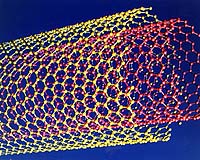
New York (UPI) May 17, 2006 Artificial kidneys and other medical devices could soon employ carbon nanotubes and other structures only nanometers or billionths of a meter wide made highly blood compatible via anticoagulants, experts told UPI's Nano World. Carbon nanotubes could find use in artificial blood vessels, cartilage or bone implants, drug-delivery mechanisms, implantable biocompatible electrodes and biosensors. However, blood components often stick to nanotubes, triggering blood-clot formation that can lead to device failure. "It's a huge problem," said chemical engineer Robert Langer of the Massachusetts Institute of Technology in Cambridge. Researcher Robert Linhardt, a biochemist at Rensselaer Polytechnic Institute in Troy, N.Y., and his colleagues experimented with coatings made with heparin, a complex sugar and anticoagulant commonly used to prevent clotting and sustain blood flow during medical procedures. They found coating multi-walled carbon tubes some 40 nanometers wide with heparin greatly cut down on blood clotting on the nanotubes, thus enhancing their blood compatibility. Their findings appeared in the journal Langmuir. Linhardt and his colleagues also experimented with dialyzers, or artificial kidneys. "Currently the most advanced kidney dialyzers use plastics that contain bonded heparin to improve their blood compatibility. Unfortunately, most of the surface area of the dialyzer is comprised of porous cellulose hollow fibers that are not heparin coated," Linhardt explained. "Thus, patients undergoing kidney dialysis must receive soluble heparin by injection to keep clots from forming on these membranes." The investigators developed membranes from composites of cellulose and heparin that have pores 20 to 40 nanometers wide. They found the membranes, each several hundred nanometers to a hundred microns thick, could filter out toxins and wastes such as urea while at the same time retain cells and valuable proteins and prevent clotting in human blood "and thus reduce bleeding complications," Linhardt said. He added cellulose-heparin composite fibers could be woven and used as fabrics to construct blood vessels. They reported these findings in the Journal of Biomedical Materials Research. Linhardt added the anticoagulant is bound to the nanomaterials and should not affect blood clotting elsewhere, such as at wounds. "Cells lining blood vessels contain bound heparan sulfate, a heparin-like molecule, and represent a naturally anticoagulant surface," he explained. "It looks like a very novel approach for making devices more blood compatible. It's really great work," Langer said. The researchers have filed provisional patents on heparin-coated cellulose materials and on blood-compatible nanomaterials. They will look into fabricating devices using their materials and "are looking for a commercial partner either in the device or pharmaceutical industry to do this," Linhardt said. Future research could also try heparin coatings on other nanomaterials, he added.
Source: United Press International Related Links -  Supercomputing Center Advances Nanotechnology Science
 Troy NY (SPX) May 16, 2006
Rensselaer Polytechnic Institute, in collaboration with IBM and New York state, has announced a $100 million partnership to create the world's most powerful university-based supercomputing center, and a top 10 supercomputing center of any kind in the world. |
|
|

| The content herein, unless otherwise known to be public domain, are Copyright 1995-2006 - SpaceDaily.AFP and UPI Wire Stories are copyright Agence France-Presse and United Press International. ESA PortalReports are copyright European Space Agency. All NASA sourced material is public domain. Additionalcopyrights may apply in whole or part to other bona fide parties. Advertising does not imply endorsement,agreement or approval of any opinions, statements or information provided by SpaceDaily on any Web page published or hosted by SpaceDaily. Privacy Statement |