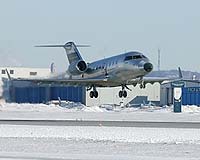
Photo of the Bombardier's next-generation Challenger 605.
Photo of the Bombardier's next-generation Challenger 605. |
The three-hour, 23-minute flight occurred on schedule as originally announced at the official launch in November 2005.
Challenger 605 aircraft serial number 5701 departed from Bombardier's Montreal-Trudeau International Airport facility under clear conditions at 12:40 p.m. and returned at 16:03 p.m. EST. It reached a maximum first flight altitude of 41,000 feet (12,496 m), and a maximum true airspeed of 420 knots (483 mph; 778 km/h). Loaded with 12,500 pounds (5,670 kg) of fuel, takeoff weight for the first flight was 38,734 pounds (17,569 kg). The flight was conducted as a stage climb to 41,000 feet (12,496 m).
"It was a great flight. We spent over three hours in the air and the aircraft performed superbly," commented captain Frank Magnusson, a 20-year career pilot joined by co-pilot Jacques Thibaudeau and project flight test engineer Mick Mansfield. "The new flight deck is fantastic. Pilots will truly appreciate the large LCD screens, their multi-function flexibility and the immediate access to critical flight information," said Mr. Magnusson.
The milestone flight was dedicated to testing basic system functionality and assessing the handling and flying qualities of the aircraft. The first series of tests occurred in an initial altitude block of 5,000 to 15,000 feet (1,524 to 4,572 m), and included handling qualities, flight control checks and avionics testing. The aircraft then climbed to 30,000 feet (9,144 m) for a series of engine, pressurization and environmental control checks. At its maximum first flight altitude of 41,000 feet (12,496 m), basic engine and handling characteristics were again tested and met all engineering expectations.
Aircraft on schedule for entry into service Following several flights in Montreal, the aircraft will relocate to Bombardier's Flight Test Center in Wichita, Kansas, for a 200-hour flight test and certification program. Transport Canada certification is expected in the fourth quarter of 2006, and the aircraft is scheduled to enter service in the third quarter of 2007.
The Challenger 605 aircraft features the Rockwell Collins Pro Line 21 avionics suite, which is fully configurable and offers pilots instant, intuitive access to critical flight information.
The integrated avionics package includes four 10 by 12-inch (25.4 by 30.5-cm) vertically aligned next generation LCD screens, increasing the display area by 55 per cent over the current flight deck.
The aircraft also includes Rockwell Collins' Integrated Flight Information System (IFIS) as standard equipment. The advanced features of this IFIS enables electronic charts, allowing pilots to call up approach plates, airport diagrams and procedures, such as standard instrument departures and standard terminal arrival routes, via customizable multi-function displays.
The flight deck is also equipped with a co-pilot side display touch screen, which enables a second copy of electronic charts for "paperless" electronic chart operations
Related Links
 Boeing Introduces New 737 Signals Intelligence Aircraft
 St. Louis MO (SPX) Jan 25, 2006
| The content herein, unless otherwise known to be public domain, are Copyright 1995-2006 - SpaceDaily.AFP and UPI Wire Stories are copyright Agence France-Presse and United Press International. ESA PortalReports are copyright European Space Agency. All NASA sourced material is public domain. Additionalcopyrights may apply in whole or part to other bona fide parties. Advertising does not imply endorsement,agreement or approval of any opinions, statements or information provided by SpaceDaily on any Web page published or hosted by SpaceDaily. Privacy Statement |