. Military Space News .
COROT Discovers Smallest Exoplanet Yet

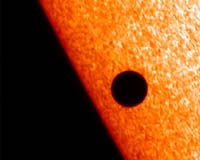
One of the methods for detecting exoplanets is to look for the drop in brightness they cause when they pass in front of their parent star. Such a celestial alignment is known as a planetary transit. From Earth, both Mercury and Venus occasionally pass across the front of the Sun. When they do, they look like tiny black dots passing across the bright surface. Such transits block a tiny fraction of the light that COROT is able to detect. Credits: CNES
by Staff Writers
Paris, France (ESA) Feb 04, 2009
COROT has found the smallest terrestrial planet ever detected outside the Solar System. The amazing planet is less than twice the size of Earth and orbits a Sun-like star. Its temperature is so high that it is possibly covered in lava or water vapour.

About 330 exoplanets have been discovered so far, most of which are gas giants with characteristics similar to Jupiter and Neptune.

The new find, COROT-Exo-7b, is different: its diameter is less than twice that of Earth and it orbits its star once every 20 hours. It is located very close to its parent star, and has a high temperature, between 1000 and 1500 degrees C.

Astronomers detected the new planet as it transited its parent star, dimming the light from the star as it passed in front of it.

The density of the planet is still under investigation: it may be rocky like Earth and covered in liquid lava. It may also belong to a class of planets that are thought to be made up of water and rock in almost equal amounts. Given the high temperatures measured, the planet would be a very hot and humid place.

"Finding such a small planet was not a complete surprise", said Daniel Rouan, researcher at the Observatoire de Paris Lesia, who coordinates the project with Alain Leger, from Institut d'Astrophysique Spatiale (Paris, France). "COROT-Exo-7b belongs to a class of objects whose existence had been predicted for some time. COROT was designed precisely in the hope of discovering some of these objects," he added.

Very few exoplanets found so far have a mass comparable to Earth's and the other terrestrial planets: Venus, Mars, and Mercury. This is because terrestrial planets are extremely difficult to detect.

Most of the methods used so far are indirect and sensitive to the mass of the planet, while COROT can directly measure the size of its surface, which is an advantage. In addition, its location in space allows for longer periods of uninterrupted observation than from ground.

This discovery is significant because recent measurements have indicated the existence of planets of small masses but their size remained undetermined until now.

The internal structure of COROT-exo-7b particularly puzzles scientists; they are unsure whether it is an 'ocean planet', a kind of planet whose existence has never been proved so far. In theory, such planets would initially be covered partially in ice and they would later drift towards their star, with the ice melting to cover it in liquid.

"This discovery is a very important step on the road to understanding the formation and evolution of our planet," said Malcolm Fridlund, ESA's COROT Project Scientist.

"For the first time, we have unambiguously detected a planet that is 'rocky' in the same sense as our own Earth. We now have to understand this object further to put it into context, and continue our search for smaller, more Earth-like objects with COROT," he added.
Share This Article With Planet Earth
del.icio.usdel.icio.us DiggDigg RedditReddit
YahooMyWebYahooMyWeb GoogleGoogle FacebookFacebook


Related Links
Searching for Exoplanets
Lands Beyond Beyond - extra solar planets - news and science
Life Beyond Earth


Memory Foam Mattress Review
Newsletters :: SpaceDaily :: SpaceWar :: TerraDaily :: Energy Daily
XML Feeds :: Space News :: Earth News :: War News :: Solar Energy News


Worlds apart: Satellite spots smallest 'exoplanet' ever
Paris (AFP) Feb 3, 2009
An orbital French observatory has spotted a distant world beyond the Solar System -- similar in size to Earth but boilingly hot -- that could be dubbed a "sauna planet," astronomers reported on Tuesday.


  • German troops to be stationed in France in post-war first
  • Commentary: Discordant wavelengths
  • China upset over shoe protest, but no harm to UK ties: govt
  • Chinese military chief vows nuclear, conventional build-up

  • Europe could be within Iranian missile range: officer
  • Iran risks 'consequences' if it ignores UN: Clinton
  • Analysis: Ahmadinejad does it again
  • NKorea vows to retain atomic bombs until US 'threat' ends

  • NKorea To Test Missile As US Vows Action
  • Norway Tests Naval Strike Missile At Pt Mugu
  • Germany Requests Addition Of Secondary Missile
  • Pakistan should exploit US missile strikes, say analysts

  • Ballistic Missile Proliferation Part Four
  • Russia missile plans dependent on US missile defence: ministry
  • When Getting MAD Does Not Work Part Two
  • Club Of Nine Gives Missile Defense A Boost Part One

  • China Eastern may take three years to be profitable: chairman
  • First China-assembled Airbus set for May test flight: report
  • New Airbus joint-venture with China announced
  • New Turbines Can Cut Fuel Consumption For Business Jets

  • Global Hawk UAV Sustainment Contract Issued
  • Russian Killer UAVs Could Target US Missile Bases
  • Raytheon's Unmanned Ground Control System First To Be NATO-Certified
  • Analysis: Iraqis may access UAV videos

  • Dogs of War: That is the question
  • Four US soldiers killed in Iraq helicopter crash
  • Iraqi PM says US troops could pull out before deadline
  • Dogs of War: Slippery slope

  • Boeing Receives Contract To Upgrade B-1 Bomber Avionics
  • Boeing, US Navy Deliver Proposal To Equip Brazil's Air Force With Super Hornets
  • Longbow Data Link Tested On Apache Block 3 Powered Flight
  • EADS Receives Contract To Build SETI Systems For Navy

  • The content herein, unless otherwise known to be public domain, are Copyright 1995-2007 - SpaceDaily.AFP and UPI Wire Stories are copyright Agence France-Presse and United Press International. ESA Portal Reports are copyright European Space Agency. All NASA sourced material is public domain. Additional copyrights may apply in whole or part to other bona fide parties. Advertising does not imply endorsement,agreement or approval of any opinions, statements or information provided by SpaceDaily on any Web page published or hosted by SpaceDaily. Privacy Statement