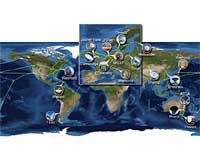
Networks and telescopes used in the round-the-world observations. Image credit - Paul Boven/JIVE.
Networks and telescopes used in the round-the-world observations. Image credit - Paul Boven/JIVE. |
"This demonstration is an unprecedented and extraordinary feat of coordination, involving 17 telescopes and 28 data networks around the world," says Dr Chris Phillips of CSIRO's Australia Telescope National Facility.
In Australia, the telescopes involved are: CSIRO's Australia Telescope Compact Array near Narrabri, NSW; CSIRO's 22-m Mopra telescope near Coonabarabran, NSW; and the University of Tasmania's 26-m telescope at Mt Pleasant near Hobart, Tasmania.
Australia's National Research and Education Network, AARNet, and SXTransPORT will carry the data from the Australian telescopes.
AARNet CEO Dr Chris Hancock says AARNet has continuously demonstrated the value and significance of a high-speed network connection in enabling e-VLBI research to occur in real-time. "Over the years, our involvement in these demonstrations have showcased Australia's capabilities and commitment towards collaborating with researchers around the world to further astronomy research," he says.
Along with other telescopes near Kashima, Japan, and Shanghai, China, the Australian telescopes will kick off the demonstration at 19:00 AEDT tonight.
These telescopes will take part in two observing sessions: 19:00 AEDT to midnight on Thursday 15 January, and 17:00 AEDT to midnight on Friday 16 January.
Using an astronomical technique called electronic Very Long Baseline Interferometry (e-VLBI), telescopes participating in the experiment will observe the same region of sky simultaneously. Data from each telescope will be sampled and streamed through high-speed optical-fibre networks to a central processor at JIVE (the Joint Institute for VLBI in Europe) in the Netherlands.
Operating in real-time, this central data processor - a purpose-built supercomputer - will decode and correlate the data for every possible pair of telescopes.
Through e-VLBI, astronomers can generate images of cosmic radio sources with up to one hundred times better resolution than images from the best optical telescopes.
The ability to send data electronically and correlate it in real-time means astronomers can have their image within hours of doing an experiment, rather than weeks later as occurred with the traditional VLBI method of recording data onto disks and shipping it around.
This e-VLBI observation is made possible by the Express Production Real-time e-VLBI Service (EXPReS) and the cooperation of radio observatories and National Research and Education Networks throughout the world.
Funded by the European Commission, EXPReS has been working since 2006 to connect radio telescopes around the world with the correlator at JIVE using high-speed optical-fibre networks.
The demonstration will take place during the official opening ceremony for the International Year of Astronomy being held at the office of UNESCO in Paris.
Participants at the opening ceremony will include Nobel Prize winners and aspiring young scientists from over 100 countries. Australia will be represented by Chief Scientist Professor Penny Sackett, herself an astronomer.
CSIRO's Australia Telescope National Facility and the Anglo-Australian Observatory jointly form the 'national node' for the International Year of Astronomy in Australia.
Share This Article With Planet Earth
 del.icio.us del.icio.us |
 Digg Digg |
 Reddit Reddit |
 YahooMyWeb YahooMyWeb |
 Google Google |
 Facebook Facebook |
 Asian telescopes to kick-start stargazing marathon
 Sydney (AFP) Jan 15, 2009
| The content herein, unless otherwise known to be public domain, are Copyright 1995-2007 - SpaceDaily.AFP and UPI Wire Stories are copyright Agence France-Presse and United Press International. ESA Portal Reports are copyright European Space Agency. All NASA sourced material is public domain. Additional copyrights may apply in whole or part to other bona fide parties. Advertising does not imply endorsement,agreement or approval of any opinions, statements or information provided by SpaceDaily on any Web page published or hosted by SpaceDaily. Privacy Statement |