
Subscribe free to our newsletters via your
. Military Space News .


FARM NEWS
Can Observations of a Hardy Weed Help Feed the World?
by Staff Writers
Chicago IL (SPX) Dec 24, 2012


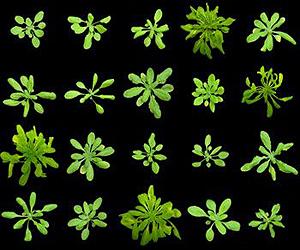
File image: Arabidopsis thaliana (also known as mouse-eared cress).

As the human population increases, so too do the demands and stresses on agriculture. In the January 2013 issue of International Journal of Plant Sciences, Penn State University Waller Professor of Plant Biology Dr. Sarah Assmann explores how the responses to environmental stresses by one small, genetically diverse plant species might illuminate possible approaches to addressing growing human demand for crop products amid decreasing resources.

In the article, Dr. Assmann describes how human population growth presents new challenges to twenty-first-century agriculture, especially since such abiotic stresses as climate change and poor-quality soils can disrupt the ability of many crops to flourish and provide sufficient calories, nutrients, and other resources.

According to the U.N.'s Food and Agriculture Organization, the Earth's population will reach nine billion people by the year 2050.

To meet the needs of this population, Dr. Assmann says, plant biologists must study how and why some plants are heartier and more capable than others of tolerating these stresses.

Dr. Assmann's focus is on a small flowering plant, a distant cousin of cabbage and canola that can be found growing wild across much of the globe. She explains that this species, Arabidopsis thaliana (also known as mouse-eared cress), is an ideal study system in part because it has not been domesticated.

Unlike crops, which for millennia have been selectively refined to express certain traits, Arabidopsis has not been cultivated and thus has not suffered the same loss of genetic diversity.

This robust genetic makeup contributes to the plant's tolerance of stresses associated with climate change and rising temperatures: increased carbon dioxide concentrations, drought, salinity, and mineral limitation and toxicity.

"Ideally, if we can understand better the genetic diversity of this species, we can begin to explore the possibility of related biotechnological manipulations within crop species," Dr. Assmann says.

"Here we have a great opportunity to harness the genetic variation in Arabidopsis to inform crop improvement efforts and ameliorate the effects of climate change on crop yield."

The International Journal of Plant Sciences is proud to present Dr. Sarah Assmann's research in its 2013 Coulter Review.

The annual Review represents a unique opportunity for scientists working at the forefront of their fields to share their insights and updates on the latest developments in plant biology. The Review is named in honor of John Merle Coulter (1851-1928), the first Head Professor of Botany at the University of Chicago and creator of the journal.

More information about the history of John M. Coulter can be found online here. Dr. Assmann's article is freely available online ahead of print at and will be published in the January 2013 issue of the journal. Sarah M. Assmann, "Natural Variation in Abiotic Stress and Climate Change Responses in Arabidopsis: Implications for Twenty-First Century Agriculture." International Journal of Plant Sciences 174:1 (January 2013). doi:10.1086/667798

.


Related Links
University of Chicago Press
Farming Today - Suppliers and Technology


Comment on this article via your Facebook, Yahoo, AOL, Hotmail login.

Share this article via these popular social media networks
del.icio.usdel.icio.us DiggDigg RedditReddit GoogleGoogle


FARM NEWS
The Green Revolution is wilting
Minneapolis MN (SPX) Dec 24, 2012
The Green Revolution has stagnated for key food crops in many regions of the world, according to a study published in the Nature Communications by scientists with the University of Minnesota's Institute on the Environment and McGill University in Montreal, Canada. Led by IonE research fellow Deepak Ray, the study team developed geographically detailed maps of annual crop harvested areas and yiel ... read more


FARM NEWS
NATO to deploy Patriots in Turkey over next few weeks

U.S. seeks double Israel missile funding

NATO chief denounces Iran's allegations on Patriots

Russia shuts down Azerbaijan radar station: Baku

FARM NEWS
Raytheon awarded $254.6 million for Tomahawk missile

NATO says Syria regime firing 'Scud-style missiles'

Raytheon awarded contract for SM-2 production

Brazil invests in rocket technology

FARM NEWS
Northrop Grumman, US Navy Complete At-Sea Deck Handling Trials of X-47B Unmanned Demonstrator

Pakistani drone crashes in northwest: officials

Boeing Demos Unmanned Little Bird for Republic of Korea Army

Boeing's Reusable, Unmanned X-37B Orbital Test Vehicle Begins Second Flight

FARM NEWS
Raytheon's US Navy satellite terminals reach Full Rate Production milestone

General Dynamics' 30,000th Combat Search and Rescue Radio Goes to Work for USAF

Europe launches major British military satellite

N. Korea satellite appears dead: scientist

FARM NEWS
Supacat opens Australian design facility

NGC Provides Attitude Heading Reference For Sikorsky's S-76D Helicopter

Lockheed Martin Wins Role on Army Software and Systems Engineering Contract

Integrated soldier kits for more troops

FARM NEWS
Putin signs helicopter, jet deals with Indian PM

Putin targets arms deals, doubling in trade on India trip

Putin to push for arms deals in India

Congress sends sweeping defense bill to Obama

FARM NEWS
Japan's incoming PM pledges to mend ties with China

Outside View: Ticking time bombs

China ships in disputed waters, first since Japan poll

Russia widens anti-U.S. retaliation

FARM NEWS
Synthetic and biological nanoparticles combined to produce new metamaterials

Nanocrystals Not Small Enough to Avoid Defects

Nature Materials Study: Boosting Heat Transfer With Nanoglue

New optical tweezers trap specimens just a few nanometers across


The content herein, unless otherwise known to be public domain, are Copyright 1995-2014 - Space Media Network. AFP, UPI and IANS news wire stories are copyright Agence France-Presse, United Press International and Indo-Asia News Service. ESA Portal Reports are copyright European Space Agency. All NASA sourced material is public domain. Additional copyrights may apply in whole or part to other bona fide parties. Advertising does not imply endorsement,agreement or approval of any opinions, statements or information provided by Space Media Network on any Web page published or hosted by Space Media Network. Privacy Statement