
. Military Space News .
BIO FUEL
Carbon-neutral 'biofuel' from lakes
by Staff Writers
Basel, Switzerland (SPX) Apr 01, 2021

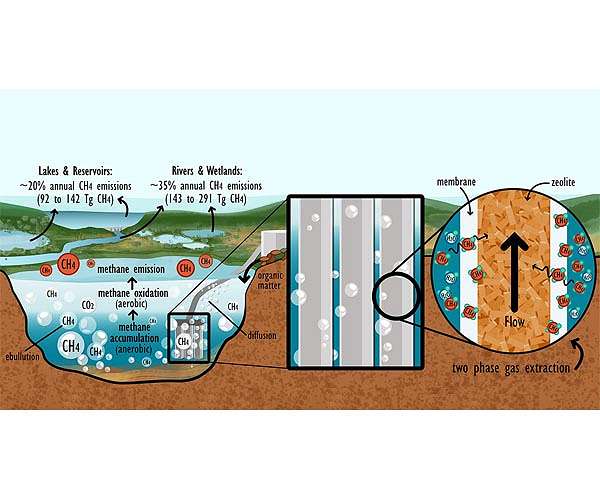
Conceptual design for a technological implementation: A mobile device equipped with high-performance membranes autonomously searches for the highest methane concentration on the lake bottom. The processed gas is fed via a hose to a collection station on the shore, where it is processed into methanol for energy production.

Lakes store huge amounts of methane. In a new study, environmental scientists at the University of Basel offer suggestions for how it can be extracted and used as an energy source in the form of methanol.

Discussion about the current climate crisis usually focuses on carbon dioxide (CO2). The greenhouse gas methane is less well known, but although it is much rarer in the atmosphere, its global warming potential is 80 to 100 times greater per unit.

More than half the methane caused by human activities comes from oil production and agricultural fertilizers. But the gas is also created by the natural decomposition of biomass by microbes, for example in lakes. In their most recent publication, researchers at the University of Basel in Switzerland outline the potential and theoretical possibilities for using methane from lakes and other freshwater bodies for sustainable energy production.

Methane from lakes and water reservoirs makes up about 20% of global natural methane missions. "That would theoretically be enough to meet the world's energy needs," says Maciej Bartosiewicz, a postdoc in the Department of Environmental Sciences of the University of Basel. Lakes continuously absorb CO2 from the atmosphere through the growth of phytoplankton. Microbes convert the carbon, fixed by photosynthesis, into methane when they process biomass. That way, carbon bound in the methane remains within the natural cycle during combustion. Fossil fuels could be partially replaced by "natural" renewable methane. Methane gas is already burned in gas-fired power plants for electricity production and used as a fuel in the form of liquid methanol.

Lakes as huge energy stores
The idea described in the article isn't completely new: since 2016, methane in Lake Kivu between Rwanda and the Democratic Republic of Congo has been extracted from a depth of 260 meters, cleaned and used for energy supply directly via generators.

"Methane occurs in high concentrations in large quantities on the lake bed there," explains Bartosiewicz. "The methane concentration is about 100 times higher than in ordinary lakes." Low concentrations made extracting methane from conventional lakes seem too technically difficult until a few years ago. But new microporous membranes made of polymeric materials now allow the gas to be separated from the water much more efficiently.

The researchers have made the first concrete proposals in this regard: using a hydrophobic gas-liquid membrane contactor, a methane-containing gas mixture can be separated from water and the methane concentrated. Zeolite minerals are particularly suitable for enrichment, since hydrophobic crystalline substances can adsorb and release gases.

Potential positive effects on ecosystems
"With our idea, we wanted to start a broad discussion about the potential, feasibility and risks of a technology like this," says Bartosiewicz. "Until now, no studies have addressed the effects of methane removal on lake ecosystem functioning, but no immediate negative effects can be foreseen with our current understanding."

However, removing excess carbon could even help curb excessive phytoplankton bloom formation and reduce natural greenhouse gas emissions from lakes. More work is needed before any practical implementation of this initial theoretical idea, says Bartosiewicz. But he's convinced: "This concept could one day make an important contribution to reaching our climate goals."

Research paper


Related Links
University Of Basel
Bio Fuel Technology and Application News


Thanks for being here;
We need your help. The Space Media Network continues to grow but revenues have never been harder to maintain.

With the rise of Ad Blockers, and Facebook - our traditional revenue sources via quality network advertising continues to decline. And unlike so many other news sites, we don't have a paywall - with those annoying usernames and passwords.

Our news coverage takes time and effort to publish 365 days a year.

If you find our news sites informative and useful then please consider becoming a regular supporter or for now make a one off contribution.
SpaceMediaNetwork Contributor
$5 Billed Once


credit card or paypal
SpaceMediaNetwork Monthly Supporter
$5 Billed Monthly


paypal only


BIO FUEL
Shrub willow as a bioenergy crop
Washington DC (SPX) Mar 29, 2021
Renewable energy demand and consumption is at an all-time high in the United States. Shrub willow - a quick-growing woody crop - can be an excellent source of renewable bioenergy. The crop is harvested and turned into wood chips, which can be used for heat, mulch, animal bedding, biochar, and biofuel. In a new study, researchers grew shrub willow on a semi-commercial scale to better understand the nuances of this bioenergy crop. The research was published in Agronomy Journal, a publication o ... read more

Comment using your Disqus, Facebook, Google or Twitter login.


Share this article via these popular social media networks
del.icio.usdel.icio.us DiggDigg RedditReddit GoogleGoogle

BIO FUEL
Missile Warning Satellite Delivered to Cape Canaveral

Lockheed Martin awarded $3.7B to modernize key missile defense mission

Lockheed, Northrop to compete for Next Generation Interceptor program

Northrop Grumman Common Infrared Countermeasures System ready for full-rate production

BIO FUEL
US Air Force Likely About to Test-Fire ARRW Hypersonic Missile for First Time - Report

Lockheed Martin awarded $1B contract for Precision Fires All-Weather Rocket

USS Gabrielle Giffords launches Naval Strike Missile in operational test

Lockheed Martin wins $2.76B Army contract for guided missile rockets

BIO FUEL
Martin UAV unveils V-BAT 128

Citadel Defense wins $5M counter drone contract from DoD

Shadowy drone programme gives Yemen rebels regional reach

Northrop Leonardo team up for UAV pitch for Australian Navy

BIO FUEL
Japan-Germany international joint experiment on space optical communication

Parsons awarded $250M Seabed-to-Space ISR contract

Air Force exercises push data integration from across military domains

Airbus, Fujitsu and Thales in team up for UK army future tactical communication program

BIO FUEL
Marines deploy with new JLTV following month-long training exercise

Marine Corps fires commander over July 2020 AAV accident that killed 9

Army tests oxygen generator with longer shelf life

AFRL partnership seeks to "engineer" improved human performance

BIO FUEL
China affirms strong Serbia ties on defence tour of east Europe

Northrop Grumman prepares IBCS for initial operational test and evaluation

Lockheed Martin well-positioned to capitalize on key technologies with Aerojet Rocketdyne acquisition

NATO chief says defence spending up despite pandemic

BIO FUEL
NATO allies intercept 6 groups of Russian aircraft over Europe

Philippines deploys air force jet over Chinese ships

Brazil foreign, defense ministers fall as Bolsonaro struggles

Philippines deploys more navy ships to disputed sea amid row with China

BIO FUEL
Scientists use DNA technology to build tough 3D nanomaterials

New "metalens" shifts focus without tilting or moving

Nanowire could provide a stable, easy-to-make superconducting transistor

New technique builds super-hard metals from nanoparticles


The content herein, unless otherwise known to be public domain, are Copyright 1995-2024 - Space Media Network. All websites are published in Australia and are solely subject to Australian law and governed by Fair Use principals for news reporting and research purposes. AFP, UPI and IANS news wire stories are copyright Agence France-Presse, United Press International and Indo-Asia News Service. ESA news reports are copyright European Space Agency. All NASA sourced material is public domain. Additional copyrights may apply in whole or part to other bona fide parties. All articles labeled "by Staff Writers" include reports supplied to Space Media Network by industry news wires, PR agencies, corporate press officers and the like. Such articles are individually curated and edited by Space Media Network staff on the basis of the report's information value to our industry and professional readership. Advertising does not imply endorsement, agreement or approval of any opinions, statements or information provided by Space Media Network on any Web page published or hosted by Space Media Network. General Data Protection Regulation (GDPR) Statement Our advertisers use various cookies and the like to deliver the best ad banner available at one time. All network advertising suppliers have GDPR policies (Legitimate Interest) that conform with EU regulations for data collection. By using our websites you consent to cookie based advertising. If you do not agree with this then you must stop using the websites from May 25, 2018. Privacy Statement. Additional information can be found here at About Us.