
Subscribe free to our newsletters via your
. Military Space News .


FARM NEWS
Cat domestication traced to Chinese farmers 5,300 years ago
by Staff Writers
St. Louis MO (SPX) Dec 17, 2013


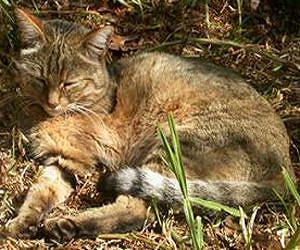
The Near Eastern Wildcat, native to Western Asia and Africa, is believed to be the primary ancestor of all domestic cats now living around the globe.

Five-thousand years before it was immortalized in a British nursery rhyme, the cat that caught the rat that ate the malt was doing just fine living alongside farmers in the ancient Chinese village of Quanhucun, a forthcoming study in the Proceedings of the National Academy of Sciences has confirmed.

"At least three different lines of scientific inquiry allow us to tell a story about cat domestication that is reminiscent of the old 'house that Jack built' nursery rhyme," said study co-author Fiona Marshall, PhD, a professor of archaeology in Arts and Sciences at Washington University in St. Louis.

"Our data suggest that cats were attracted to ancient farming villages by small animals, such as rodents that were living on the grain that the farmers grew, ate and stored."

Set for early online publication in PNAS during the week of Dec. 16, the study provides the first direct evidence for the processes of cat domestication.

"Results of this study show that the village of Quanhucun was a source of food for the cats 5,300 years ago, and the relationship between humans and cats was commensal, or advantageous for the cats," Marshall said.

"Even if these cats were not yet domesticated, our evidence confirms that they lived in close proximity to farmers, and that the relationship had mutual benefits."

Cat remains rarely are found in ancient archaeological sites, and little is known about how they were domesticated. Cats were thought to have first been domesticated in ancient Egypt, where they were kept some 4,000 years ago, but more recent research suggests close relations with humans may have occurred much earlier, including the discovery of a wild cat buried with a human nearly 10,000 years ago in Cyprus.

While it often has been argued that cats were attracted to rodents and other food in early farming villages and domesticated themselves, there has been little evidence for this theory.

The evidence for this study is derived from research in China led by Yaowu Hu and colleagues at the Chinese Academy of Sciences. Hu and his team analyzed eight bones from at least two cats excavated from the site.

Using radiocarbon dating and isotopic analyses of carbon and nitrogen traces in the bones of cats, dogs, deer and other wildlife unearthed near Quanhucan, the research team demonstrated how a breed of once-wild cats carved a niche for themselves in a society that thrived on the widespread cultivation of the grain millet.

Carbon isotopes indicate that rodents, domestic dogs and pigs from the ancient village were eating millet, but deer were not. Carbon and nitrogen isotopes show that cats were preying on animals that lived on farmed millet, probably rodents. At the same time, an ancient rodent burrow into a storage pit and the rodent-proof design of grain storage pots indicate that farmers had problems with rodents in the grain stores.

Other clues gleaned from the Quanhucun food web suggest the relationship between cats and humans had begun to grow closer. One of the cats was aged, showing that it survived well in the village. Another ate fewer animals and more millet than expected, suggesting that it scavenged human food or was fed.

Recent DNA studies suggest that most of the estimated 600 million domestic cats now living around the globe are descendants most directly of the Near Eastern Wildcat, one of the five Felis sylvestris lybica wildcat subspecies still found around the Old World.

Marshall, an expert on animal domestication, said there currently is no DNA evidence to show whether the cats found at Quanhucun are descendants of the Near Eastern Wildcat, a subspecies not native to the area. If the Quanhucun cats turn out to be close descendents of the Near Eastern strain, it would suggest they were domesticated elsewhere and later introduced to the region.

"We do not yet know whether these cats came to China from the Near East, whether they interbred with Chinese wild-cat species, or even whether cats from China played a previously unsuspected role in domestication," Marshall said.

This question is now being pursued by researchers based in China and in France. Other members of the research team include Xianglong Chen, Changsui Wang and Liangliang Hou, all affiliated with the Chinese Academy of Sciences' Key Laboratory of Vertebrate Evolution and Human Origins and the Institute of Vertebrate Paleontology and Paleoanthropology; Songmei Hu, of the Archaeological Research Institute of Shaanxi Province, Xi'an, China; and Xiaohong Wu, of the Department of Archaeology, Peking University, in Beijing.

Changsui Wang designed the research project. Songmei Hu, a zooarchaeologist, conducted the biometric measurement of cat bones. Weilin Wang, an archaeologist, excavated the Quanhucun site and supplied the archaeological context, including pottery cited in the paper. Xianglong Chen and Liangliang Hou prepared collagen samples for testing, and Xiaohong Wu conducted the radiocarbon dating.

.


Related Links
Washington University in St. Louis
Farming Today - Suppliers and Technology


Comment on this article via your Facebook, Yahoo, AOL, Hotmail login.

Share this article via these popular social media networks
del.icio.usdel.icio.us DiggDigg RedditReddit GoogleGoogle


FARM NEWS
Biodegradable or not?
Leipzig, Germany (SPX) Dec 16, 2013
In order to improve the evaluation process for the long-term consequences of pesticides, scientists have developed a new detection method and a model that can enable determinations regarding whether and how readily biodegradable the residues of pesticides are. The study, conducted by scientists at the Helmholtz-Centre for Environmental Research (UFZ), the Rhine-Westphalian Technical Univer ... read more


FARM NEWS
Patriot missiles demonstrate field readiness

U.S. to boost Israel defense missile funding by $173M

Astrium, Raytheon team to compete for NATO ballistic missile defense work

Iran nuclear accord means NATO missile defence unnecessary: Russia

FARM NEWS
US to cut funding on Turkish Chinese-missile purchase

Merrill Lynch rejects Turkey role over China missile plans: report

Turkey says no new bids to rival China missile offer

Kongsberg seals Penguin missile deal with New Zealand

FARM NEWS
US Air Force has secretly built a new stealth drone

Northrop starts production of Global Hawk UAS for NATO

Pentagon chief talks drones with Pakistan PM

Northrop Grumman Begins On-Time Production of First NATO Global Hawk

FARM NEWS
Military Communication Improved as 6th Boeing-built Wideband Satellite Enters Service

Radio Gateway Connects US and Allied Troops to a Common Mobile Network

Northrop Grumman Reinvents Satellite Communications for Aircraft

US Navy Accepts MUOS-2 Satellite, Ground Stations After On-Orbit Testing

FARM NEWS
Researchers Develop World's Highest Quantum Efficiency UV Photodetectors

Lockheed Martin Joint Light Tactical Vehicle Completes Manufacturing Review

Raytheon demonstrates unparalleled precision in live-fire testing of self-propelled howitzer

U.S. Army holds online development event

FARM NEWS
Lockheed Martin names CEO Hewson as new chair

Bristol-Myers Squibb Foundation funds veteran programs

Obama opens way to Gulf grouping military sales

EU leaders mull defence cooperation as tight budgets bite

FARM NEWS
'No one will prevail over Russia militarily'

China's graft crackdown hits watches, luxury market

NATO chief hopes for new EU defence commitment

US warship threatened China's security: state media

FARM NEWS
Alzheimer-substance may be the nanomaterial of tomorrow

Oregon scientists offer new insights on controlling nanoparticle stability

Less is more with adding graphene to nanofibers

Graphene-based nano-antennas may enable networks of tiny machines


The content herein, unless otherwise known to be public domain, are Copyright 1995-2014 - Space Media Network. AFP, UPI and IANS news wire stories are copyright Agence France-Presse, United Press International and Indo-Asia News Service. ESA Portal Reports are copyright European Space Agency. All NASA sourced material is public domain. Additional copyrights may apply in whole or part to other bona fide parties. Advertising does not imply endorsement,agreement or approval of any opinions, statements or information provided by Space Media Network on any Web page published or hosted by Space Media Network. Privacy Statement