
 |
 |
 |
 |
 |
 |
 |
 |
 |
 |

| . |  |
. |

Paris, France (SPX) Apr 18, 2011 This image of the nebula NGC 3582, which was captured by the Wide Field Imager on the MPG/ESO 2.2-metre telescope at ESO's La Silla Observatory in Chile, shows giant loops of gas bearing a striking resemblance to solar prominences. These loops are thought to have been ejected by dying stars, but new stars are also being born within this stellar nursery. These energetic youngsters emit intense ultraviolet radiation that makes the gas in the nebula glow, producing the fiery display shown here. NGC 3582 is part of a large star-forming region in the Milky Way, called RCW 57. It lies close to the central plane of the Milky Way in the southern constellation of Carina (The Keel of Jason's ship, the Argo). John Herschel first saw this complex region of glowing gas and dark dust clouds in 1834, during his stay in South Africa. Some of the stars forming in regions like NGC 3582 are much heavier than the Sun. These monster stars emit energy at prodigious rates and have very short lives that end in explosions as supernovae. The material ejected from these dramatic events creates bubbles in the surrounding gas and dust. This is the probable cause of the loops visible in this picture. This image was taken through multiple filters. From the Wide Field Imager, data taken through a red filter are shown in green and red, and data taken through a filter that isolates the red glow characteristic of hydrogen are also shown in red. Additional infrared data from the Digitized Sky Survey are shown in blue. The image was processed by ESO using the observational data identified by Joe DePasquale, from the United States, who participated in ESO's Hidden Treasures 2010 astrophotography competition . The competition was organised by ESO in October-November 2010, for everyone who enjoys making beautiful images of the night sky using astronomical data obtained using professional telescopes.
Share This Article With Planet Earth
Related Links ESO Stellar Chemistry, The Universe And All Within It

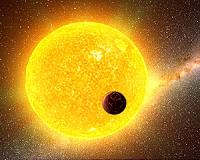 Kepler's Census Of Sun-Like Stars
Birmingham, UK (SPX) Apr 18, 2011 NASA's Kepler Mission has detected changes in brightness in 500 Sun-like stars, giving astronomers a much better idea about the nature and evolution of the stars. Prior to Kepler's launch in March 2009, astronomers had identified the changes in brightness, or oscillations, of about 25 stars similar to our Sun in size, age, composition and location within the Milky Way galaxy.The discoverie ... read more |
|
|
| The content herein, unless otherwise known to be public domain, are Copyright 1995-2010 - SpaceDaily. AFP and UPI Wire Stories are copyright Agence France-Presse and United Press International. ESA Portal Reports are copyright European Space Agency. All NASA sourced material is public domain. Additional copyrights may apply in whole or part to other bona fide parties. Advertising does not imply endorsement,agreement or approval of any opinions, statements or information provided by SpaceDaily on any Web page published or hosted by SpaceDaily. Privacy Statement |


 del.icio.us
 Digg
Digg Reddit
 YahooMyWeb
 Google
 Facebook


