
Subscribe free to our newsletters via your
. Military Space News .


FARM NEWS
Chill-tolerant hybrid sugarcane also grows at lower temperatures
by Staff Writers
Champaign IL (SPX) Jul 30, 2015


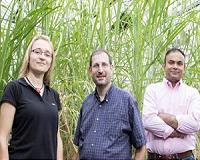
University of Illinois postdoctoral researcher Katarzyna Glowacka, left, plant biology professor Erik Sacks, visiting scholar Shailendra Sharma and their colleagues found that chill-tolerant sugarcane hybrids, called 'miscanes', also photosynthesize at lower temperatures. Image courtesy L. Brian Stauffer. For a larger version of this image please go here.

U.S. farmers have long hoped to extend sugarcane's growing range northward from the Gulf coast, substantially increasing the land available for sugar and biofuels. Several hybrid canes developed in the 1980s have proved hardy in cooler climes, surviving overwinter as far north as Booneville, Arkansas.

But until now, no one had tested whether these "miscanes," as they are called, actually photosynthesize, and thus continue to grow, when the thermometer dips.

Researchers now report that two miscanes - the offspring of crosses between sugarcane and a hardy, cold-tolerant grass, Miscanthus - perform as well as the grass species Miscanthus x giganteus at 10 degrees Celsius (50 F), staying green and converting carbon dioxide to plant matter at a steady rate. Although the rate of photosynthesis drops in the miscanes at 10 C, it doesn't stall out altogether, as it does in sugarcane.

"There are two different aspects of cold tolerance," said University of Illinois crop sciences professor Erik Sacks, who led the research with postdoctoral researcher Katarzyna Glowacka.

"Surviving over the winter is one thing, but we also need the plants to be productive at the beginning of the season and at the end of the season in a more northern - or higher altitude - environment where it's colder, because the season is shorter as you go further north."

Unlike tropical sugarcane, Miscanthus x giganteus is just as productive in the cool spring and autumn as in the heat of summer. It sprouts earlier than corn in the spring, and its leaves stay green and active well into the autumn.

"Typically, with sugarcane, when you lower the temperature to 10 or even 14 degrees (Celsius), there is very little growth or no growth, and leaves lose their ability to conduct photosynthesis," Glowacka said. "The plants will not die, but they don't grow."

Modeling studies suggest that extending sugarcane's growing season by 30 days - allowing it to photosynthesize in cooler temperatures the way Miscanthus does - can boost sugarcane yield by as much as 25 percent in the U.S., Glowacka said.

The researchers exposed the miscanes to 10 days of 10-degree C conditions in the laboratory, measuring the rate of photosynthesis all the while. When they raised temperatures again to 25 degrees (77 degrees F), photosynthesis rebounded in the miscanes similar to Miscanthus x giganteus x giganteus. This means that the gains in chill-tolerance did not blunt sugarcane's productivity - a happy finding, the researchers said.

Field studies confirmed the laboratory findings
"If we could get these plants to grow as far north as hardiness zone 8, that would be really great," Sacks said. "That's a huge amount of land, and some of it is not very productive currently."

The miscanes could be grown for sugar or as a productive biofuels crop on the least productive land in the American South, Sacks said.

"To avoid potential food vs. fuel concerns, we wouldn't put it in a place with highly productive agriculture, like the Mississippi Delta," he said.

Many years of work remain before chill-tolerant miscanes are available for production on a large scale, the researchers said. But the new findings establish that sugarcane can be made chill-tolerant without losses in productivity, they said.

The researchers report their findings in the journal Global Change Biology Bioenergy. Co-authors Sacks, Glowacka, crop sciences professor Stephen Long and visiting scholar Shailendra Sharma are affiliates of the Carl R. Woese Institute for Genomic Biology at the U. of I. This research is part of the PETROSS (Plants Engineered to Replace Oil with Sugarcane and Sweet Sorghum) project, which is funded through the Department of Energy Advanced Research Projects Agency-Energy (ARPA-E). Collaborators on the study included scientists from the U.S. Department of Agriculture - Agricultural Research Service in Canal Point, Florida.


Thanks for being here;
We need your help. The Space Media Network continues to grow but revenues have never been harder to maintain.

With the rise of Ad Blockers, and Facebook - our traditional revenue sources via quality network advertising continues to decline. And unlike so many other news sites, we don't have a paywall - with those annoying usernames and passwords.

Our news coverage takes time and effort to publish 365 days a year.

If you find our news sites informative and useful then please consider becoming a regular supporter or for now make a one off contribution.
SpaceMediaNetwork Contributor
$5 Billed Once


credit card or paypal
SpaceMediaNetwork Monthly Supporter
$5 Billed Monthly


paypal only


.


Related Links
University of Illinois at Urbana-Champaign
Farming Today - Suppliers and Technology


Comment on this article via your Facebook, Yahoo, AOL, Hotmail login.

Share this article via these popular social media networks
del.icio.usdel.icio.us DiggDigg RedditReddit GoogleGoogle


FARM NEWS
Rice disease-resistance discovery closes the loop for scientific integrity
Davis CA (SPX) Jul 28, 2015
When disease-resistant rice is invaded by disease-causing bacteria, a small protein produced by the bacteria betrays the invader. Upon recognizing that protein, the rice plants sense that a microbial attack is underway and are able to mount an immune response to fend off bacterial infection, reports a research team led by the University of California, Davis. Identification of the tiny prot ... read more


FARM NEWS
$1.5B contract goes to Lockheed Martin for Patriot interceptors

Russia Will Knock Out US Missile Shield Installations If Attacked

US Awards Contract to Develop Missile Defense Command System

US Authorizes 'Forward-Based' Missile Defense System for Allies

FARM NEWS
State Dept. OKs TOW missile sale to Lebanon

More Hydra-70 rockets on way for U.S. military, allies

Iran says UN resolution not linked to ballistic missiles

Israel jails Palestinian engineer over Hamas rocket design

FARM NEWS
Amazon wants air space for delivery drones

Drones may soon carry blood samples to the lab

Patrick Stewart endorses Snotbot whale research drone

The Friendly Unmanned Skies

FARM NEWS
Harris replacing satellite communications terminals

Lockheed Martin set to advance RF sensors development

Navy engineer invents new data transmission system

Fourth MUOS arrives in Florida for August launch

FARM NEWS
Navy researches use of transparent material as armor

Shoot-from-the-hip, around corner sighting capability unveiled

Cost of USAF decoy systems reduced

Women push for equality in Latin America military ranks

FARM NEWS
French defence minister visits Cairo after warplane deal

Britain extends Lockheed Martin military inventory contract

India clears $4.74 billion defence purchase

US military to consider transgender troops

FARM NEWS
Olympics: China sees justice in 'historic' Olympics award

NATO eastward expansion would be 'catastrophic': Russian official

Trump the Donald and other musings

Russia revises navy doctrine over NATO's 'inadmissible' expansion

FARM NEWS
Breakthrough in knowledge of how nanoparticles grow

On the way to breaking the terahertz barrier for graphene nanoelectronics

A most singular nano-imaging technique

Plantations of nanorods on carpets of graphene capture the Sun's energy


The content herein, unless otherwise known to be public domain, are Copyright 1995-2014 - Space Media Network. All websites are published in Australia and are solely subject to Australian law and governed by Fair Use principals for news reporting and research purposes. AFP, UPI and IANS news wire stories are copyright Agence France-Presse, United Press International and Indo-Asia News Service. ESA news reports are copyright European Space Agency. All NASA sourced material is public domain. Additional copyrights may apply in whole or part to other bona fide parties. Advertising does not imply endorsement, agreement or approval of any opinions, statements or information provided by Space Media Network on any Web page published or hosted by Space Media Network. Privacy Statement All images and articles appearing on Space Media Network have been edited or digitally altered in some way. Any requests to remove copyright material will be acted upon in a timely and appropriate manner. Any attempt to extort money from Space Media Network will be ignored and reported to Australian Law Enforcement Agencies as a potential case of financial fraud involving the use of a telephonic carriage device or postal service.