
. Military Space News .
BIO FUEL
Converting carbon dioxide to carbon monoxide using water, electricity
by Staff Writers
Chicago IL (SPX) Oct 16, 2017


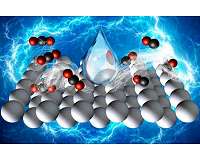
This is the reduction of CO2. Image courtesy Mr. Aditya Prajapati.

Researchers at the University of Illinois at Chicago and the Joint Center for Artificial Photosynthesis have determined how electrocatalysts can convert carbon dioxide to carbon monoxide using water and electricity. The discovery can lead to the development of efficient electrocatalysts for large scale production of synthesis gas - a mixture of carbon monoxide and hydrogen.

"The electrochemical reduction of carbon dioxide to fuels is a subject of considerable interest because it offers a means for storing electricity from energy sources such as wind and solar radiation in the form of chemical bonds," said Meenesh Singh, assistant professor of chemical engineering and lead author on the study published in the journal Proceedings of the National Academy of Sciences.

During his postdoctoral research at the University of California, Berkeley, Singh studied artificial photosynthesis and was part of a team that developed artificial leaves that, when exposed to direct sunlight, were capable of converting carbon dioxide to fuels.

In his latest research, Singh developed a state-of-the-art multiscale model that unites a quantum-chemical analysis of reaction pathway; a microkinetic model of the reaction dynamics; and a continuum model for transport of species in the electrolyte to learn precisely how carbon dioxide can be electrochemically reduced through a catalyst, in this case silver, and made into carbon monoxide.

While the most plausible reaction pathway is usually identified from quantum-chemical calculation of the lowest free-energy pathway, this approach can be misleading when coverages of adsorbed species differ significantly, Singh said. It is essential, therefore, to integrate the effects from electronic states of a catalyst at the atomic-level with the dynamics of species in the electrolyte at the continuum-level for accurate prediction of electrocatalytic reaction pathways.

"This multiscale model is one of the biggest accomplishments in electrochemistry," he said.

To understand how electrocatalysts in fuel cells or electrochemical cells work, scientists need to first probe the electronic and quantum levels, which can be extremely challenging in the presence of an electric field, said Jason Goodpaster, assistant professor of chemistry at the University of Minnesota and one of the co-authors. It took Singh and Goodpaster more than one year to individually produce and benchmark the models and integrate them into a multiscale framework for full-scale simulation of the electrochemical reaction.

This is the first time, Singh said, that scientists have predicted quantitatively from first principles, the current density of carbon monoxide and hydrogen as a function of applied potential and pressure of carbon dioxide.

"Once you recognize how these reactions are occurring on electrocatalysts, you can control the catalysts structure and operating conditions to produce carbon monoxide efficiently," Singh said. Since they are product gases - carbon monoxide and hydrogen are insoluble in aqueous electrolytes - they can be readily separated as synthesis gas and converted into fuels such as methanol, dimethyl ether, or a mixture of hydrocarbons.

Electrocatalysts such as gold, silver, zinc, palladium and gallium are known to yield mixtures of carbon dioxide and hydrogen at various ratios depending on the applied voltage, Singh said. Gold and silver exhibit the highest activity towards carbon dioxide reduction, and since silver is more abundant and less expensive than gold, "silver is the more promising electrocatalyst for large-scale production of carbon monoxide," he said.

BIO FUEL
Breaking down stubborn cellulose
Styria, Austria (SPX) Oct 16, 2017
Biofuels obtained from biomass are becoming increasingly important. Apart from biomethane, however, they cannot be produced efficiently, cheaply and sustainably since the current technological complexity and costs are still too high. Partly to blame is cellulose, a polysaccharide and plant constituent which is not water soluble and thus difficult to process. Typically, biorefineries use a ... read more

Related Links
University of Illinois at Chicago
Bio Fuel Technology and Application News


Thanks for being here;
We need your help. The Space Media Network continues to grow but revenues have never been harder to maintain.

With the rise of Ad Blockers, and Facebook - our traditional revenue sources via quality network advertising continues to decline. And unlike so many other news sites, we don't have a paywall - with those annoying usernames and passwords.

Our news coverage takes time and effort to publish 365 days a year.

If you find our news sites informative and useful then please consider becoming a regular supporter or for now make a one off contribution.
SpaceMediaNetwork Contributor
$5 Billed Once


credit card or paypal
SpaceMediaNetwork Monthly Supporter
$5 Billed Monthly


paypal only


Comment using your Disqus, Facebook, Google or Twitter login.

Share this article via these popular social media networks
del.icio.usdel.icio.us DiggDigg RedditReddit GoogleGoogle

BIO FUEL
US to sell $15 bn THAAD missile defense to Saudi Arabia

Australia's new frigates to feature long-range missile defence system

PAC-3 MSE Test Successful from Remote Launcher

Saudi intercepts Yemen rebel missile

BIO FUEL
State Department approves sale of AMRAAM missiles to Netherlands

Lockheed Martin test of ATACMS missile system successful

Missile test fears as N. Korea marks key party anniversary

Raytheon integrates Stinger missile with armored vehicle

BIO FUEL
Death toll from US drone strike in Pakistan rises to 26: officials

UK will not confirm drone death of IS 'White Widow' recruiter

New long range drones expected in 2018

Boeing to acquire Aurora Flight Sciences

BIO FUEL
Harris supplying tactical radios to Navy, Marines

82nd Airborne tests in-flight communication system for paratroopers

SES GS to Provide More MEO-enabled SATCOM Solutions for U.S. Government

L3 satellite terminals for Air National Guard

BIO FUEL
Israeli artillery shells becoming precision guided weapons

Rheinmetall, Paravan team on autonomous vehicle technology

Orbit Logic Awarded Navy Autonomy Contract

Australia seeks small diameter bombs from U.S.

BIO FUEL
Whistleblower protection bill sent to President as complaints of retaliation grow

UK defence giant BAE Systems to axe almost 2,000 jobs

Leonardo opens new site in Australia

Australia to upgrade submarines, frigates

BIO FUEL
India, Russia to hold first 'tri-service' war games

China's Xi caught between Kim nukes, Trump tweets

Xi is everywhere: China's omnipresent leader

Trump puts America first, but more and more alone

BIO FUEL
Paper-based supercapacitor uses metal nanoparticles to boost energy density

Nanoscale islands dot light-driven catalyst

Tungsten offers nano-interconnects a path of least resistance

Nanoparticle supersoap creates 'bijel' with potential as sculptable fluid


The content herein, unless otherwise known to be public domain, are Copyright 1995-2024 - Space Media Network. All websites are published in Australia and are solely subject to Australian law and governed by Fair Use principals for news reporting and research purposes. AFP, UPI and IANS news wire stories are copyright Agence France-Presse, United Press International and Indo-Asia News Service. ESA news reports are copyright European Space Agency. All NASA sourced material is public domain. Additional copyrights may apply in whole or part to other bona fide parties. All articles labeled "by Staff Writers" include reports supplied to Space Media Network by industry news wires, PR agencies, corporate press officers and the like. Such articles are individually curated and edited by Space Media Network staff on the basis of the report's information value to our industry and professional readership. Advertising does not imply endorsement, agreement or approval of any opinions, statements or information provided by Space Media Network on any Web page published or hosted by Space Media Network. General Data Protection Regulation (GDPR) Statement Our advertisers use various cookies and the like to deliver the best ad banner available at one time. All network advertising suppliers have GDPR policies (Legitimate Interest) that conform with EU regulations for data collection. By using our websites you consent to cookie based advertising. If you do not agree with this then you must stop using the websites from May 25, 2018. Privacy Statement. Additional information can be found here at About Us.