. Military Space News .
Cosmic Suburbia Is A Better Breeding Ground For Stars

The blue dots are active star-forming galaxies in and around a galaxy cluster called Abel 1763. Observations from NASA's Spitzer Space Telescope show that galaxies in filaments form stars at twice the rate of galaxies in dense clusters. Image credit: NASA/JPL-Caltech
by Staff Writers
Pasadena CA (JPL) Jan 29, 2008
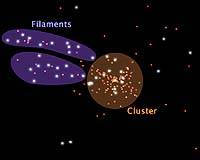
New observations from NASA's Spitzer Space Telescope suggest that galaxies prefer to raise stars in cosmic suburbia rather than in "big cities." Galaxies across the universe reside in cosmic communities, big and small. Large, densely populated galactic communities are called galaxy clusters. Like big cities on Earth, galaxy clusters are scattered throughout the universe, connected by a web of dusty "highways" called filaments.

While thousands of galaxies live within the limits of a cluster, smaller galactic communities are sprinkled along filaments, creating celestial suburbs. Over time, astronomers suspect that all galactic suburbanites will make their way to a cluster by way of filaments.

For the first time, Spitzer's supersensitive eyes have caught an infrared glimpse of several galaxies traveling along two filamentary roads into a galaxy cluster called Abell 1763.

"This is the first time we've ever seen a filament leading into a cluster with an infrared telescope," says Dario Fadda, of the Herschel Science Center, which is located at the California Institute of Technology in Pasadena, Calif.

"Our observations show that the fraction of starburst galaxies in the filaments is more than double the number of starburst galaxies inside the cluster region," he adds.

According to Fadda, clusters and the filaments that connect them are among the largest structures in the cosmos. To see them, astronomers need instruments that can map large areas of sky and have the sensitivity to resolve individual galaxies.

Luckily, instruments aboard Spitzer can do both. Using the telescope's multiband imaging photometer, Fadda and his colleagues saw structures spanning 23 million light-years.

They used the observatory's infrared array camera to collect a census of each galaxy's star formation and used a ground-based telescope at the Kitt Peak National Observatory near Tucson, Ariz., to determine which galaxies belonged to the cluster and surrounding filaments.

Ultimately, Fadda found that galaxies in the filaments form stars at a higher rate than their cluster counterparts.

"The new Spitzer findings will provide valuable insights into how galaxies grow and change as they leave cosmic suburbia for the big cities," says Fadda.

He notes that future infrared missions will be able to follow in Spitzer's footsteps and study how filaments and clusters affect the growth of galaxies in greater detail. One such mission is the European Space Agency's Herschel Space Telescope, which has significant NASA involvement.

His paper on this topic has been accepted for publication in Astrophysical Journal Letters. Co-authors on the paper include Andrea Biviano of the INAF/Osservatorio Astronomico di Trieste, Italy; Florence Durret of Institut d'Astrophysique de Paris, France; and Francine Marleau and Lisa Storrie-Lombardi of the Spitzer Science Center, Pasadena, Calif.
Community
Email This Article
Comment On This Article

Related Links
http://www.spitzer.caltech.edu/spitzer
Spitzer at NASA
Stellar Chemistry, The Universe And All Within It


Memory Foam Mattress Review
Newsletters :: SpaceDaily :: SpaceWar :: TerraDaily :: Energy Daily
XML Feeds :: Space News :: Earth News :: War News :: Solar Energy News


Unusual Older Stars Giving Birth To Second Wave Of Planets
Los Angeles CA (SPX) Jan 21, 2008
Hundreds of millions - or even billions - of years after planets would have initially formed around two unusual stars, a second wave of planetesimal and planet formation appears to be taking place, UCLA astronomers and colleagues believe. "This is a new class of stars, ones that display conditions now ripe for formation of a second generation of planets, long, long after the stars themselves formed," said UCLA astronomy graduate student Carl Melis, who reported the findings today at the American Astronomical Society meeting in Austin, Texas.


  • US-China developing better military ties: US admiral
  • Analysis: Taiwan faces better PLA ability
  • India showcases military might
  • NATO chief urges Russia to stop 'unhelpful rhetoric'

  • Outside View: Getting tougher on Iran
  • UN resolution on Iran to 'open new directions': Rice
  • No early end to NKorea nuke deadlock: SKorean FM
  • 'Serious consequences' if UN adopts sanctions: Iran

  • Taiwan arms warship with supersonic missiles: report
  • NATO Could Use US Missiles For South East Theater Defense
  • Analysis: Capabilities of Chinese missiles
  • Israel test-fires ballistic missile after Iran warning

  • Northrop Grumman Spehar VP Kinetic Energy Interceptors
  • Olmert Backs Iron Dome Of Layered Missile Defense For Israel
  • Japan to boost air defences: report
  • ABM Turnaround In Seoul With SM-3s For Sejong The Great

  • China to build 97 new airports by 2020
  • Qatar Airways looking to natural gas fuel
  • EADS offers to build military, civilian aircraft in US
  • Purdue Wind Tunnel Key For Hypersonic Vehicles And Future Space Planes

  • Iraq War See Widespread Use Of Unmanned Air Vehicles
  • BAE Systems Delivers UAV Target Detection Systems To US Army
  • Unmanned Aerial Vehicles Show Battlefield To Soldiers
  • GA-ASI And SENER Sign Teaming Agreement On Predator UAS Series

  • US not interested in permanent Iraq bases: Gates
  • Democrats want Congress to OK any military agreement with Iraq
  • Iraq military deal won't tie US hands: State dept
  • US unlikely to cut Iraq forces below pre-surge levels: analysts

  • Defense Focus: FCS follies -- Part 1
  • Boeing And SAIC Announce Accelerated Testing Of FCS Early Prototype Systems
  • Military eyes new robotic vision system
  • Eurofighter Typhoon Logs Over 35,000 Flying Hours

  • The content herein, unless otherwise known to be public domain, are Copyright 1995-2007 - SpaceDaily.AFP and UPI Wire Stories are copyright Agence France-Presse and United Press International. ESA Portal Reports are copyright European Space Agency. All NASA sourced material is public domain. Additional copyrights may apply in whole or part to other bona fide parties. Advertising does not imply endorsement,agreement or approval of any opinions, statements or information provided by SpaceDaily on any Web page published or hosted by SpaceDaily. Privacy Statement