
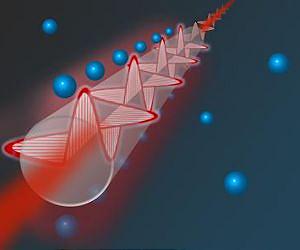
Glass fiber cables are indispensable for the internet – now they can also be used as a quantum physics lab. The Vienna University of Technology is the only research facility in the world, where single atoms can be controllably coupled to the light in ultra-thin fiber glass.
Specially prepared light waves interact with very small numbers of atoms, which makes it possible to build detectors that are extremely sensitive to tiny trace amounts of a substance.
Professor Arno Rauschenbeutel's team, one of six research groups at the Vienna Center for Quantum Science and Technology, has presented this new method in the journal Physical Review Letters. The research project was carried out in collaboration with the Johannes Gutenberg University in Mainz, Germany.
Ultra-Thin Glass Fibers
The glass fibers used for the experiment are only five hundred millionths of a millimeter thick (500 nm). In fact, they are even thinner than the wavelength of visible light.
"Actually, the light wave does not really fit into the glass fiber, it sticks out a little", Arno Rauschenbeutel explains. And this is precisely the big advantage of the new method: the light wave touches atoms which are located outside of, but very close to, the glass fiber.
"First, we trap the atoms, so that they are aligned above and below the glass fiber, like pearls on a string", says Rauschenbeutel.
The light wave sent through the glass fiber is then modified by each individual atom it passes. By measuring changes in the light waves very accurately, the number of atoms trapped near the fiber can be determined.
Atoms Change the Speed of Light
When scientists study the interaction of atoms and light, they usually look at rather disruptive effects – at least on a microscopic scale: Atoms can, for example, absorb photons and emit them later in a different direction. This way, atoms can be accelerated and hurled away from their original position.
In the glass fiber experiments at Vienna UT however, a very soft interaction between light and atoms is sufficient: "The atoms close to the glass fiber decelerate the light very slightly", Arno Rauschenbeutel explains.
When the light wave oscillates precisely upwards and downwards in the direction of the atoms, the wave is shifted by a tiny amount. Another light wave oscillating in a different direction does not hit any atoms and is therefore hardly decelerated at all.
Light waves of different polarization directions are sent through the glass fiber – and their relative shift due to their different speed is measured. This shift tells the scientists how many atoms have delayed the light wave.
Detecting Single Atoms
Hundreds or thousands of atoms can be trapped, less than a thousandth of a millimeter away from the glass fiber. Their number can be determined with an accuracy of several atoms.
"In principle, our method is so precise that it can detect as few as ten or twenty atoms", says Arno Rauschenbeutel.
"We are working on a few more technical tricks – such as the reduction of the distance between the atoms and the glass fiber. If we can do this, we should even be able to reliably detect single atoms."
Non-Destructive Quantum Measurements
The new glass fiber measuring method is not only important for new detectors, but also for basic quantum physical research. "Usually the quantum physical state of a system is destroyed when we measure it", Rauschenbeutel explains.
"Our glass fibers make it possible to control quantum states without destroying them." The atoms close to the glass fiber can also be used to tune the plane in which the light wave oscillates.
Nobody can tell yet, which new technological possibilities may be opened up by that. "Quantum optics is an incredibly innovative research area today – and the Vienna research groups in this field are competing among the best in the world", says Arno Rauschenbeutel.
